
Story contributed by Kristen
Click here for the theological background of Matthew 9-10, Mark 5 and Luke 9.
Remember, repetition helps children internalize and make connections. It might be a good idea to read the same story every day for a week. You can add different activities every day.
Jesus Heals
He said to her, “Daughter, your faith has healed you. Go in peace and be freed from your suffering.“
Mark 5:34 NIV
People were starting to notice that anyone who spent time with Jesus felt better afterward. People who were sick and hurting came to Jesus and went away healed. There was something about being with him that made wrong turn to right.
One day, Jesus was walking quickly through town. Suddenly, he heard someone running behind him. He turned around. It was someone he knew—a leader named Jarius who worked in the synagogue of Capernaum. Jarius ran to Jesus and fell at his feet, panting.
“Lord,” Jarius cried out, his voice catching, “Lord, please. It’s my daughter. My little one. She has been sick, and nothing is helping. Please, I beg of you, please make her well again. She is dying.” Jarius looked at the ground, tears running down his face.
Jesus knelt next to him and gently helped him to his feet. “Take me to your daughter, my friend,” he said softly. Together, they turned and began to run toward Jarius’ house.
The crowds were thick that morning, and it was hard to stay together. Many people touched Jesus, pressing him as he followed as quickly as he could after Jarius. And then Jesus felt something. He stopped and turned around. “Who touched me?” he asked.
His friends looked at each other and laughed. “A hundred people probably touched you, Jesus,” they said. “What do you mean?” Jesus looked through the crowd, scanning their faces.
“I felt power go from me. Someone needed me.” Slowly, a woman came from around a corner where she had been hiding. She knelt at Jesus’ feet, twisting her hands nervously in her dress.
“Jesus, I saw you passing. I knew if I only touched your clothes, I could be healed.” Her eyes filled with tears. “I am sorry, Lord, I did not think you would notice me. I have spent all I have on doctors who could not make me well. I have an issue of blood.”
Jesus knelt beside her and gently took her hand. “Lady,” he said, speaking as though she were a queen, “be healed. It is your faith that has made you whole. Go in peace, and be free from suffering.”
Before she could reply, the crowds shifted and the air filled with the sounds of wailing. Jesus stood up. “You’re too late,” someone said, “the little girl is already dead.”
Jarius, standing close to Jesus, swayed as though he would faint. Jesus went to him and helped him stand. Jesus closed his eyes, as though he was listening for something. Then he opened them and said, “she is not dead. She is asleep.”
The crowds of people around them started to laugh. “Asleep? Who is this fool? The child is dead. Go away and let the family mourn.”
Jesus and Jarius walked together to his house. Jarius motioned, and the servants let Jesus pass through. Quietly, he entered the room where the little girl laid. Her mother was there at the bedside, softly crying as she looked at her daughter’s face.
Jesus looked at the mother, his own eyes filling with tears. “May I speak to her?” He asked, gently.
“She is dead,” someone said, impatiently. The mother looked at her child and then at Jesus. Slowly, she nodded.
Jesus knelt at the little girl’s bedside and took her hand. Very softly, so only the mother could hear, he said, “little girl, arise.” There was a moment of silence, and then, like the flutter of butterfly wings, the girl opened her eyes. She sat up and looked at Jesus. He smiled. “You must be hungry,” he said, “let’s get you something to eat.”
Jesus Grieves for Suffering
When he saw the crowds, he had compassion on them, because they were harassed and helpless, like sheep without a shepherd. Then he said to his disciples, “The harvest is plentiful but the workers are few. Ask the Lord of the harvest, therefore, to send out workers into his harvest field.”
Matthew 9:36-38 NIV
And that’s what Jesus did. Everywhere he went, he saw people who were sad, or hurting, or feeling broken beyond repair. He saw right into their hearts and he said, “I see you. God has not forgotten you.” He healed people’s bodies, but more than that he healed their hurting hearts.
But here’s the tricky thing. Hurt doesn’t stay with just one person, or a few people, or even a lot of people. Hurt comes to all of us. All of us have times when we’re sad, or hurting, or feeling broken beyond repair. And Jesus knew this. For every person that Jesus healed, there were a hundred more that needed healing.
Sometimes, Jesus would look at the crowds of people in the city and think about all of the different burdens they carried. Some of them were obvious, like people with leprosy or people who were sick. Others were invisible, like people whose sadness never seemed to go away. When Jesus looked at these people, his heart filled with love and compassion. He wanted to help them, but he knew he could never reach all of them.
One day, when he looked at the crowds of people, his heart was filled with sorrow for their pain and suffering. He turned to his friends and said, “these people are so good, and they are so beloved. But they are lonely. They are hungry. They need people to help them feel God’s love.”
He turned to his friends. “Dear ones, will you help me? Will you join me doing God’s work of gathering, and healing, and inviting to God’s feast of love?”
His friends said, “yes, Jesus, that is exactly what we want to do.”
And Jesus put his arms around them and he blessed them. He said, “then go into the world, and my love will be with you. Heal, and help, and love, and lift. My blessing will be with you always.”
Jesus Feeds his Friends
“But what about you?” [Jesus] asked. “Who do you say I am?” Peter answered, “God’s Messiah.”
Luke 9:20 NIV
His friends tried to do the things Jesus did. They watched Jesus, and they followed him, and they loved him. But they were still getting used to his ways, and his words, and his miracles.
One day, Jesus was teaching a huge crowd of people in a meadow. So many people! There were people covering one hillside, and another, and people all the way from the hills to the Sea of Galilee. Jesus walked among them, teaching and talking to them, and pretty soon the whole day had gone by!
Jesus stopped talking and looked around. He looked into the faces of the people, faces he knew and loved. He saw that they wanted to stay, but he also saw that the people were hungry. They had been listening all day, and their tummies were rumbling.
Jesus called his friends over. “The people are hungry,” he said. “Yes,” said his friends, “let’s send them home to eat.” Jesus smiled. “Or we could feed them.”
His friends stared at him. “Feed them? Lord, there must be 5,000 people here.” “Yes,” said Jesus, “I think you’re right.”
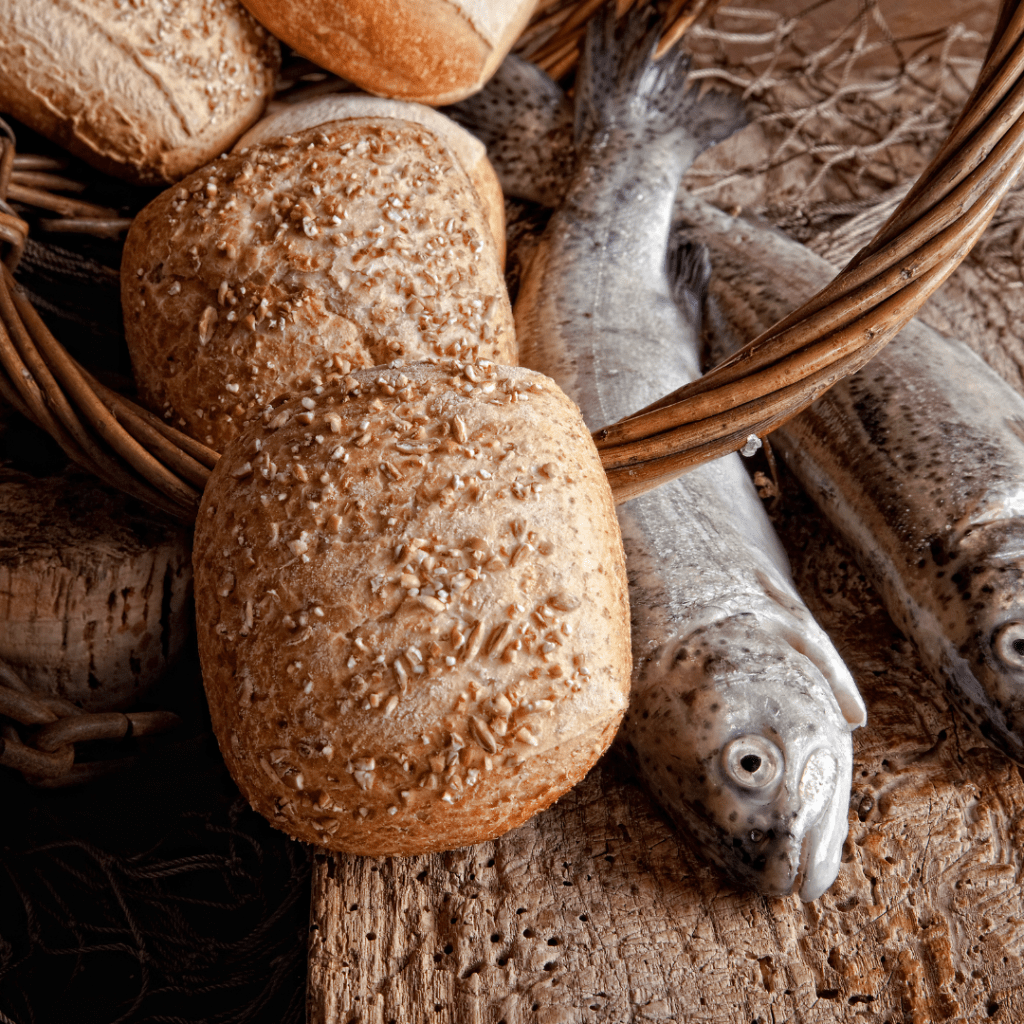
He walked over to a young girl in the crowd who was holding a basket of bread and fish. He knelt down in front of her. “It looks like you’ve brought some food,” he said, smiling at the girl. “How would you feel about sharing it?” The girl held out her basket, and Jesus took it. “Thank you,” he said.
Then he took the basket in his hands gently, almost like he was holding a baby. He looked up to heaven, and he started speaking to God. “God,” he prayed, “these people are so good. They have been listening all day. And they are hungry. Take this offering—he looked over at the girl whose basket he held—and make it enough.” Then he started walking.
He took the basket of bread and fish to the crowd at the farthest corner of the meadow. He held it out and said, “take what you need, and then pass this basket to your neighbor.”
Little by little, the basket traveled through the crowd. Jesus and his friends watched in amazement as the people ate their fill, as though they were at a great feast. They ate and they ate, taking bread and fish from the basket, but no matter how much they took there was always more. The next person who reached into the basket always found enough to fill their belly, no matter how many had eaten before. Just like a mother wants to feed everyone at her table, God had taken a small basket of bread and fish and made a feast.
Later, after the people had gone home, Jesus sat down with his friends. “Dear ones,” he said, “many people say many things about me. They are not sure who I am. So I’m wondering, who do you say I am?”
His friends gathered close to him. “Lord,” they said, “we say you are the Messiah, the Son of God.”
Ideas for play
Contributed by Kristen
Jesus heals
- Learn about what it might have meant for the disciples to call Jesus the Messiah
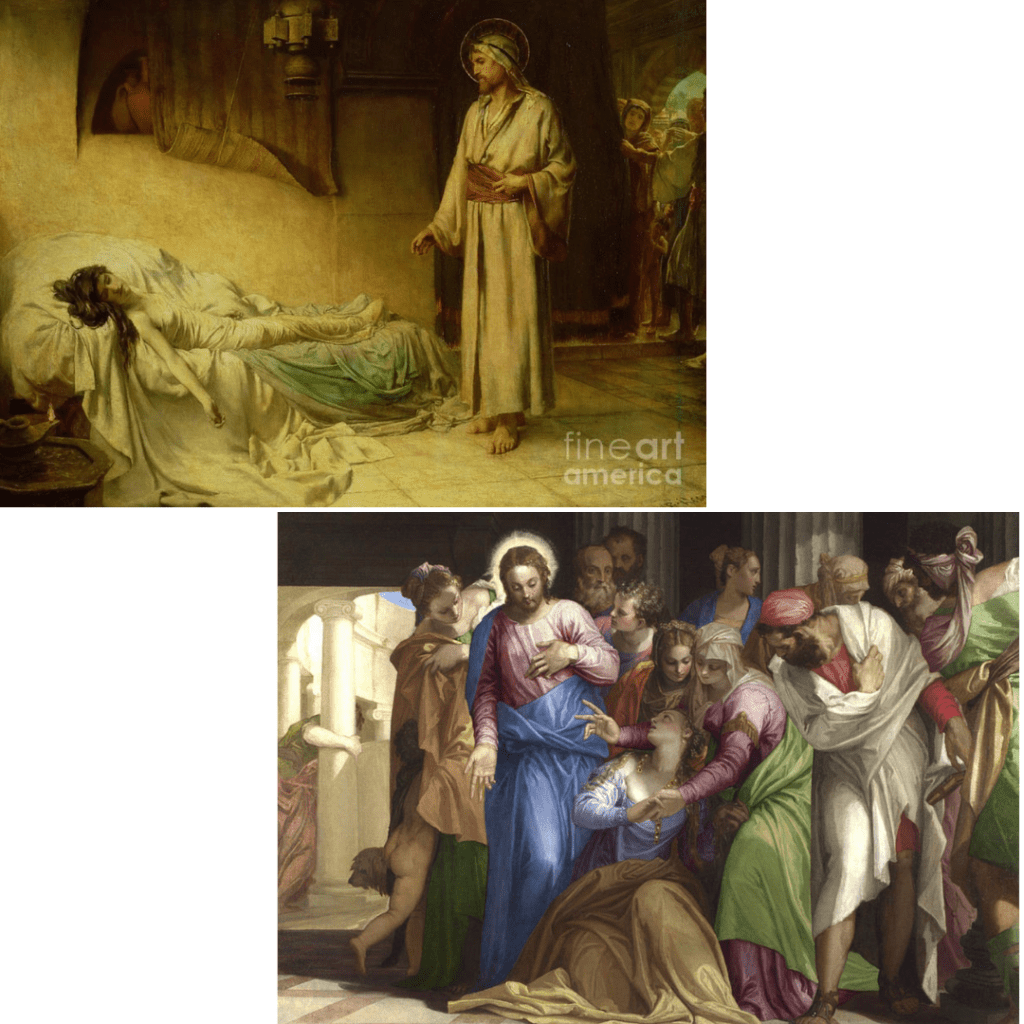
- Study different images depicting these stories and discuss (click here for a collection of paintings about Jairus’ Daughter; or click here for a collection of paintings about Woman With Issue Of Blood)
Jesus Grieves
- Read “Jesus as he really is” in Moments with Jesus (transfiguration)
- Do you think Jesus still needs help? What can you do to heal and lift and love?
Jesus feeds his friends
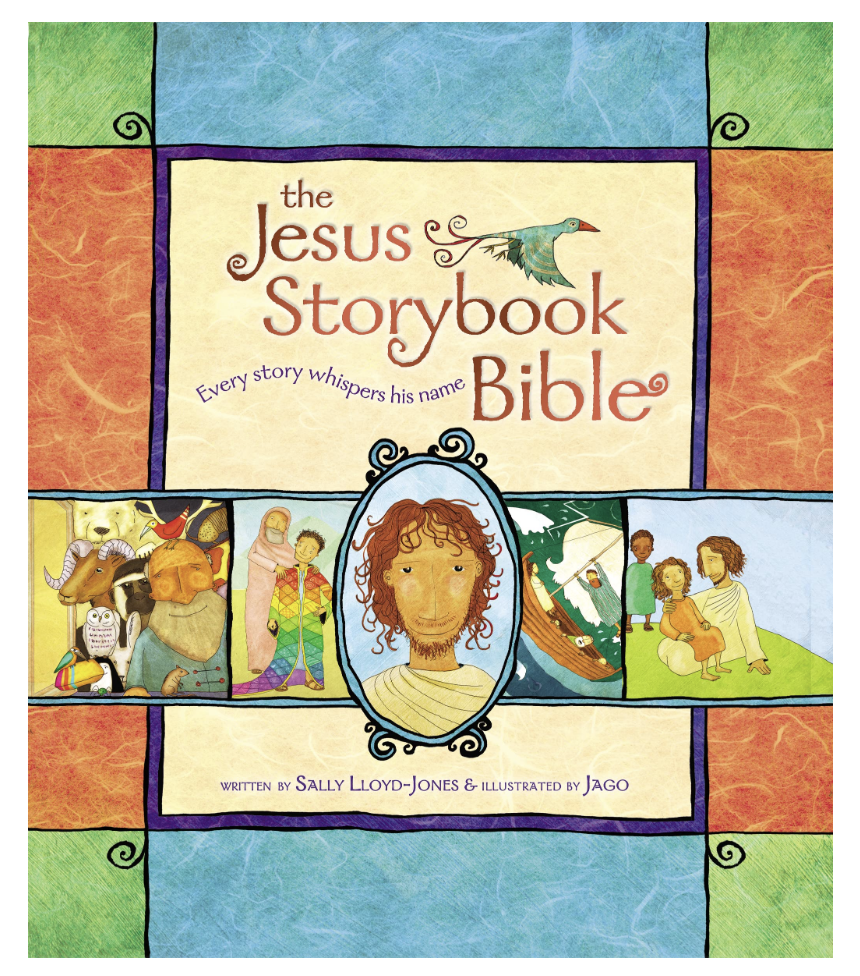
- Read: “Filled full” in the Jesus Storybook Bible
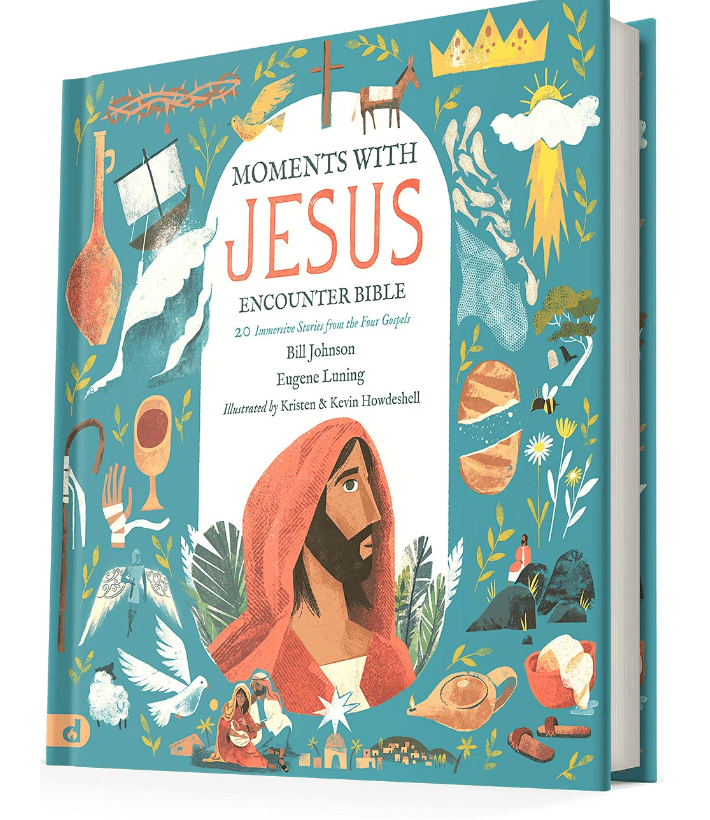
- Read “Sharing a meal with Jesus” in Moments with Jesus

- Act out the story by making loaves and fishes to hand out to crowd (example)
- Bring a meal to someone in need
Art
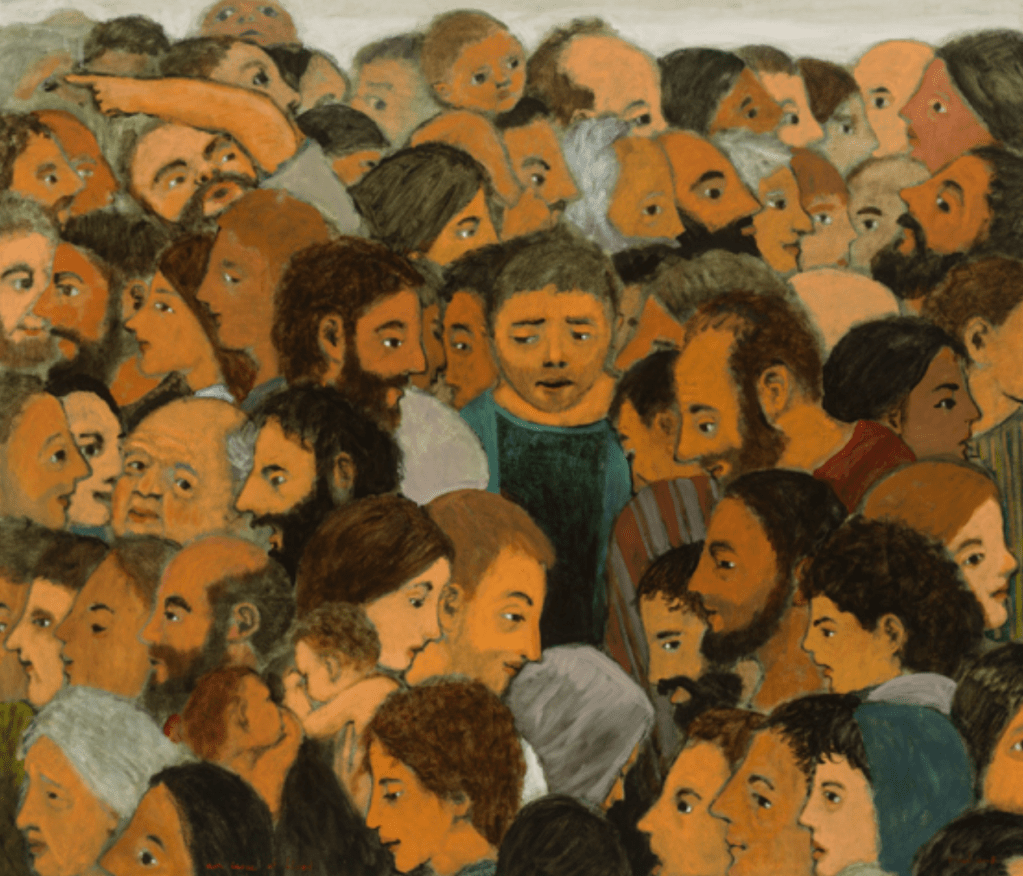
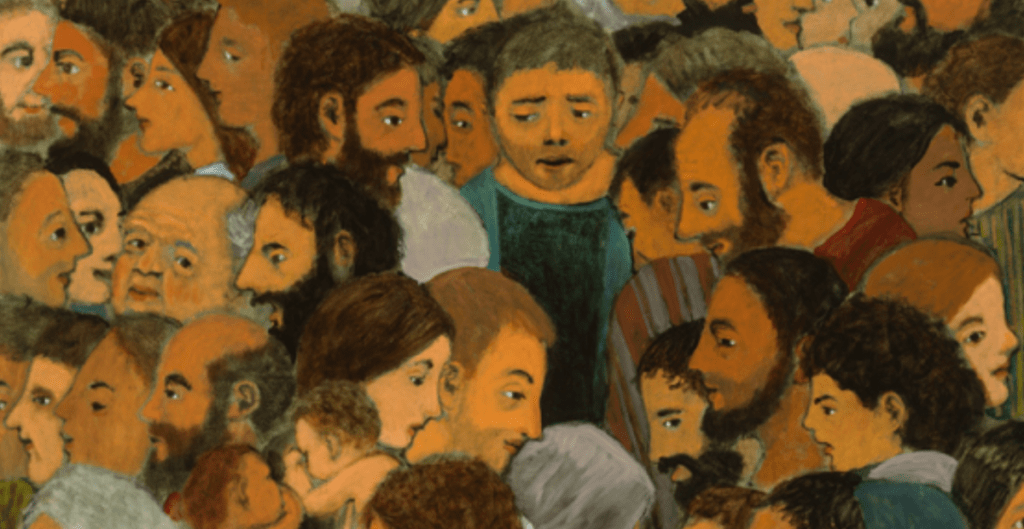
The following painting by LDS artist, Brian Kershisnik, reflects on Christ and the woman with the issue of blood. I love this depiction because it helps us to quickly enter the chaotic scene of the story—an aspect that is easy to forget or not fully experience when we read it on the page. Here, we get a better idea of why the disciples were surprised when Jesus asked them who had touched Him— just look at this crowd of people! They are pressing in on all sides, pointing, looking on, and busy with their lives. It’s not even clear where Jesus and the woman are in this painting! To me, that makes what occurred even more beautiful. It was a hectic, busy street, where no one seemed to notice the incredible need of a desperate woman. But she was healed here. HERE. In this busy street. And that’s what Jesus does. He meets us in our chaotic and busy lives, and heals us.
Here are some questions to reflect on with your child:
Where do you think Jesus is in this painting? Where do you think the woman is that He healed? What do you think it would’ve felt like to be in that crowd of people? What do you think it would have smelled like? Where do you think some of these people were going? Do you think any of the people noticed that the woman was healed? What colors do you see in this painting? What textures? How is it different from the next painting? How does this painting make you feel?
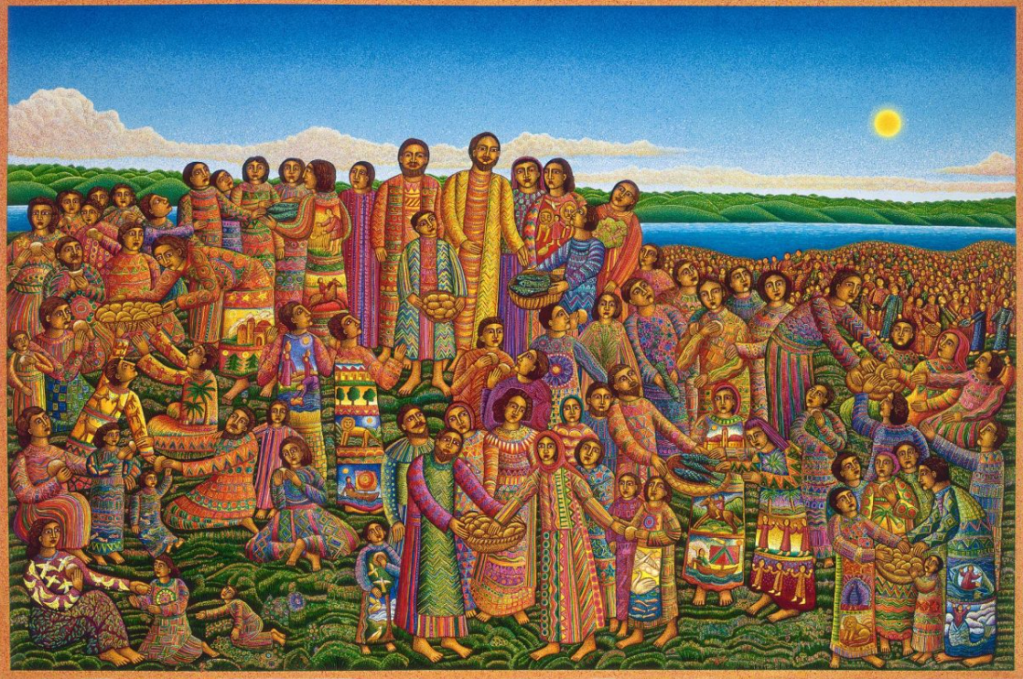
This joyful painting by John August Swanson reflects on the story of Christ feeding the crowd. Here, we are also greeted by a crowd of people, and again are struck by how Christ’s miracle impacted this scene. We know that many people were fed by a small offering, but seeing the wave of people in the background helps us have a greater vision of what this could have looked like. In the Kershisnik painting, the crowd almost masks the miracle that took place, but here the crowd enhances it. We see how each person is interacting with the food in some way and the joy that it brings to them. This is indeed a feast.
Here are some questions to reflect on with your child:
Where do you think Jesus is in this painting? What are they eating? Who is holding some of the food? What pictures do you see on some of the clothing? What do you think it would’ve felt like to be in this crowd? What do you think it would’ve smelled like? What colors do you see? What textures? How does this painting make you feel?
Poem
This is not
the age of information.
This is not
the age of information.
Forget the news,
and the radio,
and the blurred screen.
This is the time of loaves
and fishes.
People are hungry,
and one good word is bread
for a thousand.
From The House of Belonging: poems by David Whyte (Many Rivers Press). Copyright © 1996 by David Whyte.
Some questions to reflect on with your child:
How can words be delicious? How can words be filling? When have words made you feel sad? When have words made you feel full and happy? What are words that can fill other people? Did you know that Jesus is sometimes called “the word”? Why do you think that is?
Music
This song by Wes Lambert draws from the story of Christ feeding the multitude and recognizes that everything we have has been given to us and it is enough.
Lyrics:
Every time I see the lack
Lord remind me what I have.
When I think it’s not enough
I remember what you’ve done.
Take my loaves and my fishes
My little life you’ll multiply.
All I am has been given
Break me apart to share who you are.
When I’m worried or concerned
You can do beyond the norm.
Teach my doubt it’s not how much.
All you needs a willing heart.
Take my loaves and my fishes.
My little life you’ll multiply.
All I am has been given.
Break me apart to share who you are.
So I’ll give thanks for what I have
And give you what is in my hands
To feed your hungry world in need
To give away what you gave me.
 milk & honey mamas
Leave a comment