

Story contributed by Kristen
Click here for the theological background of Matthew 18; Luke 10
Remember, repetition helps children internalize and make connections. It might be a good idea to read the same story every day for a week. You can add different activities every day.
“Go, and do thou likewise.”
Luke 10:37
One day, Jesus’ friend Peter was wondering something. Maybe you’ve wondered about this too. He was wondering what it means to say you’re sorry and to really mean it.
What if someone really hurts your feelings, and then they say sorry. Do we need to say it’s okay? What if they do it again, and again, and again? This is a good question. Peter was wondering what it means to forgive someone. What do you think it means?
Forgiveness doesn’t mean saying things are okay that aren’t okay. If someone pushes you and you fall down, it’s okay to be hurt and angry. Forgiveness means letting yourself feel your hurt and your anger so that it doesn’t have to stay trapped in your body. Forgiveness means saying, “we can try again.”
It feels really good when someone forgives you. All of us hurt each other, sometimes on accident and sometimes on purpose. Forgiveness gives us a chance to try again, to start over, and to make things right. It gives other people the same chance.
Peter wanted to know what Jesus thought about all of this. So he asked. And Jesus said, “ah. That is a good question. Let me tell you a story.” And he tilted his head back, and he closed one eye, and he began.
Once, there was a powerful, rich king. This king had many powerful, rich servants who all had many servants themselves. These leaders were well known by the regular people, and most of the regular people were very afraid of them. They were strong, and loud, and they could buy anything they wanted with the money they had, and their houses were huge and comfortable, and they always had whatever food they wanted.
The regular people were quiet. They worked hard, and they went home to their small houses with cracks in the roofs. They were often hungry, and tired, and worried.
One day, one of the powerful servants of the king got into trouble. He had been reckless. He had spent more money than he had, and he owed the king a great debt. The king was angry. The money didn’t matter to him because he already had so much, but he wanted his servants to obey him. He ordered the servant to pay the money right away.
The servant fell to his knees. “Mighty king, please have mercy on me,” he said. “I will get you the money. I just need a little more time.” The king looked at his servant, who was also his friend, and he had compassion. His heart softened a little. “All right,” said the king, “I will forgive you. You can have a little more time.”
The servant went away, but in his heart he was very afraid. He didn’t want anyone to know what had happened. He wanted people to think he was the same powerful, tough leader he had always been. So when a regular person came to him, one of his servants, he decided to show how tough he was. The servant said, “Good sir, I know I owe you a small amount of money, but my family is hungry. Please, could I have just a few more days?”
“No!” the man roared. “How dare you cross me! You will be punished at once.” He was too afraid of losing his position, of having people think he was not tough anymore. He would not forgive his servant.
Jesus looked at Peter. “What do you think, my friend?” he asked.
What do you think?
Another day, Jesus was talking with a crowd of people. They were asking him questions, asking him to heal them, and reaching out hoping for just a moment with him. A young woman came up to him through the crowd. “Rabbi,” she said, “who is my neighbor?”
Jesus looked at her, and he smiled. “That is a good question,” he said, “let me tell you a story.” And he tilted his head back, and closed one eye, and began.
Once, there was a man traveling across desert roads. The journey was long and hard, and the man was tired. He knew that the paths he followed were dangerous, filled with hungry thieves and robbers, and he held his bag close and walked carefully.
But all in an instant, in the terrible heat of the day, everything changed. From behind a rock came a figure, and then two figures, and then three, four, five. Robbers. They grabbed the man and took his bag. They beat him, wounded him, and ran away, leaving him for dead. There he was, alone in the dusty road, too hurt even to cry out.
Before too long, another traveler passed by. It was a Priest who taught the Law and tried to be righteous. He looked at the injured traveler and thought, “ah, what bad luck. I have too many good things to do, so I’d better pass by.” He went around the man and didn’t look back.
Then, another traveler passed by. This time, it was a Levite, a Temple worker. He saw the man and stopped for a moment. But he saw the blood from the man’s injuries, and thought, “I cannot get my cloak dirty before the Temple ceremony.” So he walked on.
The injured man was not going to last much longer. Alone in the dust, he was afraid he would never see another sunrise. But then, a third traveler passed by. This traveler was a Samaritan. Judeans like the Priest and the Levite did not care for Samaritans. Samaritans, they thought, did not have their religion right. They were not good people, they thought, so they tried to ignore them. But the Samaritan saw the injured man, and he stopped. He looked at him. He felt compassion for what had happened. He ran over to him and lifted his head up. He gave him some water from his very own pouch. He gently put a piece of clean fabric over the man’s wounds. Carefully, very carefully, he placed him on his horse, and guided him to a hotel where he could recover and heal.
“So,” said Jesus, “which one of these travelers was a neighbor to the injured man?” The woman who had asked the question replied, “the one who was merciful.” He smiled. Then he looked around at the crowd of people listening. Kindly, his voice full of love, he said, “go and do likewise.”
Ideas for Play
Contributed by Kristen
The Unmerciful Servant

- Read Go and Do Likewise


- Read a book about forgiveness. Here’s a few options:

- Watch Burrow (links to official clip, full short on Disney+) and discuss how the bunny made a mistake and caused a lot of damage to the other animals’ homes. She needed to be forgiven. Did the animals give her that gift? Were they able to try again?
- Have you ever needed to forgive someone? Have you been forgiven? Write and illustrate the story!
The Good Samaritan

- Read Go and Do Likewise


- Read Who is my Neighbor

- Here are some other books about helping:

- Act it out! Flannel board might be especially fun.

- Who are some of your neighbors? Make a list of people in your circle. Are there needs you are aware of? Ways you might be able to join someone in their grief or lend a listening ear?

- Brainstorm ways you can lift up the people around you. Check out Just Serve for ideas of ways you can get involved locally. Lasagna Love is another great organization. Is there someone you could send a note/letter/text to? Bring a goody? Send a video message? Is there anyone in your circle who might feel left out? What might you do?
Poem
Compiled by Caroline
My mom had me memorize this poem when I was young and it’s been a gift. Lines from it will float up to the surface when needed and it’s been a constant reminder to live a peaceable life and a life of hospitality.
When I think of the Good Samaritan, I think of the power in stopping on the road. Everyone was traveling it, but one person stopped. Maybe we don’t need to happen upon someone while we’re moving past the road, maybe instead we build our house right there—right where we’re always in the position to be bothered, to be stopped, to be a friend to man.

The House By The Side Of The Road
By Sam Walter Foss
There are hermit souls that live withdrawn
In the place of their self-content;
There are souls like stars, that dwell apart,
In a fellowless firmament;
There are pioneer souls that blaze the paths
Where highways never ran-
But let me live by the side of the road
And be a friend to man.
Let me live in a house by the side of the road
Where the race of men go by-
The men who are good and the men who are bad,
As good and as bad as I.
I would not sit in the scorner’s seat
Nor hurl the cynic’s ban-
Let me live in a house by the side of the road
And be a friend to man.
I see from my house by the side of the road
By the side of the highway of life,
The men who press with the ardor of hope,
The men who are faint with the strife,
But I turn not away from their smiles and tears,
Both parts of an infinite plan-
Let me live in a house by the side of the road
And be a friend to man.
I know there are brook-gladdened meadows ahead,
And mountains of wearisome height;
That the road passes on through the long afternoon
And stretches away to the night.
And still I rejoice when the travelers rejoice
And weep with the strangers that moan,
Nor live in my house by the side of the road
Like a man who dwells alone.
Let me live in my house by the side of the road,
Where the race of men go by-
They are good, they are bad, they are weak, they are strong,
Wise, foolish – so am I.
Then why should I sit in the scorner’s seat,
Or hurl the cynic’s ban?
Let me live in my house by the side of the road
And be a friend to man.
Art
Compiled by Caroline
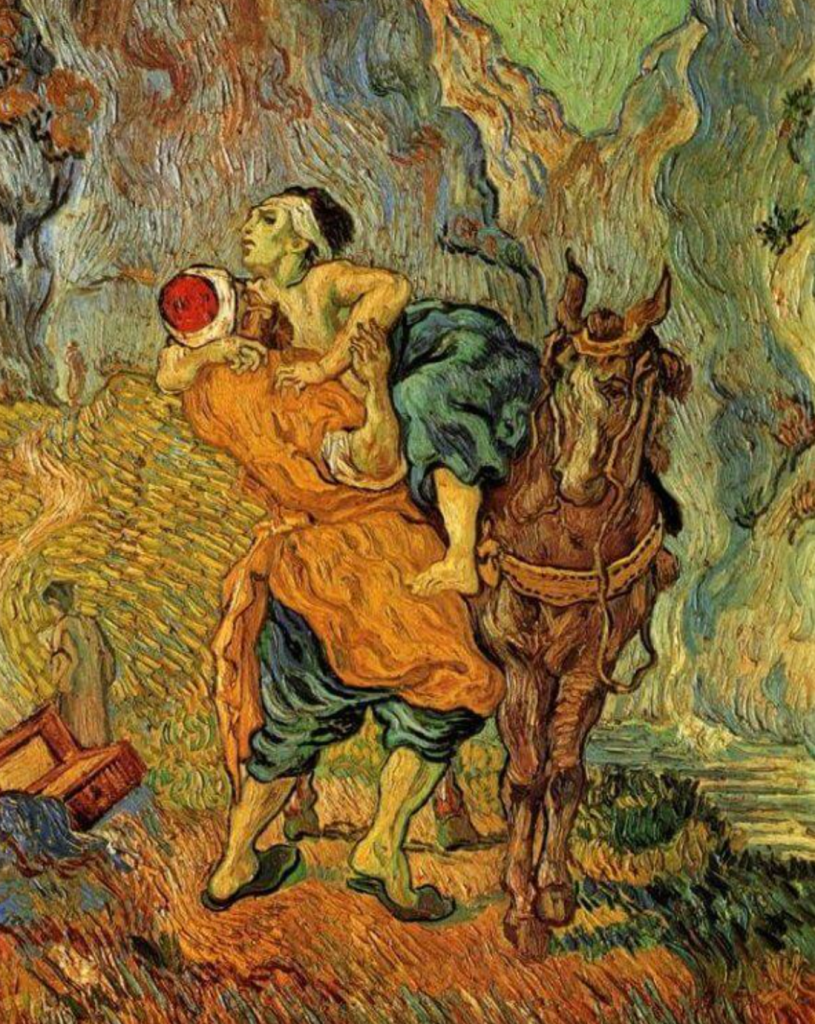
What do you see? Why is the man lifting the other man? Does it look easy to lift the man? Do you see the two people walking away? What colors do you see? What textures? How does this painting make you feel?
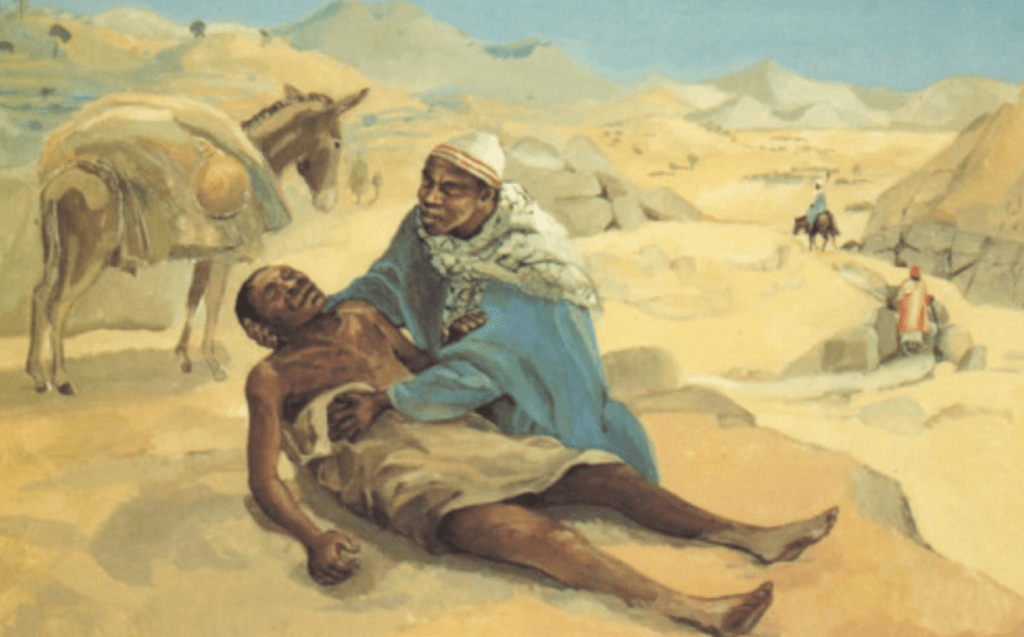
What do you see? How is this painting different from the one above? What is the man dressed in blue doing? What do you think the man in blue is feeling? What do you think the other man is feeling? Do you see the two people walking away? What colors do you see? How are these colors different from the previous painting? What textures do you see? How does this painting make you feel?

The Parable of the Unmerciful Servant by Jan van Hemessen
What do you think these men are doing? Can you find a crown? Can you find coins? Can you find the servant being thrown into prison? Can you find the man writing down how much money is owed? What do you think each person is feeling in this painting?
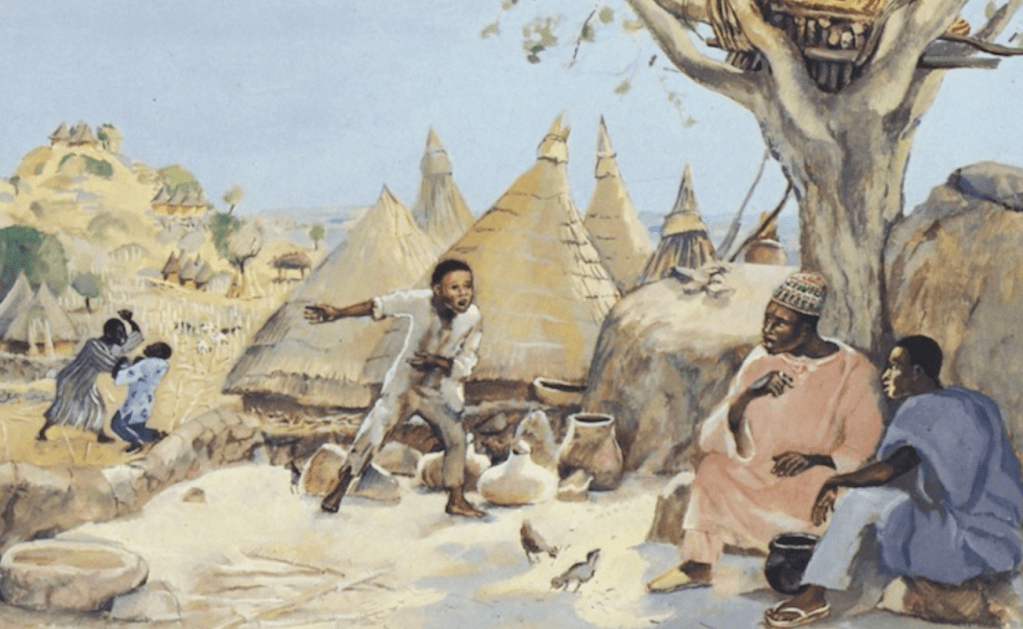
How is this painting different from the one above? What do you think is happening in this painting? What do you think the boy is saying? Where is the unforgiving servant? What do you think each person is feeling in this painting?
Music
The first song is an arrangement of the primary song I’ll Walk With You to focus on being a neighbor, and the second is an arrangement of Brightly Beams Our Father’s Mercy to focus on forgiveness.
 milk & honey mamas
Leave a comment