
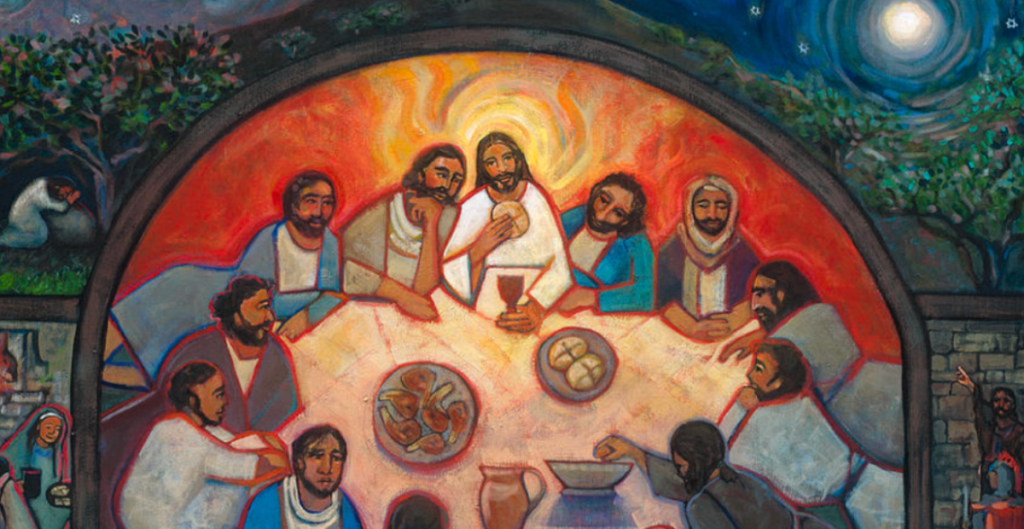
Story contributed by Kristen
Click here for the theological background of Matthew 26; Mark 14; and John 13
Remember, repetition helps children internalize and make connections. It might be a good idea to read the same story every day for a week. You can add different activities every day.
A new commandment I give unto you, That you love one another; as I have loved you, that ye also love one another
John 13:34
Remember the last week of Jesus’ life on earth? What are some of the things you remember?
I want to remember one of my favorite stories with you. It’s about a time Jesus showed extra tender love to his friends. How they sat together and ate together and took care of each other and Jesus reminded them that he would always love them, no matter what.
Here’s what happened.
It was Passover, the day Jews celebrate God’s great miracle rescuing them from their hard lives in Egypt. Jesus loved that story. He loved the God that rescues, and parts the Red Sea, and celebrates freedom dancing joyfully in the wind. Jesus and his friends gathered at another friend’s house. They ate the bitter herbs, and the lamb, and the egg, and the apple together. They told the ancient story, the story of their people. They remembered how God had not left them alone. They remembered the prophetess Miriam, and they sang her songs of hope and love. They held each other’s hands, and they laughed at each other’s jokes, and they were peaceful, and happy, and calm.
Then Jesus sat again, and it was very quiet at the table. Jesus was thinking, looking for the words to say. When he spoke, his voice was quiet and soft, but so powerful it filled the room.
He took bread in his hands and broke it into pieces. He placed the pieces on a plate and took the plate in his hands. He looked down.
“This bread,” he said, “is like my body. It is like your bodies, too. It is full of life, but it will die. It will fill your bellies, but only for tonight. Eat this bread with me, and you will be part of my great work. Part of God‘s great work.”
Jesus passed the plate around.
“Tomorrow, we will be hungry again. Tomorrow, we will not feel the peace we feel tonight. So when I am gone, break bread again. Share it. Feast every day and invite other hungry people. This is God’s work. This is our work.”
The disciples ate, each one savoring the taste of the bread, seasoned with the sound of Jesus’ words.
Then Jesus poured the grape juice into cups, one for each disciple.
“This wine,” he said, is like my blood. It is like your blood too. Tomorrow we will be thirsty again. Tomorrow we will feel pain. So when I am gone, drink wine again. Share it. Drink every day and invite other thirsty people. This is God’s work. This is our work.”
The disciples drank. The wine had never been sweeter.
Jesus looked around the table again. He looked at each one of his friends. He thought about their struggles, and their pains, and their joys, and their successes. He saw how tired they looked, with full bellies and warm insides.
“I have one more thing to say,” said Jesus. “And it is the most important of all.”
He paused for a moment, as though he was searching for words.
“Love each other. Forget many other things I have said, but do not forget this. Love each other, as I love you.”
After a long while of peaceful quiet, Jesus stood up. He looked around the table at all of his friends, noticing each one’s different nose, and eyes, and hands. He filled a bowl with water, and he pulled a piece of fabric from his satchel. Then he walked back to the table, and he knelt down.
He knelt in front of John, and he took John’s foot in his gentle, sturdy hands, and he poured water over John’s dusty foot. He poured water, and then he scrubbed the dirt away. And then he dried the water away.
John covered his face with his hands.
“Jesus, you are so much greater than me. I cannot let you do this.”
Jesus looked up into John’s face.
“Oh my beloved,” he said, “this is my work. To love all of you, your spirit and your body. Let me care for you, my friend, and learn to care for others.”
So John watched, wondering, as the Master cradled his feet, washed away the dust, and wrapped each one as gently as a baby. From place to place around the table Jesus went, washing each friend’s feet. As he went one by one, they talked in quiet voices.
I wish I knew what they said to each other. I wonder if Jesus blessed them as he took their feet gently in his hands. I wonder how it felt to be there.
Soon, each disciple‘s feet were cleaned and dried. Each one had been held, oh so lovingly, and each one felt Jesus seeing them—all of them—completely.
Ideas for play
Contributed by Kristen
- Act out the story!

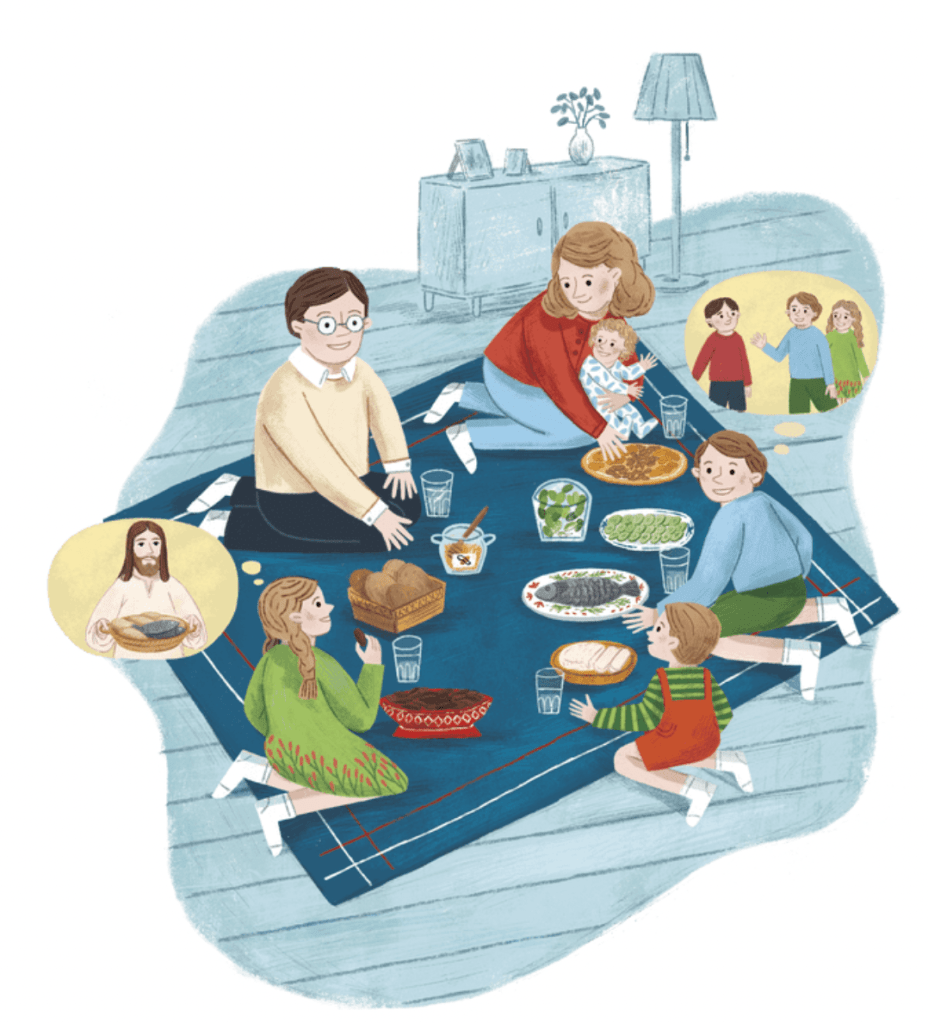
- Have a Jerusalem dinner or “last supper” feast. Learn about how Jews historically and currently celebrate Passover, and how Jesus would have celebrated. Overview here, and helpful article for context here.
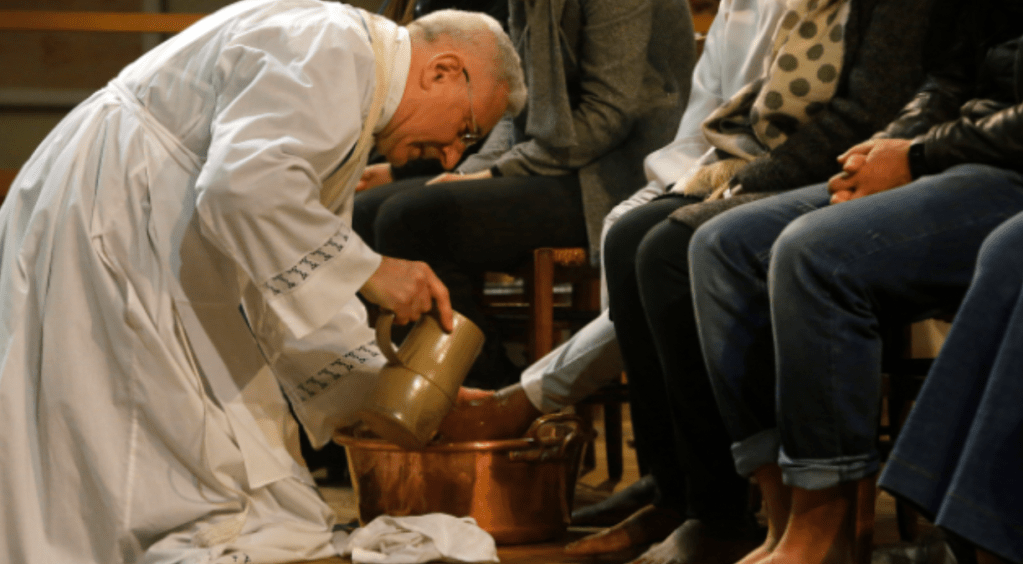
- Wash each other’s feet. Learn about the history and context of foot-washing, which is practiced in many Christian and other religious communities today.
- Say the words of the Eucharist prayers according to your tradition. Invite each family member to say the words aloud. Focus on the blessing in the words and discuss as a family.

- Make a “love one another” craft, like this one. Share messages of love with each other.
Poetry
Compiled by Caroline

Maundy Thursday is the Thursday before Easter, believed to be the time that Jesus held the last supper. This beautiful Maundy Thursday poem by Malcolm Guite rests on themes of renewal and transformation that are brought to us through Christ and imagined through the sacrament.
I recommend reading this poem throughout the week and asking your child what phrases stick out to them. You could delve into the meaning of rich words like “replenishing” and “remaking,” as well as imagining what it means to love someone into light.
Maundy Thursday
By Malcolm Guite
from Sounding the Seasons
Here is the source of every sacrament,
The all-transforming presence of the Lord,
Replenishing our every element
Remaking us in his creative Word.
For here the earth herself gives bread and wine,
The air delights to bear his Spirit’s speech,
The fire dances where the candles shine,
The waters cleanse us with His gentle touch.
And here He shows the full extent of love
To us whose love is always incomplete,
In vain we search the heavens high above,
The God of love is kneeling at our feet.
Though we betray Him, though it is the night.
He meets us here and loves us into light.
Art
Compiled by Caroline

What is Jesus doing? What is Peter doing? What title would you give this picture? Where does your eye go when you first look at this piece? Can you find the candlestick in this image? Why are Jesus and Peter in the flame? What colors do you like the most in this image? What does this image teach you about this story?

What is happening in each of the small scenes at the top of this painting? Why do you think the artist chose to paint those stories? Where does your eye go when you first look at this image? What colors do you like the most in this piece? What does this image teach you about Jesus? How does this painting make you feel?
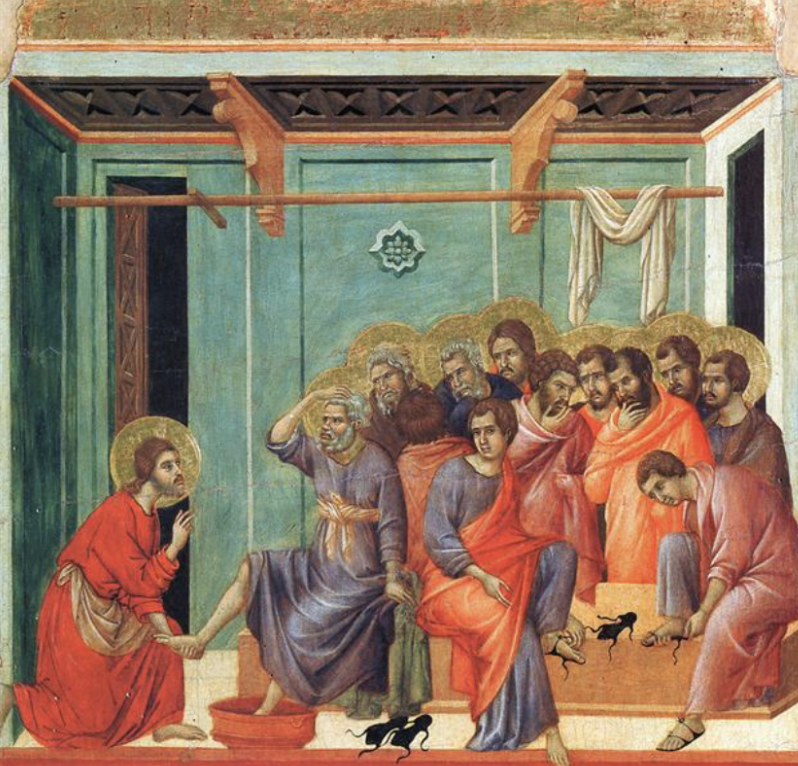
Washing of Feet, by Duccio, 1308-1311
How is this painting different from the other two paintings? How do you think the disciples are feeling in this painting? Which disciple would you like to be in this painting and why? What colors speak to you in this painting? What does this image teach you about this story/Jesus? What do you like/not like about this image?

Where is Jesus? What do you think they are eating? What do you think each disciple is feeling? Where is Judas? What can you learn from this piece? What do you like/not like about this painting?
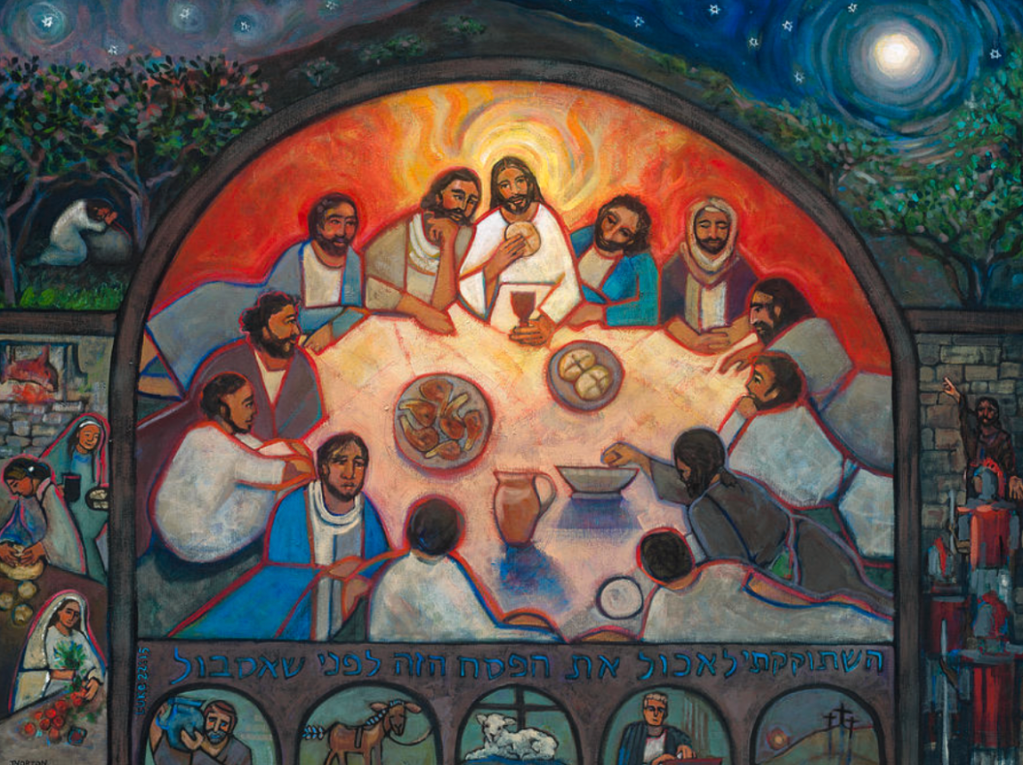
The Hebrew reads: “I have eagerly desired to eat this Passover supper with you before I suffer.” Luke 22:15.
What is being depicted in the surrounding scenes? Why do you think the artist chose these specific scenes? What do you think they are eating? What do you think the disciples are feeling? Where is Judas? How does this painting make you feel?
Music
Compiled by Caroline
Ubi Caritas has been used in traditional western Christianity as one of the antiphons (a chant used in Christian ritual) during the washing of the feet on Maundy Thursday. Below is the traditional Latin text along with the English translation. I have included three different settings of the text by modern composers. You might enjoy playing these pieces while you wash each other’s feet and discuss which piece is your favorite.
Ubi caritas et amor, Deus ibi est.
Congregavit nos in unum Christi amor.
Exsultemus, et in ipso jucundemur.
Timeamus, et amemus Deum vivum.
Et ex corde diligamus nos sincero.
Ubi caritas et amor, Deus ibi est.
Simul ergo cum in unum congregamur:
Ne nos mente dividamur, caveamus.
Cessent iurgia maligna, cessent lites.
Et in medio nostri sit Christus Deus.
Ubi caritas et amor, Deus ibi est.
Simul quoque cum beatis videamus,
Glorianter vultum tuum, Christe Deus:
Gaudium quod est immensum, atque probum,
Saecula per infinita saeculorum. Amen.
English Translation:
Where charity and love are, there God is.
The love of Christ has gathered us into one.
Let us exult, and in Him be joyful.
Let us fear and let us love the living God.
And from a sincere heart let us love each other.
Where charity and love are, there God is.
Therefore, whensoever we are gathered as one:
Lest we in mind be divided, let us beware.
Let cease malicious quarrels, let strife give way.
And in the midst of us be Christ our God.
Where charity and love are, there God is.
Together also with the blessed may we see,
Gloriously, Thy countenance, O Christ our God:
A joy which is immense, and also approved:
Through infinite ages of ages. Amen.
Ubi Caritas, by Ola Gjeilo, Voces8
Ubi Caritas, by Paul Mealor, Tenebrae
Ubi Caritas, by Rene Clausen, BYU Singers
 milk & honey mamas
Leave a comment