
Story contributed by Kristen
Click here for the theological background of Acts 22-28
Remember, repetition helps children internalize and make connections. It might be a good idea to read the same story every day for a week. You can add different activities every day.
Unpopular Paul, Imprisoned Paul
Remember what Paul did before his experience with Jesus on the road to Damascus? Paul was a very faithful Pharisee. He had spent a long time learning, and reading the scriptures, and trying very hard to be a good Jew. But then, all of a sudden, he was a Jesus follower! How do you think other Pharisees felt about that?
I wonder if some of his friends thought Paul was a little bit crazy. A lot of people were still very concerned about the Jesus followers. And they did not want Paul to be part of them. Some of these people were so concerned they decided they needed to kill Paul so that he would stop spreading the message of Jesus. They thought they were doing the right thing.
Paul had been put in prison for all of his preaching and teaching. And the people who wanted to kill Paul made a plan. But Paul’s sister found out about the plan, and because she was very brave she helped Paul. She sent her son to the prison where Paul was kept and had him deliver a message: Paul, you are in danger! The prison keeper heard the message too, and he knew he needed to get Paul out of there right away. So he got horses and soldiers and set Paul on a horse and took him to Felix, a governor in Rome.
Paul, Felix, and Drusilla
Paul was having lots of adventures! He came to Felix, who was married to a Jewish woman named Drusilla. Felix asked Paul a lot of questions. Drusilla listened. We don’t know much of what she thought. Felix asked, “so, what is all this Jesus business anyway?” And Paul told him, as best he could, what he believed. And what had happened to him. And how he wanted to follow Jesus and let everyone know what he had experienced. Something inside of Felix trembled, a lot like the way it feels when you’re watching a butterfly landing on a flower. He wanted to listen to more of Paul’s words. Maybe Drusilla did too. But other people did not want Paul to keep teaching. So Felix kept Paul bound.
Paul and King Agrippa
After two years, Paul was brought to King Agrippa. The same thing happened. The King asked Paul many questions. And Paul shared his story. And King Agrippa listened, and he was a very good listener. When he listened, he felt how much Paul believed in his own words. And he saw that Paul was honest, and that his story meant the whole world to him.
And after Paul had finished sharing his story King Agrippa came down to where Paul stood and he looked him in the eyes. And he said, “your story is convincing. Almost, I am persuaded to believe you.” He smiled at Paul, and then his servant coughed quietly and the king remembered the many other people he needed to see that day, and the many tasks he was responsible for. He knew Paul had done nothing worthy of death, but Paul had asked to testify before Caesar, the head honcho of Rome. So Agrippa gave the orders: set sail for Rome!
Paul and the Open Sea
Paul was placed on a ship with many other prisoners. Soon, they were off. They sailed through days and nights. Sometimes the wind was rough and the waves were choppy. Sometimes the skies were blue and the sun bright and warm. And one day, there was no sun at all. The waves were so high they came over the sides of the boat, flooding the deck with salty water. Rain poured from the skies. The seas churned and boiled, spinning and rocking and tearing the ship until it could not hold. Crash! The boat broke apart, wrecked in the storm! The prisoners grabbed onto whatever they could—pieces of wood, logs, parts of the boat, and swam through the churning waters until they reached land.
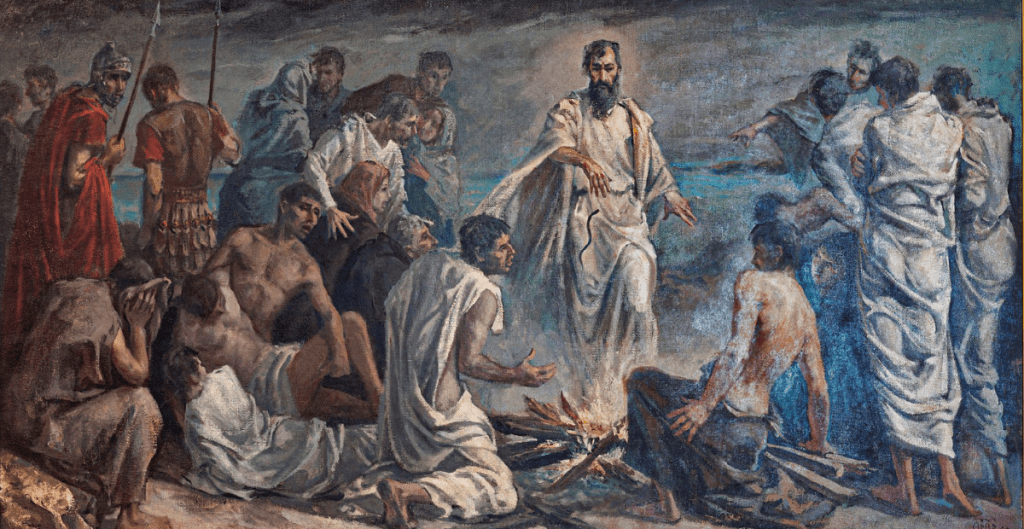
They came to an island. Exhausted, they dragged themselves to shore. Finally, the sky opened and the sun peeked through the clouds. The rain ceased, and the sea swallowed her raging currents. The waves were calm, quiet, and peaceful. When Paul had regained his strength, he looked around him. The island was home to many people. Paul introduced himself, and he saw that some of them were suffering from sickness and painful wounds. Paul called upon Jesus and prayed for the suffering people, and in the name of Jesus Paul healed them. When it was night, he built a fire with his fellow prisoners and sat to eat some dinner. In the darkness, Paul didn’t see a slithering shape slinking toward him, silent and silver in the moonlight. In a flash, the snake had leapt from the bushes and sunk its teeth into Paul’s hand. A snake-bite. The islanders looked at each other. A snake-bite meant death for sure! But Paul just shook the snake off his hand and kept cooking his dinner. The islanders watched, waiting to see signs of poison, but Paul’s hand showed no wound.
Soon, Paul and his fellow prisoners left the island. Paul went to Rome, and there he opened his mouth again. He told everyone he could about his story. He told everyone he could about Jesus, and about the island, and about how even the poisonous snake could not stop him from sharing, and singing, and hoping in Jesus.
Ideas for Play
Contributed by Kristen

- Act it out! Make a boat out of cardboard for the shipwreck (here’s a guide. A mini version would also work. I’ve made a boat out of two larger Amazon boxes with minimal effort). The bathtub might also be a great place to play!

- Act out the snake bite using a toy snake or stuffy
- Act out Paul bearing his testimony! What did Paul want people to know about Jesus? Encourage your littles to share their own feelings about Jesus. Pretend you are preaching before a king or queen!

- Make a map of Paul’s journeys and attach a paper boat to show where he traveled. Here’s an idea for reference (scroll all the way down!)
Poetry
Compiled by Caroline
The stories we have about Paul highlight his extreme patience in adversity and his hope in Christ. This poem is my reminder that these two attributes often go hand in hand. Similarly to Emily Dickinson’s famous poem “Hope is the thing with feathers,” George MacDonald compares hope to a bird. It is fragile and longing for life, only protected by the patience to achieve its aim.
As you read this poem with your children, you could ask them what they think it means to be patient and have hope. How did Paul demonstrate this? How can they have hope and patience in their life?
Hope And Patience
by George MacDonald
An unborn bird lies crumpled and curled,
A-dreaming of the world.
Round it, for castle-wall, a shell
Is guarding it well.
Hope is the bird with its dim sensations;The shell that keeps it alive is Patience.
Art
Compiled by Caroline

What do you see? How would you feel in the boat? How would you feel on the beach? What are the people doing? What colors do you see? Why does the painting feel dark?

Can you find Paul? Can you find the snake? Can you find a soldier? Can you find someone who is hurt or sick? Can you find a woman?
Music
Compiled by Caroline
Music
Some questions to think about with the song: I wonder what work Jesus gave Paul to do? I wonder what work Jesus has for you to do? I wonder what Jesus’ work is?
Lyrics:
I don’t know if we’re ready
I don’t know if we’re strong
But I know that Jesus can steady any
Rocky boat and make the waters calm
Jesus, make us ready
Teach us what You’d have us do
Jesus, give us courage
To work like You
Give us Your work
Teach us how to work Your land
Give us Your work
Give us Your labor in our hands
 milk & honey mamas
Leave a comment