
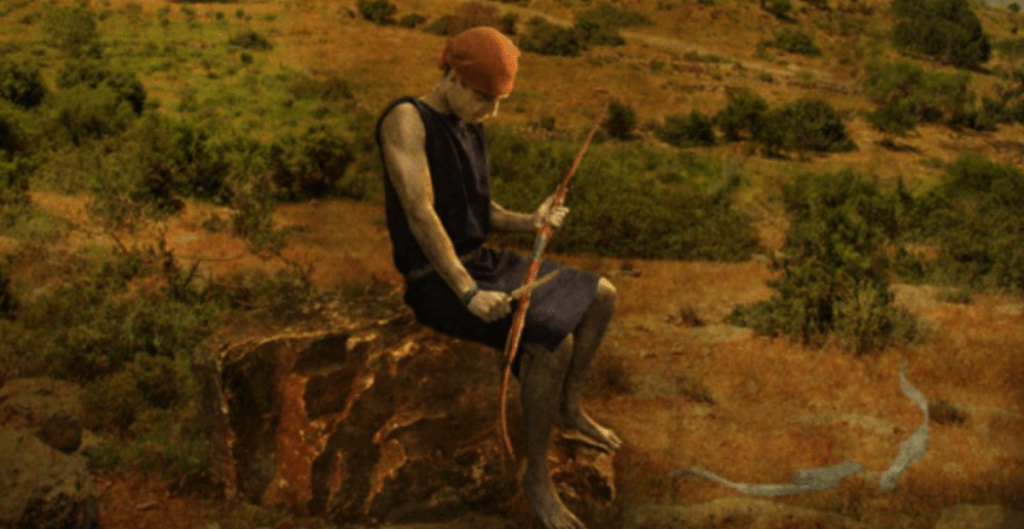
Theological Background by Kristen
Nevertheless, I do not write anything upon plates save it be that I think it be sacred. And now, if I do err, even did they err of old; not that I would excuse myself because of other men, but because of the weakness which is in me, according to the flesh, I would excuse myself.
1 Nephi 19:6
In just a few chapters (as we now have them) Nephi summarizes years of experiences. He is the author and the editor of the stories we receive; it is through his eyes that we join the ever-widening family from Jerusalem.
I often struggle with Nephi. To me, he comes off a bit self-righteous, and his tendency to preach at people leaves me white-knuckling my way through his books (I mean seriously, no dancing??) But I felt a new compassion for him this time around when I re-read his explanation of his editorial agency: I do not write anything upon plates save it be that I think it be sacred. And now, if I do err, even did they err of old; not that I would excuse myself because of other men, but because of the weakness which is in me, according to the flesh, I would excuse myself (I Nephi 19:6).
The burden of leadership and editorial responsibility shone for me in a new light through Nephi’s words. Nephi feels responsible for representing the sacred. As we read his story, we read his interpretation of that term. We see his perspective and are privy to (some of) his spiritual experiences, and that narrates the whole story.
For Nephi, God’s direction is sacred. God’s commandments are sacred. God’s words interpreted through prophets are sacred. So much of the story we receive is filtered through these lenses.
For example, Nephi writes about the women of the group bearing children in the wilderness, nourishing their pregnant bodies with raw meat and providing life-giving sustenance to their infants through breast milk. By his criteria, I think we can assume that Nephi counts it as sacred that the women are transformed to be able to “bear their journeying without murmuring” and to be “strong even like the men” (I Nephi 17:2). This is not what I would count sacred about the experience of these women. I am skeptical of Nephi’s standard of comparison – strength like the men being the measure of God’s presence. I wonder how the silent women might tell the stories. I wonder how they would narrate God’s presence. I wonder what they told their babies in the soft night sky as they soothed bad dreams and nursed to sleep.
I wish we had more voices here. Yet I feel deep within me the mistake it would be to discount Nephi’s treasures, his sacred memories. And in this paradox, I find a new kernel of compassion for the messiness of this account. It is challenging to be a leader. Nephi has powerful visions and deep convictions. Even more poignantly, he is witness to the tragic events that will befall his own people. He grapples with this, yearning to bring his family into his visions of Zion and righteousness, trying desperately to live in honor to God. Bearing the burden of this liminality and prophetic office, he may sometimes be unable to understand the feeling of being lost, unable to see the vision.
Nephi’s narration is thus also a story about the challenges of following a visionary leader. What for Nephi is beyond doubt is, as far as we know, a matter of faith for the others. Perhaps God would reveal more to the others if they asked, perhaps not. I have never had a powerful vision or experience of profound visitation. What do you do when someone else in your religious community has the ear of God and you, for whatever reason, don’t seem to? What do you do when you struggle, deeply and personally, with the directions they’re advocating for?
And what do you do when you’re Nephi, convinced of the vision for the promised land, yearning with all your heart to bring your beloveds with you to safety, and they will not listen?
Living in community is, profoundly, a challenge. We don’t always catch the same vision. We aren’t always equally convinced. God speaks clearly to some; for others it’s nothing but endless muddles.
Nephi’s community fails. They rupture, break, and become enemies. As we read Nephi’s account, we should see the warning signs of the splinters that will become full bodied breaks. Nephi knows they will break, and he still tries to keep them together. Perhaps as he writes he is pressing this desperation into memory, hoping that we know he tried with all his being to bring them all into the vision. And perhaps as we read this earnest narration we can soften with compassion for the failure that resists the blame Nephi and we want to place.
The angel of Nephi’s vision invites him to “look, look.” I think the invitation is still open. Look, how hard it must have been, for all of them. Look, what was sacred to them? Look, what is sacred to you, where do you see yourself in the story, what do you see? Look, God is still at work in failure and tragedy. Look, this is a story about us.
Ideas for Play
Contributed by Kristen
- Make your own sacred plates! What stories from your family or elsewhere do you consider sacred?

- Read some of the stories from the text, and/or listen to the Book of Mormon storybook

- Build a boat! Cardboard, fabric, felt, or imagination.
- Act out your favorite stories and explore with your kids (building a boat, breaking the bow, etc)

- Make a liahona and play with following directions
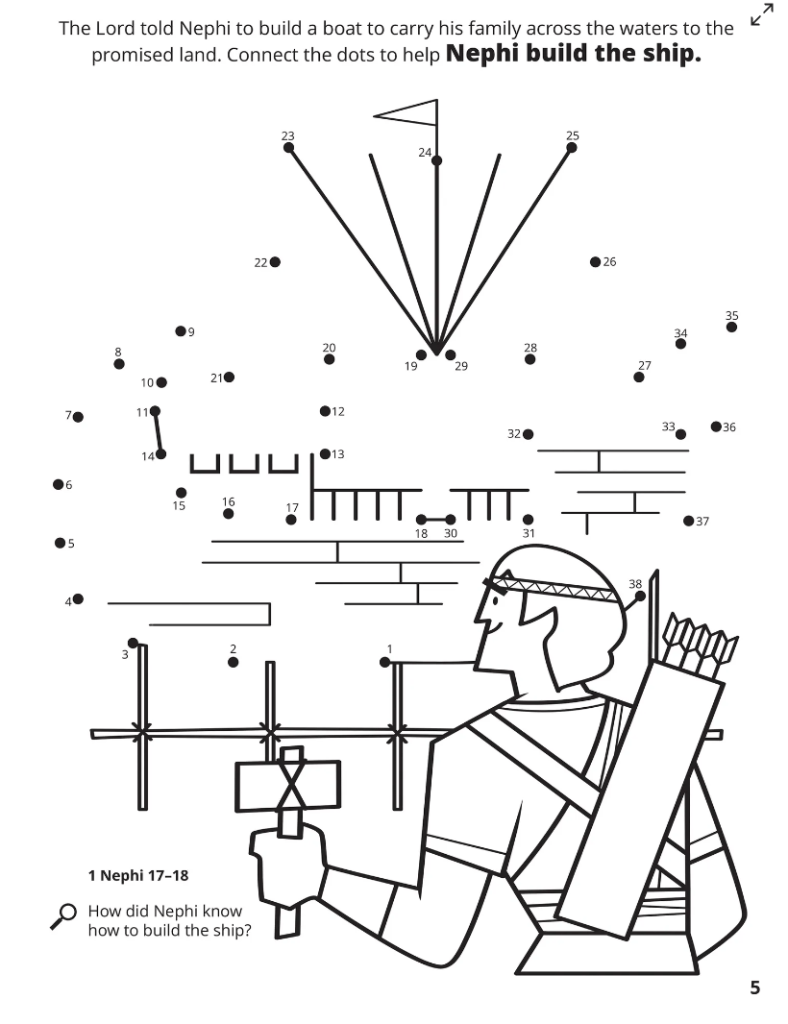
- Connect the dots for Nephi’s boat
- Draw pictures of the stories and discuss
Poetry
Compiled by Caroline
Nephi’s Vision (as sung by Johnny Cash)
by James Goldberg from his collection Let Me Drown with Moses
Note from the poet:
In this poem, I wanted to get out the assured tone we associate with scripture length to get some of those other layers. Johnny Cash felt like the right sort of voice to put in people’s heads. Hopefully, looking back at scripture in a new tone can help you see things that were already there.
You know I grew up goodly,
and you know I love the Lord.
I’ve followed his voice to the end of the earth
for the bittersweet taste of His word.
But I’ve seen the scourges coming
if my children’s faith grows cold.
Yes, I’ve seen the plates of fire God made
to refine these plates of gold.
I’ve seen Jerusalem strut through the day,
seen the way her drunks sway in the night.
And I’ve walked down the narrow path
where you’ve got to do wrong when it’s right.
Yes, I’ve felt the white-hot heat that forged
this iron rod I hold.
Oh, I’ve seen plates of fire God made
to refine these plates of gold.
Went and asked God for a vision–
and an angel said, Behold.
The future’s filled with a fire, son,
to refine your plates of gold.
Music
Compiled by Caroline
Just a little talk with Jesus, The Lower Lights
Art
Compiled by Caroline

Anastacia Kadomtsev, Sariah and Her Daughters, 2023. The Book of Mormon Art Catalog


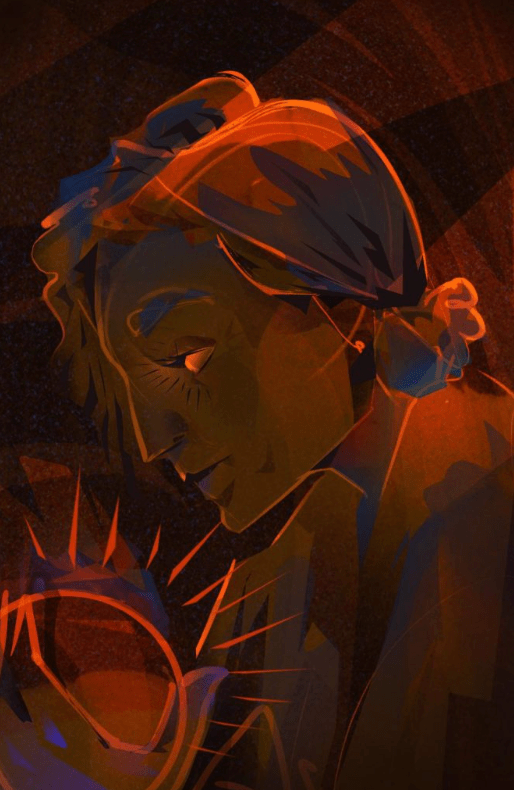
 milk & honey mamas
Leave a comment