

Theological Background by Kristen
Remember playing the telephone game? One person whispers a phrase into the next person’s ear, going around and around trying—as goofily as possible—to discern the original phrase. Usually, of course, the phrase has been delightfully distorted and the group can laugh at the linguistic morphing. In the game, such shifts are welcome and even anticipated. But real, embedded versions of telephone feel much higher stakes.
The story goes like this: we begin with something unpolluted, pure, pristine. In the wrong hands, it is distorted. In the right hands (line of authority) it remains clear. So we create a myth of singularity, a straight line of truth from one receptacle to the next.
We often talk, for example, about how frequently the Book of Mormon talks about Jesus. It seems that we sometimes have an idea that the ancient prophets taught the same Christological doctrine from Lehi down through Moroni. The prophets themselves suggest this very kind of thinking; King Benjamin doesn’t waste any breath in declaring unequivocally that “there are not any among you, except it be your little children that have not been taught concerning these things, but what knoweth that ye are eternally indebted to your heavenly Father, to render to him all that you have and are; and also have been taught concerning the records which contain the prophecies which have been spoken by the holy prophets, even down to the time our father, Lehi, left Jerusalem” (Mosiah 2:34).
It piques my interest, however, to note that what King Benjamin teaches about Jesus is markedly different than what later prophets teach. At the beginning of his sermon, the King teaches a dramatic version of prosperity gospel clearly following Jacob and his predecessors:
“And now, I say unto you, my brethren, that after ye have known and have been taught all these things, if ye should transgress and go contrary to that which has been spoken, that ye do withdraw yourselves from the Spirit of the Lord, that it may have no place in you to guide you in wisdom’s paths that ye may be blessed, prospered, and preserved—
I say unto you, that the man that doeth this, the same cometh out in open rebellion against God; therefore he listeth to obey the evil spirit, and becometh an enemy to all righteousness; therefore, the Lord has no place in him, for he dwelleth not in unholy temples.
Therefore if that man repenteth not, and remaineth and dieth an enemy to God, the demands of divine justice do awaken his immortal soul to a lively sense of his own guilt, which doth cause him to shrink from the presence of the Lord, and doth fill his breast with guilt, and pain, and anguish, which is like an unquenchable fire, whose flame ascendeth up forever and ever.
And now I say unto you, that mercy hath no claim on that man; therefore his final doom is to endure a never-ending torment” (Mosiah 2:35-39).
I think of Lehi, imploring his sons to believe that the path is simple and clear. Obey and prosper, disobey and suffer. Benjamin, bless him, casts the stakes in much starker terms (later prophets, by the way, do not speak of suffering in hell). The King is relying on a paradigm he has inherited about good and bad, right and wrong, truth and error.
But here’s the catch: good King Benjy was visited by an angelic messenger who told him about Jesus. To his understanding of a Judaic tradition as interpreted by diasporic prophets, he adds an atonement theology. To his paradigm of good and evil, of the covenant relationship, he adds Jesus. Jesus can repair the breach, Benjamin intuits. Jesus can cover the failure of the covenant invocation. It follows from this paradigm that the King teaches of a “natural man” opposed to God, in need of intervention. King Benjamin’s teachings about atonement are in line with what scholars call a ransom or satisfaction model of atonement. It is what we would expect a nineteenth century theology to teach.
King Benjamin wrestles with the tradition he inherits, the responsibility he feels, and the angelic message he receives. He maps his visionary experiences onto his theological inheritances, as anyone would. Just like us, he is trying to make sense of his moment, with the context and understanding he has.
But teachings about Jesus and Jesus’ atonement in the Book of Mormon are not monolithic. They will shift and shimmer from Benjamin to Alma to Amulek to Queen Lamoni to Moroni. Because these were people, not gods. They were trying to make sense of their moment with the tools they had. They listened to the phrases they received, and they passed them down in the best way they knew how.
We who still listen wonder what they meant. We wonder what we will whisper to our children as we pass them the words we have ingested. We feel for the heartbeat in the texts and find it resurrected within us, imagining the heat of the crowd listening to their king. Imagining what they heard and what stuck with them. Imagining what the children thought, and felt, and wondered. Imagining these stories alive, beating again, listening back to us.
Ideas for Play
Contributed by Kristen


- Pitch a tent in your living room or backyard or wherever and pretend to be King Benjamin’s people! Read his words aloud
- Act the scene out using dolls, pictures, or people
- Act out the angel coming to the king. What does king Benjamin believe about Jesus? What do you believe about Jesus?
- How does Jesus matter to you even though he lived so long ago? How did he matter to them even though he hadn’t come yet?
- Choose your favorite verses and write them out. Discuss as a family
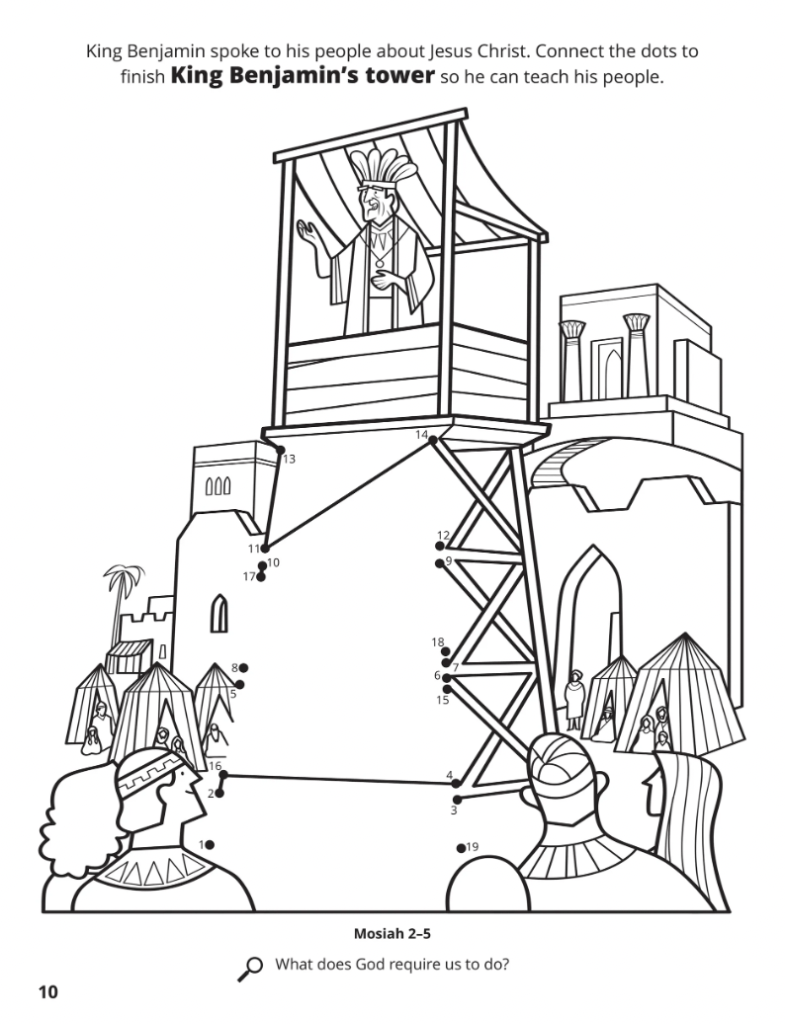
- Empathize with the King a bit. What did he care about? What was he worried about? What did he hope for his people? What was his goal with this sermon?
Poetry
Compiled by Caroline
If I can stop one heart from breaking
by Emily Dickinson
If I can stop one heart from breaking, I shall not live in vain;
If I can ease one life the aching,
Or cool one pain,
Or help one fainting robin
Unto his nest again,
I shall not live in vain.
Art
Compiled by Caroline

Music
Compiled by Caroline
Search, Ponder, and Pray–The Kentucky Sunbeams
 milk & honey mamas
Leave a comment