

Theological Background by Kristen
“You who would read this book,” Marguerite Porete wrote sometime between 1296 and 1306, “If you indeed wish to grasp it / Think about what you say, / For it is very difficult to comprehend; / Humility, who is keeper of the treasury of / Knowledge / And the mother of the other Virtues, / Must overtake you.” In 1310, Marguerite was burned at the stake, condemned for heresy. Her book was deemed heretical and banned from circulation. “Theologians and other clerks,” her book’s introduction continues, “You will not have the intellect for it, / No matter how brilliant your abilities, / If you do not proceed humbly. / And may Love and Faith, together, / Cause you to rise above Reason, / [since] they are the ladies of the house.”
About Marguerite’s personal life we know almost nothing. She was one of the growing movement of beguines, religiously devout women who lived together without taking vows of enclosure. Her theology, as recorded in her book, was not markedly different from others circulating around the same time. Nevertheless, her book was condemned and burned in her presence by her local bishop. After his death, she sought to have the condemnation overturned by seeking the sanction of three different religious authorities (a friar, an enclosed monk, and a scholastic theologian). Wendy Farley writes, “Apparently ignorant of the larger swirls of church politics in which she was becoming enmeshed, she seemed to think that if these three very different sources of authority approved her writing, it would be reconsidered by the new bishop. Instead, he had her arrested and handed over to King Philip the Fair’s political ally, confessor, and chief inquisitor, William of Paris. She was held in his prison for eighteen months, during which time she refused to confess or otherwise cooperate with her accusers.” After eighteen months, at the behest of William of Paris, theologians were called to deliberate at her trial. They read fifteen sentences from her book, without context, and declared them heretical. She was condemned as a heretic, taken to a field in Paris, and burned alive.
The book of Mosiah’s Abinadi was condemned as a heretic and burned alive in quite a different context than the medieval Marguerite. Yet as I read his story this time around, I was intrigued by the parallel themes of mysticism, allegiance, power, and violence.
The power to interpret a tradition and draw ways forward has always been contested (it has also always been gendered). This power is a sore spot in the Book of Mormon, whose authors and editors bemoan the misdirections and wayfaring movements of those who would reject or distort the original direction as interpreted. This is not to say that the writers were dogmatic or (necessarily) hegemonic, but rather that they were extremely pious and devoted to their beliefs. Interestingly, following the Jewish tradition, the Book of Mormon prophets are deeply concerned with a social gospel and adamantly opposed to the abuse of power in the name of religion. Abinadi wields the words of Isaiah in much the same way as his predecessors and for the purpose of condemning a manipulation of power for the benefit of a very few.
I find it especially interesting to see Isaiah pop up as the word of law, authority, and call to repentance again given the different geographic and social context. To me, this indicates what I have suggested previously, a thirst for a clean line of interpretation from Jerusalem to Lehi to Abinadi. We Latter Day Saints, incidentally, have this same thirst, believing in a clean line from Jesus to President Nelson. In his own context, Isaiah was a voice for orthodoxy and social reform, making his use in the Book of Mormon particularly relevant. And I am certainly not attempting to redeem the actions of king Noah, whose use of power was apparently exploitative. I am interested, however, in wondering who gets to define the boundaries of a tradition, particularly as it expands and morphs through changing contexts. Alma, of course, will be transformed by Abinadi’s message and create a fledging community whose core beliefs infuse our current tradition. But the political, the social, and the religious coalesce and interact with each other in complementary and contradicting ways as Alma draws a way forward from Abinadi’s murder.
So it was for Marguerite, so it is for us. In her book, Marguerite distinguishes between Holy Church the Little, governed by Reason, and Holy Church the Great, governed by Love. Importantly, Holy Church the Little is operant in the human world, while Holy Church the Great is beyond the human realm, or unrealized in the world. Drawing the boundaries of Holy Church the Little sometimes impedes the work of Holy Church the Great. I wonder if Marguerite’s analysis has relevance to the Book of Mormon. Holy Church the Little is contested, enmeshed with political authority and the hierarchical imbalances of power. Holy Church the Great is a dream, a longing, a vision in the soul of believers, a heartbeat in the songs of the prophets. Mediating between these two comes with great risks. Many voices are lost to history with the power to determine orthodoxy is wielded by a very few.
But, the longing. I feel the longing from Marguerite to Abinadi to myself. For the vision to be real. For the beloved community to be right here. For the words and the deeds to match, to make sense, to spread their wings. Abinadi’s calls to repentance are not just about religious orthodoxy, they are about longing. Beyond dogmas, Abinadi is a believer in the long arc of dreams carefully preserved in the pages his heroes left behind. We are dreamers, still, longing for the beautiful land to flow with milk and honey, to answer our pleas for peace, to bring forth abundantly.
When the boundaries of a tradition are defined by those hungry for power, it takes the courage of a Marguerite and an Abinadi to claim their ground. “Your vision is not mine,” they say, “and I lay claim to interpretation. I belong here, too.” Ah, and we long for the outcomes to be beautiful. We long for the stories to end not in fire but in spring. And yet.
And yet, Alma will descend from fire to water, baptizing a new community toward Zion. And we daughters of Marguerite walk in a long tradition of wanderers who believed in a new day.
And yet, fire. Pain. And yet, birth. Life. And yet.
Ideas for play
Contributed by Kristen

- Read the Book of Mormon storybook
- Watch Book of Mormon videos
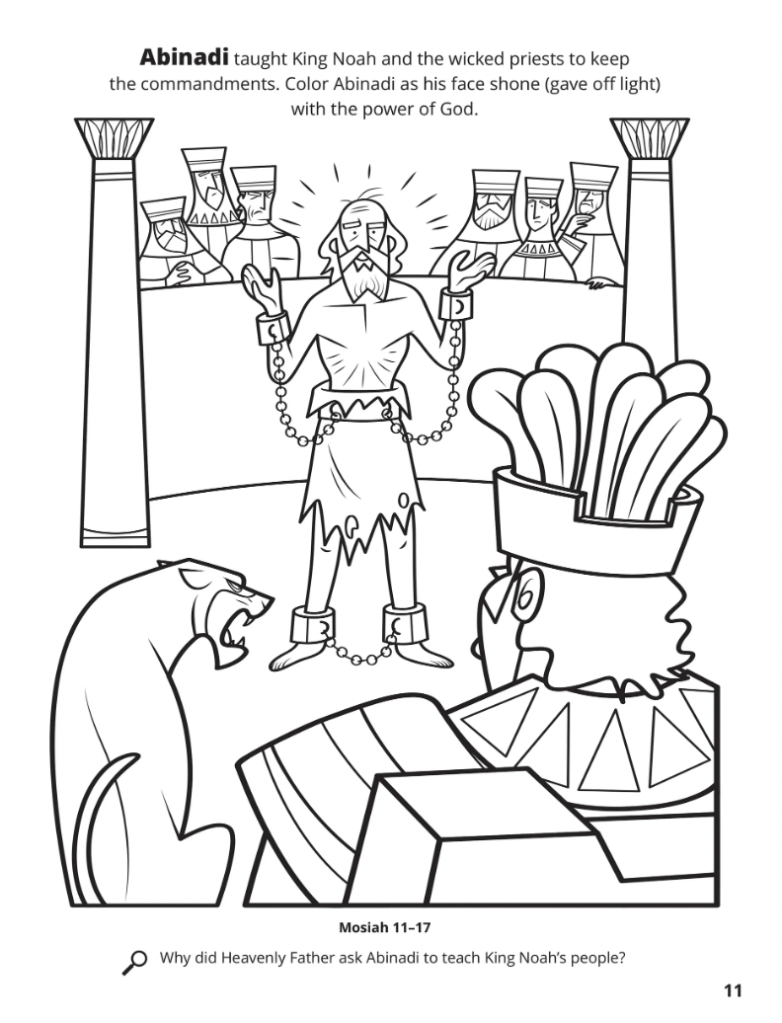
- Abinadi coloring page
- Act out the story
- Tell the story with puppets, felt characters, stuffies, etc
- Why do you think King Noah didn’t want to listen?

- Learn a bit about Marguerite Porete and other female mystics!
- What is a prophet? Who can be a prophet? Was Marguerite a prophet?
Poetry
Compiled by Caroline
From The Mirror of Simple Souls
By Marguerite Porete
You who would read this book,
If you indeed wish to grasp it,
Think about what you say,
For it is very difficult to comprehend;
Humility, who is keeper of the treasury of
Knowledge
And the mother of the other Virtues,
Must overtake you.
Theologians and other clerks,
You will not have the intellect for it,
No matter how brilliant your abilities,
If you do not proceed humbly,
And may Love and Faith, together,
Cause you to rise above Reason,
[Since] they are the ladies of the house.
Even Reason witnesses
In the Thirteenth Chapter of this book,
And with no shame about it,
That Love and Faith make her live
And she does not free herself from them,
For they have lordship over her,
Which is why she must humble herself.
Humble, then, your wisdom
Which is based on Reason,
And place all your fidelity
In those things which are given
By Love, illuminated through Faith.
And that you will understand this book
Which makes the Soul live by love.
Art
Compiled by Caroline
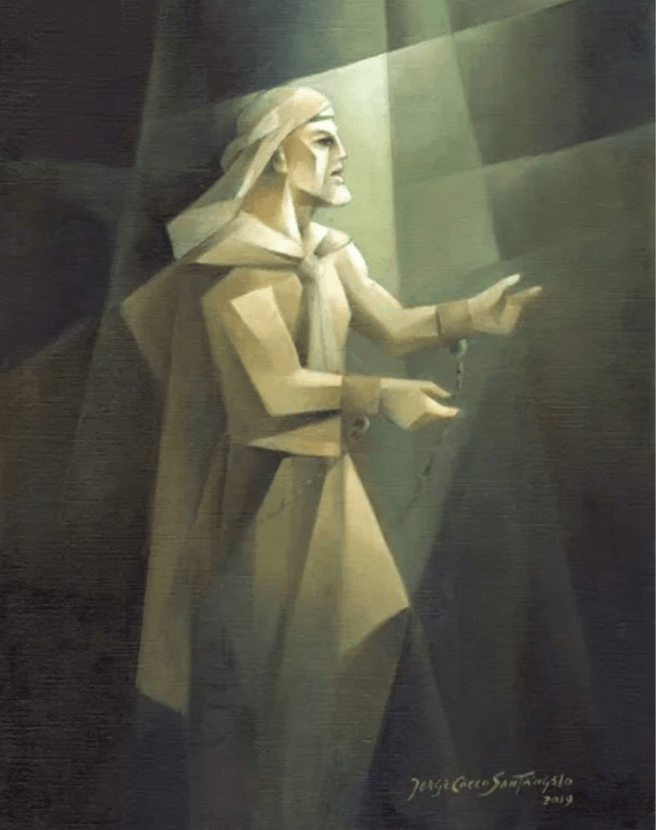
Jorge Cocco Santángelo, Abinadi in Chains, 2019. The Book of Mormon Art Catalog

Music
Compiled by Caroline
The Way Your Kingdom Comes, The Soil and The Seed Project
 milk & honey mamas
Leave a comment