

Theological Background by Kristen
I think young Alma’s story changes everything. Until now, much of the talk of Jesus Christ has been fairly abstract. With Alma, and then with Alma’s son, it comes to life in vivid color. If we were to reference our diagram again, it might look something like this:

Jesus changes everything. This is a ransom atonement model, where the salvific power of Jesus literally saves the sufferer from the demands of justice; Alma, in this frame, is snatched from the punishment he says he deserves. But it doesn’t end with browbeating and self-flagellation. It ends with transformation so entire as to awaken a new life. The Jesus of young Alma gives him not just forgiveness but rebirth. This is God the mother at work, birthing new possibilities for a child closed off to love.
Julian of Norwich writes of Christ as mother birthing humanity on the cross. Mother-Jesus dies in childbirth, literally giving her life for the possibility of what will come after. Elizabeth Johnson writes of this Jesus dying in a Kenosis of patriarchy, a vacuuming out of power-ethos to be replaced completely with love.
For Alma, all things are new. But for the text, for the people still struggling, there is still much confusion. A power ethos is, indeed, powerful. It gives an illusion of meaning, of importance, of significance. Its tantalizing grip continues to characterize the complex tales we read in the Book of Mormon. Mormon, understandably, tries to make sense of tragedy, violence, and suffering through the rod paradigm: the wicked receive their just punishment, bringing condemnation on themselves, and the righteous prosper. In this framework, he employs a race or skin-based theology of consequence: “For every man receiveth wages of him whom he listeth to obey, and this according to the words of the spirit of prophecy; therefore let it be according to the truth.” (Alma 3:27) Yet only chapters earlier, Alma the younger was visited by an angel and ransomed from what the wages he paid contrary to his parents’ wishes.
The Book of Mormon writers, including its editor, struggle to make sense of Jesus. What does it mean for Jesus to enter all of our messiness, our complexity, our inability to remain cleanly in bounds? What does Jesus have to do with our fearsome, naked vulnerability?
In Alma 4:3 we read that “Every soul had cause to mourn.” This we can understand. Beyond the labels of wicked or righteous, Nephite or Lamanite, believer or unbeliever, the suffering of war touched everyone. We need no imagination to draw comparisons to motherless children, or anguished mothers, or starving youth, or innocence robbed forever to know that this is a true story, this war story. Because war is never beautiful, unambiguous, or godly.
Jesus, life, surprising life. Death, trauma, suffering. Thousands of years old, this is still our story.
Ideas for Play
Contributed by Kristen

- Read the Book of Mormon storybook!
- What does Jesus mean to you? How does Jesus change things in your life?

- Create a big mess. You could use dirt (in a container, lol), flour, or sand. Add some destructive elements like little cars or other obstacles. Sometimes things are messy! Does Jesus always “fix” the mess? No. But Jesus can help us to find the strength to clean up the mess, or to find what’s missing, or to organize what we need to.
- What are some messy things in our world today? How might Jesus help?
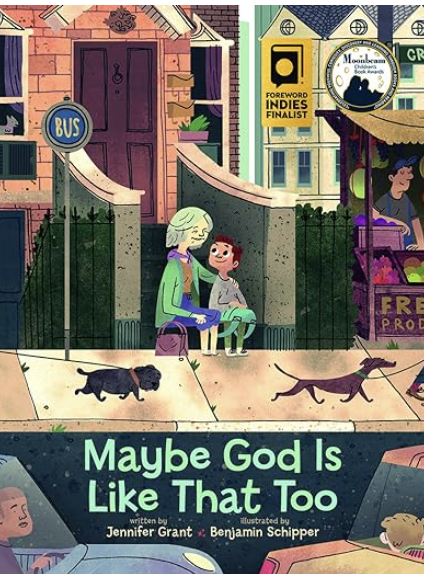
Read some books about Jesus:

Artwork


Poetry
To Live in the Mercy of God
To lie back under the tallest
oldest trees. How far the stems
rise, rise
before ribs of shelter
open!
To live in the mercy of God. The complete
sentence too adequate, has no give.
Awe, not comfort. Stone, elbows of
stony wood beneath lenient
moss bed.
And awe suddenly
passing beyond itself. Becomes
a form of comfort.
Becomes the steady
air you glide on, arms
stretched like the wings of flying foxes.
To hear the multiple silence
of trees, the rainy
forest depths of their listening.
To float, upheld,
as salt water
would hold you,
once you dared.
.
To live in the mercy of God.
To feel vibrate the enraptured
waterfall flinging itself
unabating down and down
to clenched fists of rock.
Swiftness of plunge,
hour after year after century,
O or Ah
uninterrupted, voice
many-stranded.
To breathe
spray. The smoke of it.
Arcs
of steelwhite foam, glissades
of fugitive jade barely perceptible. Such passion—
rage or joy?
Thus, not mild, not temperate,
God’s love for the world. Vast
flood of mercy
flung on resistance.
 milk & honey mamas
Leave a comment