

Theological Background by Kristen
Alma’s son gets his feet under him. He is established in his ministry. He is confident in his ability to receive God’s word. In a manner reminiscent of Elijah’s angelic commission to a snack and a nap, Alma is directed to the home of a hospitable stranger who will become a kindred spirit and fast friend. He is the beneficiary of (unnamed) female labor, which is alluded to when we learn of Amulek’s large household. And with Amulek, he begins one of the most complicated threads of missionary work I know of.
The style of encounter in these chapters is largely patriarchal. I do not mean this as a criticism or condemnation, but merely as an observation. According to the language of the text, they are directly addressing men only. We do not know if women were allowed to public forums, or if women could be lawyers or hold positions of authority. We do know that Alma and Amulek provide spit-fire arguments, drawn from a thorough understanding of scripture and tradition, in defense of their call to repentance. Their engagement with the lawyers is primarily rational—they are able to meet Zeezrom’s practiced verbal blows with their own practiced theological addresses. Their cause at this point is logical. They rehearse the scriptures (an apparently valued and revered authority for all, given their respect to it), demonstrating the veracity of their claims with such expertise as to cause Zeezrom to seriously sweat and eventually abandon his own position. Apparently, their remarks draw at least some number of converts, though we are given no context for their conversions or the tenor of their beliefs, hopes, and expectations in conversion.
We know what happens next. We know, and wish we did not know. We wish if we read it again, it will all happen differently, but it never does. The fires are lit each time I open the chapters, and each time the logic evaporates in the heat.
Much of what is happening in this section is preparatory. The editor, too, knows what is coming. We are being prepared to understand how such a tragedy could occur. We are being prepared to nod in understanding when the inhabitants of Ammonihah are annihilated, every one, women and children, until their bones are heaped up on the land. We are led to anticipate God’s judgment upon the perpetrators as Alma and Amulek watch the innocents helplessly.
The Jesus train has been rolling with increasing momentum to this point. But perhaps we falter in the wake of tragedy, coming to a severe testing point of the paradigms holding everything together thus far. We have withstood the family rupture, the wars and feuds on both sides. We have withstood battered hopes and wayward children, enemy lines drawn and resentments cemented. Can we withstand the fires of Ammonihah? Can the writers find Jesus in this story, and can we make sense of the ways they do?
Ideas for Play
Contributed by Kristen

- Read the Book of Mormon storybook
- Watch Book of Mormon videos
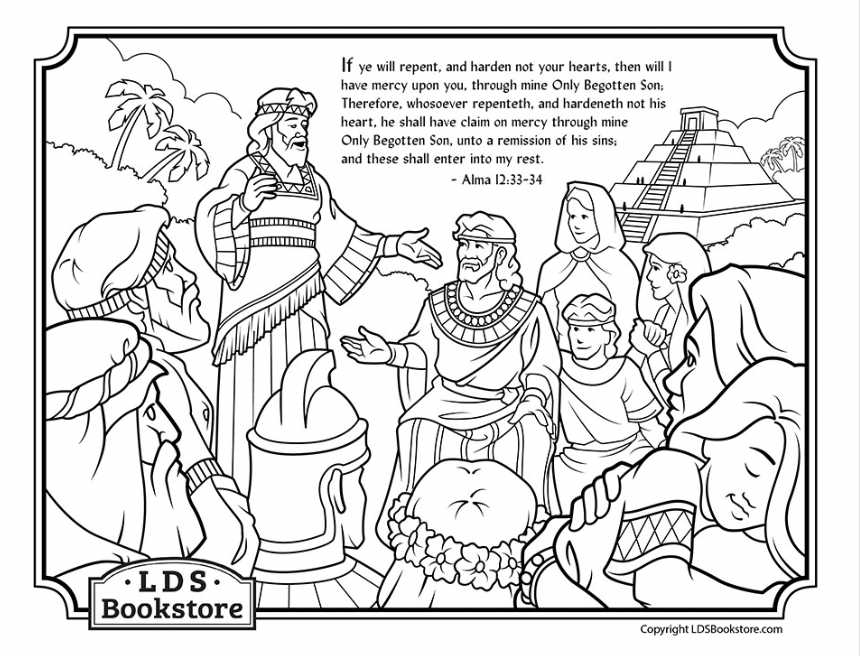
- Coloring page of Alma and Amulek
- Tell the story of Elijah and compare to Alma and Amulek
- Why are friends important? How can friends and rest help us?

- Prepare a small meal and welcome “Alma” into your home. Add your testimony to his to help him teach the people about Jesus
Artwork
Compiled by Caroline

Poetry
Compiled by Caroline
I measure every Grief I meet (561)
I measure every Grief I meet
With narrow, probing, eyes –
I wonder if It weighs like Mine –
Or has an Easier size.
I wonder if They bore it long –
Or did it just begin –
I could not tell the Date of Mine –
It feels so old a pain –
I wonder if it hurts to live –
And if They have to try –
And whether – could They choose between –
It would not be – to die –
I note that Some – gone patient long –
At length, renew their smile –
An imitation of a Light
That has so little Oil –
I wonder if when Years have piled –
Some Thousands – on the Harm –
That hurt them early – such a lapse
Could give them any Balm –
Or would they go on aching still
Through Centuries of Nerve –
Enlightened to a larger Pain –
In Contrast with the Love –
The Grieved – are many – I am told –
There is the various Cause –
Death – is but one – and comes but once –
And only nails the eyes –
There’s Grief of Want – and grief of Cold –
A sort they call “Despair” –
There’s Banishment from native Eyes –
In sight of Native Air –
And though I may not guess the kind –
Correctly – yet to me
A piercing Comfort it affords
In passing Calvary –
To note the fashions – of the Cross –
And how they’re mostly worn –
Still fascinated to presume
That Some – are like my own –
Music
Compiled by Caroline
Is He Worthy?, Andrew Peterson
 milk & honey mamas
Leave a comment