

Theological Background by Kristen
My daughter and I have been learning about bodies for the past couple of weeks. She is completely captivated by what she has discovered about the respiratory system, especially the lungs. I’ve watched her staring in fascination at photos and representations of lungs, stunned to discover the complexity and beauty of something as seemingly mundane as breathing.
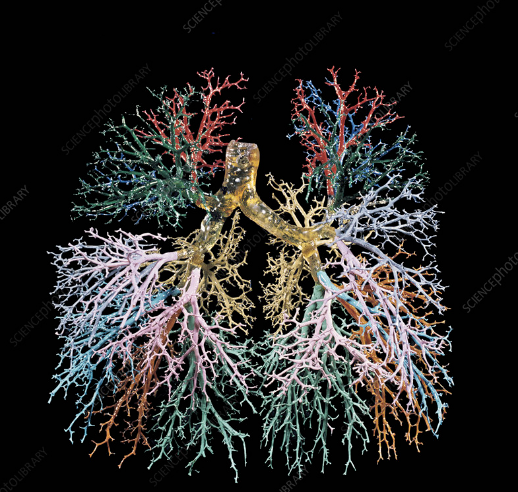
Perhaps most captivating at all: our lungs look like trees. Right there, smack dab at heart center, tree of life.

Here’s another image in resin from Science Photo online
And here’s an artistic representation by Catherine Lucy:

It’s cool, right? The breath of life, the sustaining force of mortality, nurtured by this perennially maternal image heralded in many cultures as the feminine divine. Tree of life. Give us this day our daily breath.
I had a professor during my Mdiv degree who would gather us at the end of class and lead us through a few rounds of breath. Then she would release the class with the words, “may the breath be our blessing.” Attention to breath forms the fundamental core of many spiritual practices and even traditions, and in contrast I usually take for granted the roughly 22,000 times I breathe in and out a day. Our breath, be it ragged, steady, forced, shallow, deep, clear, constructed, or laden, is our constant accompaniment.
When Alma talked to the poor Zoramites, he talked about humility. Then he talked about atonement. And then he talked to his own children, who were confused and hurting and wounded beneath the layers of moral uprightness. The threads of these theological discourses are connected and interwoven, and I am still trying to tease out their relationships. But I think his central theological message is this:
We are terribly broken. In the coming chapters, Alma will develop a robust atonement theology markedly different from his predecessors. At its core: the importance of Jesus. Alma and Amulek are, after all, talking to Zoramites in the aftermath of Korihor, the antichrist. Their missionary efforts are focused on combating theologies that misunderstand or discredit the need for an ultimate Savior.
We are terribly broken. But we do not want to see it. We laugh away our vulnerability and woundedness. We pretend we are strong and powerful and eternally good. We pretend we will not die. But sometimes, death knocks right at our door. We cannot pretend that everything is perfect and we can build our way to everlasting honor. There are no ladders to heaven at our house. Our feet are too dirty to climb the ladder next door. Our bellies are too empty to think straight, to join the philosophers rationalizing salvation. Perhaps there is no way for us to make it into the safe places with the sweet smelling bread and the assurances of salvation. Perhaps we are doomed to stay with dirty feet and empty bellies. Perhaps there is no room for us here.
We are terribly broken, and so is our neighbor. Only our neighbor is weeping at the top of the ladder, pretending his tears are for you when they are really for his own aching heart. We are terribly broken, and dirty feet and empty bellies crack the lies wide open until we stare them right in the face. This is humility, getting honest about the cracks in the foundation and in our own longing to live. We want so much to live, and to live unencumbered. We want so much to control the wind and the rain and the coming and going of wellness. And, and, and, we cannot. This is humility. Letting it go. Realizing what we are, realizing where we are. We are not the controllers of the cosmic drama. We are not faithful to a puppeteer. We are dependent, always, on that glorious tree inside of us to sift the air we breathe. To bring us to life.
Breathe in, savoring the rush of oxygen. Moment to moment, I lean on you and you on me. Moment to moment, the lure of independence is a great fabrication. We are not autonomous beings responsible for rationalizing salvation. We are not training to be free of dependency. We are training to be awake to our dependence. I eat because of the sweat and labor and life and thought of a hundred others. I cry because my heart walks outside of my body. I laugh because it is oh so beautiful. I breathe because the great tree inside of me expands and contracts, sending oxygen to my body through the limbs of her majestic body. As I breathe, I rely on my breath. As I live, I depend on sustenance for my life.
Recognizing our vulnerability, our fierce dependency, this is the seed of humility. It can grow into fear and possessiveness, and it can grow into gratitude and compassion. Alma teaches his friends that faith is the stuff of the latter. It is the plant that gives, without money and without price. It is the price of awakening, of realizing that it is not our prettiest thoughts and smartest musings and sculpted bodies and moral undertakings that earn our salvation. It is our release to the cadence of mortality, the unknown and unwritten. The breath of life.
So I hear in Amulek’s prayer, wafting like the smell of sweet bread through my open window, centuries later and still alive.
Call upon God to feel yourself pooled in the ocean of life.
Cry low for waves of mercy, find them enveloping you already.
Keep calling, feeling your neediness, seeing your helplessness.
You are not alone, little spider, little bird.
When you sit to eat, behold the miracle of convergence.
Can you see how lives came together to sustain yours?
Can you taste the story, the sweat, of that one sweetest peach?
When you lie to sleep, behold the marvel of your being.
Your hair numbered, your breath known.
See your children sleeping. Feel their precariousness catch in your throat.
All is held, moment by moment, beyond our control.
Love it anyway.
Behold your neighbor, how he torments you.
See how he is your own mirror.
Behold yourself, how she torments you.
Feel the wrinkles beside your eyes,
release your tense shoulders.
Ah, the things you carry.
Recall how your dreams have grown, changed, fled, broken, arrived.
Who comes with you, when you walk into a room?
Whose stories have sustained your life?
See the threads, invisible strings, filling the universe with wonder.
You are not alone, you are not one, you are everything.
Everything is one, unhidden, revealed, laid bare.
See how the eye of the heavens beholds you, salty with tears.
See how the whale crests the wave.
See how the mother returns for her young,
how the open heart turns to the hurting.
See how the broken ones gather to a listening ear.
See how the Mother hears, heavy with holding.
Cry it out, little one.
The God of this place is wild.
(adapted from Alma 34:17-28)
Ideas for Play
Contributed by Kristen

- Read from the Book of Mormon storybook!
- Read this article about this chapter’s relationship to other events in the story.
- Watch the Book of Mormon video for Alma 32
- Latter-day kids video about faith and seeds

- The word as a seed activity page
- Heart tree coloring page
- Read Alma 34:17-28 and discuss Amulek’s prayer. Treat it as poetry. How does it feel to taste these words in your mouth? To hear them? What do you think Amulek felt?
- Discuss faith. What do you think faith is? What does it mean to feel faith? To act in faith? Are those two different things?
- Tell some stories of faith, either feeling or acting or both. How do we act in faith in different areas of our life? (trusting people? Waiting for a sunrise? Getting an education?)

- Read some books about faith and interdependence:
Artwork
Compiled by Caroline


Poetry
Compiled by Caroline
“Why struggle to open a door between us when the whole wall is an illusion?” ― Rumi
Music
Compiled by Caroline
If You Listen, Elizabeth Mitchell

 milk & honey mamas
Leave a comment