

Theological Background by Kristen
When I read these chapters looking for what I wanted to write about, I kept thinking about how important the stakes felt. I have read the Book of Mormon a lot of times. I know what’s coming next. I know that these chapters are the “before.” It’s the “always darkest before the dawn” moment, the last battle before Gandalf crests the hill on shadowfax bringing the new day. In a narrative sense, the pre-dawn moments have to be stark (and dark and macabre and all the time-setting adjectives). The drama highlights the apocalyptic reveal of the Savior, the redemption, the climax. The Jesus moment is sort of the dénouement, the “unknotting” in the arc of the narrative. But something about reading these chapters in anticipation of dénouement actually left me with knots in my stomach.
Is Nephi, flowering, blooming, morning glory Nephi a “before”? Is Samuel the Lamanite preparatory? Abish? Queen Lamoni? Nephi, bold and sad brother Nephi whose family feud opens this book? Alma, touched by the dreams of his father?
Perhaps yes. And. After Jesus comes, there’s a hiccup of peace. Then there is war. Brutal, unspeakable, merciless war. An entire civilization is annihilated. The book ends with only anticipatory hope, the dream of a someday redemption.
Before Jesus, there is hope and tension and trouble. There are signs and hope for signs and dreams of a coming. There is a whole world of troubles brewing beyond the threshold of belief and unbelief. Gadianton robbers build an empire in caves and thickets, constructing their own story and believing it. And then after Jesus? Hope and tension and trouble. A whole world of troubles brewing beyond the threshold of belief or unbelief. There is not a single story in the Book of Mormon, or a single tagline. The human story is more complicated than a single dichotomy.
So I look to the in between. The space in the middle of before and after. Each character in this complex, beautiful, achingly messy book has their own before and after and in between. Each one has their own dénouement. Jesus happens on the scale of the book and Jesus happens within each character, most of whose names and stories and eyes we can only imagine.
Before Jesus comes, Jesus means the world to a boy who spent his life denying him. Before Jesus comes, he shines in the dreams of a teenager far from home. Before Jesus comes, he speaks peace to missionaries and breathes life to queens and comforts grieving mothers. After Jesus comes, he weeps in a cave with Mormon, surveying the loss of a people. After Jesus comes, he radiates from the quill of this editor who longs for the story’s resolution, who longs for it to be clean and simple and explainable. After Jesus comes, he appears to a boy in the woods who wants to string the world together and to his mother who already knows the feel of Jesus’ touch.
Jesus’ coming in the Book of Mormon fulfills the dreams and longings of writers centuries back. It confirms the belief of the prophets building on each other toward a unified vision. It means the world to a generation who will be permanently changed by his visit and to the millions who take comfort in a god of the whole earth. And Jesus’ coming is not the whole story, nor can it dictate the cadence of the whole story. Jesus is alive on every page of this book. He is the dream of Nephi lost in the wilderness, of Lehi desperate for a rod to cling to, of Jared’s empathetic prayer and Abish’s power to raise her queen from death. Jesus animates Samuel’s prophecies and burns in the fires of Nephi’s prison. Jesus hovers over the waters of the Jaredite barges and Jesus is wounded with the young not-Lamanites who take their parents’ debt on themselves.
Jesus is in between. Jesus is before and after and all around. The dénouement is ongoing, perpetual, eternal. God may be the great untyer of knots.

Ideas for Play
Contributed by Kristen

- Read from the Book of Mormon storybook

- Watch the Book of Mormon video on the signs coming

- Watch the nativity video
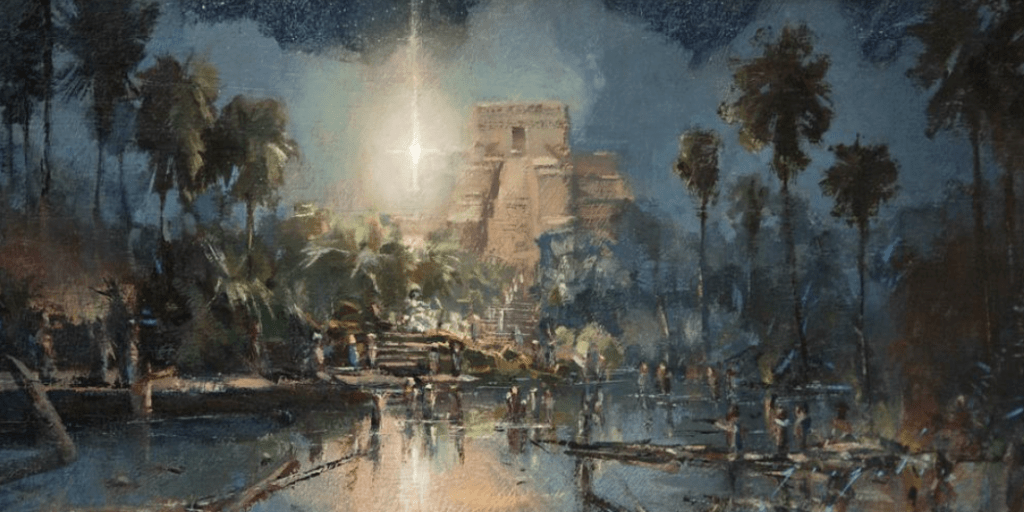
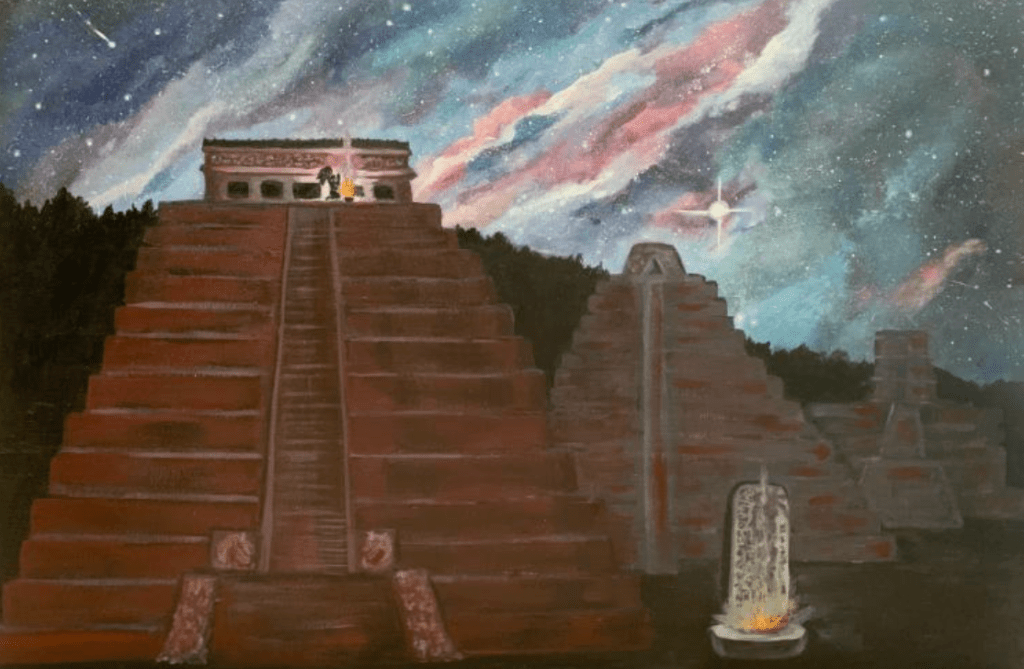
- Act the story out! How do you think it felt to see the signs of Christ’s birth? Read from the Book of Mormon as you act the story out

- Make a room really dark like it’s night. Maybe pretend to be sleeping. Then light the room up (flashlight or lantern) with the star and imagine it’s light all through bedtime and nighttime and the day for three days and nights!
Artwork
Compiled by Caroline
Poetry
Compiled by Caroline
by Christian Rossetti
BEHOLD, the Bridegroom cometh: go ye out
With lighted lamps and garlands round about
To meet Him in a rapture with a shout.
It may be at the midnight, black as pitch,
Earth shall cast up her poor, cast up her rich.
It may be at the crowing of the cock
Earth shall upheave her depth, uproot her rock.
For lo, the Bridegroom fetcheth home the Bride:
His Hands are Hands she knows, she knows His Side.
Like pure Rebekah at the appointed place,
Veiled, she unveils her face to meet His Face.
Like great Queen Esther in her triumphing,
She triumphs in the Presence of her King.
His Eyes are as a Dove’s, and she’s Dove-eyed;
He knows His lovely mirror, sister, Bride.
He speaks with Dove-voice of exceeding love,
And she with love-voice of an answering Dove.
Behold, the Bridegroom cometh: go we out
With lamps ablaze and garlands round about
To meet Him in a rapture with a shout.
Music
Compiled by Caroline
Lord, Answer Again. Liturgical Folk.
When He Arrives, Liturgical Folk
Come Light Our Hearts, Rain For Roots
 milk & honey mamas
Leave a comment