
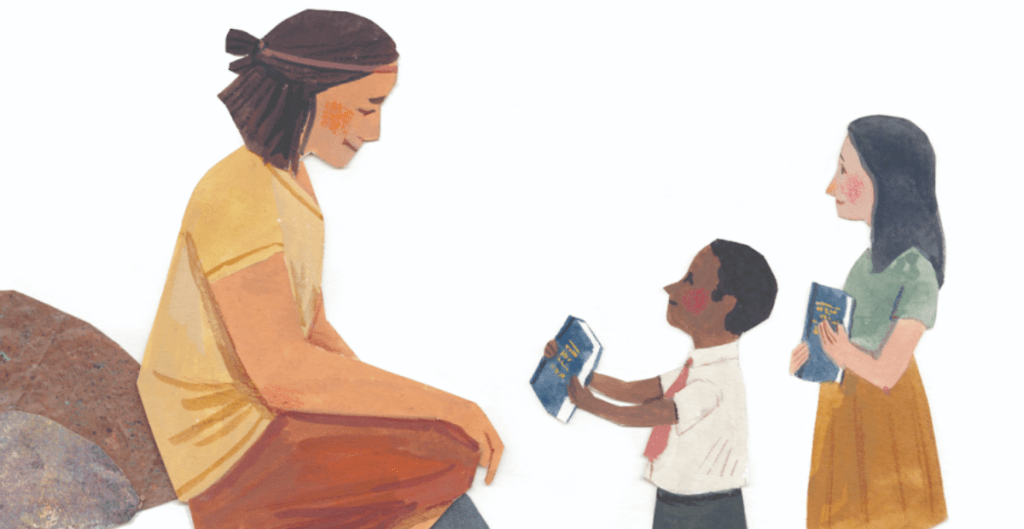
Contributed by Kristen
And Moroni’s hope is audacious. There at the end, after the final battle, after the scent of blood and rot so thick the land repels it, after the haunted children and human offerings, after the war crimes lands the world over will repeat and repeat and repeat, there is stillness. There at the end, only the vultures circling overhead accompany the scene. It is over, this great clash between people, this war upon war. It is over, this fight between brothers, and no one has won. Victory has no register to the animals who walk over the bones, the trees whose mycelium swallow the flesh, the rivers running red.
There is evil here, as there always is and war. And there are people, too. People who once looked to the heavens to meet their God, creating societies in the image of mercy. In the evil there are people who were once brothers. There is good, there is brokenness, there is despair. And now, there is only memory. And at the end, a boy looks up from a book. The story hurts him physically, like a blow to the chest. It is his own story, and the lifeless bodies he mourns before him are the bodies of his people.
But in the pages, and between them, above them, within them, he dreams a dream. There is a face he knows in the dream, kind and soft and quiet. And a voice, as soft as a mother calling. I have always been here, my child, on every page of the book. I know every story. I know you. The voice says other words, on the breath of the wind, and Moroni catches them like he is holding stars in the sky. And between wake and sleep he sees what the prophecies of women and men the world over have always seen: the world, continuing on. After the calamity, the sun would rise. Tomorrow, a new moon. Winter would come, blanketing this place with snow. Spring would thaw. Soon, no physical trace would remain on the earth. The birds would sing here again, the animals return. The trees would keep the story curled within, passed only to the squirrels skittering on their skin. And one day, there would be people again. The descendents of these who now lay dead know nothing of this battle now scattered on land and water far away. One day, their ancestors would call them home. Is the blood still good?
In the end, Moroni puts his faith in the brothers. The family will not be broken forever. Moroni does not know the brokenness that the land and its people will know on the day his book is lifted from the womb of the earth. But he believes in the brotherhood. He believes that the bond of brothers is stronger than the stain of death, of despair, of evil. Jesus carries the bonds, he believes, wearing the scars between us like flesh scarring over a wound.
At the end of the world, Moroni sees the circle of life. Birth follows death, and death birth. Children would come, and fox kits. Salmon would run upstream again, even with no one to greet them, and bears cubs would emerge from their caves in the spring. At the end of the world, Jesus. Life after death, and death after life. At the end of the world, hope. Not for a new world, but a better one. A world where brothers take hands and greet each other by name. A world where wrongs are made right and the past haunts not with agony but with knowledge. A world where the children of every species are safe from harm. A world of life, and death, and life and death again.
He calls to the dust: carry my words, the words of my body which tomorrow will swirl in the wind as you. Carry my words over the mountains and across the sea, over centuries and dynasties and evils again and again. From dust we came, to dust we will return. In every breath of the wind, the voice of the ancestors, calling to the world, settling into the sediments, swirling in every memory.
The dust obeys, mercy upon mercy, and holds the words of the boy for winters and springs a thousand years over. And from the dust, we hear them. To the dust, we return them, singing back and forth with those who have come before and those who will follow. Again and again, these elements constituting and reconstituting our beings, we hope for a better world. Our bodies our prayers, we turn to our work. The whole earth will smell of new seeds and rain on the dust. They will be with us, the soil holding every story, and we will prepare a table with no limits. We will gather then, brother and sister and kin every one, and every creature will sit down together upon the dust that is our being, and we will give thanks that we are part of the circle of living. And the day will pass, and a new day will shine, and on and on and on. Amen.
And now, I would commend you to seek this Jesus of whom the prophets and apostles have written, that the grace of God the Father, and also the Lord Jesus Christ, and the Holy Ghost, which beareth record of them, may be and abide in you forever. Amen. Ether 12:41
Ideas for Play
Contributed by Kristen

- Read the Book of Mormon storybook!
- Read the final testimony of Moroni from the Book of Mormon and discuss as a family.
- What do you think gave Moroni hope?
- Talk about sad stories. What do we do with sad stories? How do we bear witness to tragedy?
- Watch this interpretation of Moroni’s final testimony (Book of Mormon video)
- Tell the story of Joseph Smith receiving the plates
- Act these stories out!
- Find your favorite verse from Moroni’s final testimony. Why do you like it? Draw and illustrate the words and hang up in your home.
- Talk about how the world continues on after tragedy. What does the circle of life mean to you? What does the dust mean to you?
- Watch this performance of the circle of life and discuss
- What does Moroni teach about Jesus? What do you believe about Jesus? How does Jesus help you make sense of tragedy?

- Read this book, Known, adapted from Psalm 139
Poetry
Compiled by Caroline
Late Ripeness Czeslaw Milosz (1911–2004)
Not soon, as late as the approach of my ninetieth year
I felt a door opening in me and I entered
the clarity of early morning.
One after another my former lives were departing,
like ships, together with their sorrow.
And the countries, cities, gardens, the bays of seas
assigned to my brush came closer,
ready now to be described better than they were before.
I was not separated from people, grief and pity joined us.
We forget ‒ I kept saying ‒ that we are children of the King.
From where we come there is no division
into Yes and No, into is, was and will be.
Moments from yesterday and from centuries ago ‒
a sword blow, the painting of eyelashes before a mirror
of polished metal, a lethal musket shot, a caravel
staving its hull against a reef ‒ they dwell in us,
waiting for a fulfilment.
I knew, always, that I would be a worker in the vineyard,
as are all men and women living at the same time,
whether they are aware of it or not.
Music
Compiled by Caroline
 milk & honey mamas
Leave a comment