
Theological Background Contributed by Kristen
I’m thinking about truth (what a word, what an idea). I’m thinking about claiming something is “true,” and what that means. More true than another claim? Categorically true? Reductively true? Contextually true? True in all aspects, with no caveats? Logically true? Effectively? Phenomenologically? Conditionally? I even looked up common metaphors for truth, finding a few of them pattering around in my head:
- Truth is a beacon
- Truth is a mirror
- Truth is a puzzle piece
- Truth is a key
- Truth is a foundation
- Truth is a compass
- Truth is a sword
- Truth is a seed
- Truth is a shield
- Truth is a river
- Truth is a recipe
- Truth is a roadmap
- Truth is a scale
- Truth is a story
- Truth is a voice
Truth claims and religion find themselves mixed up quite without boundary. It has become important for religious people to speak about what is “true,” often in opposition to alternate views. The truth sets us free, the saying goes, suggesting in a decidedly Platonic sense that truth is “out there” in a perfected form, and that locating it will set us in right orbit.
The issue for me is not whether ultimate truth exists in some objective form, but how we earthlings gate-keep its existence; I suspect that we are more prone to inhabit the role of truth’s jailor than of its grateful recipient. My musings unsurprisingly rumble around this year’s sacred text, nicknamed “the doctrine and covenants.” What is doctrine, what are covenants? What are these texts, who were these people, what did they work for, and how do I bring my children to these stories?
I have wrestled with these questions as a theologian, a person of faith, and a mother. I am an ethnic Mormon, my Mormon ancestors trailing back to the days of Joseph himself. The stories of Kirtland and Nauvoo and Utah are in my blood and bones, sewn into my tissues in ways I could never begin to untangle. The stories matter, I will always say, the stories of people working out their way with God matter. The stories help us understand ourselves, our fears and our ghosts, our ways of engaging God and our ways of engaging each other. The stories are part of our cultural landscape, part of our doctrine, part of the body of our church. I want to know the stories of the people who saw the heavens opening. I want to know about the people whose hearts and bodies broke for it, who believed in their own witness, who sacrificed everything for their conviction. I believe it is important to honor stories of devotion wherever we find them, and that is how I will be engaging the sections of D&C this year: as stories of devotion.
You might read these sections as the voice of God to all people, and I know I can learn from you – I don’t want to take away from that. But we will be reading them as individual people’s experiences with the divine, filtered through their own context and culture.
Not long before Joseph Smith’s vision, Charles Finney had an experience praying to God and witnessing Christ calling him to the work of religious revival. About a century earlier, women like Sarah Osborn and Jarena Lee forged pioneering paths in the landscape of the first great awakening in America, proclaiming their experiences of personal revelation and God’s call. Before any of them, during what is sometimes referred to as the “dark ages,” women like Julian of Norwich, Marguerite Porete, Mechthild of Magdeburg, and Hildegard of Bingen recorded their experiences with the divine in words of love, intimacy, and tenderness.
The message of the Latter-day Saint movement for me is not that God moves in a straight line from man to man through an unbroken chain of authority, waiting for appropriate recipients, but that God moves. When I look around at the landscape of the restoration, I see fire after fire on hilltops of prayer, pilgrims seeking solace for broken hearts. The further I travel, the more fires I see. God is proliferate, prodigious, pollinating. Where a seeker drops a tear of sorrow or heartache, a sprout of life begins. For a question, an earful universe. The earth herself is abuzz with the fire of pollinating love, abounding over and over with reckless abandon.
The mystical experience of Joseph Smith was a pollinating one. From the seeds of his and his collaborator’s efforts we walk through forests today. But as the wise Charles Inoueye once advised me, there are as many ways to be Mormon as there are members of the church. So as we study the D&C this year, I am calling on you. I am calling on friends and fellow strugglers to share how you interpret the principles of this gospel we call home. I hope we will find that we disagree. I hope we will be surprised by how others connect themselves to our shared fabric. I hope we will knit expansiveness as well as safety.
Here on this blog, you will continue to find stories, background (with help from historian friends), art, poetry, and music. You will also find guest posts about various topics covered throughout the doctrine and covenants that continue to define Mormonism. We will share resources for study and our ideas for working with little ones, ushering them into our shared fabric and asking them to pick up their own threads.
Truth is a beacon. Truth is a mirror. Truth is a puzzle piece. Truth is a key. Truth is a foundation. Truth is a compass. Truth is a sword. Truth is a seed. Truth is a shield. Truth is a river. Truth is a recipe. Truth is a roadmap. Truth is a scale. Truth is a story. Truth is a voice. Falling from the sky, growing from the earth, stretching and binding and connecting the starry mycelium beneath our feet, proliferate, prodigious, pollinating truth.
“There are a thousand thousand reasons to live this life, every one of them sufficient.” – Marilynn Robinson
Joseph Smith story (for kids)
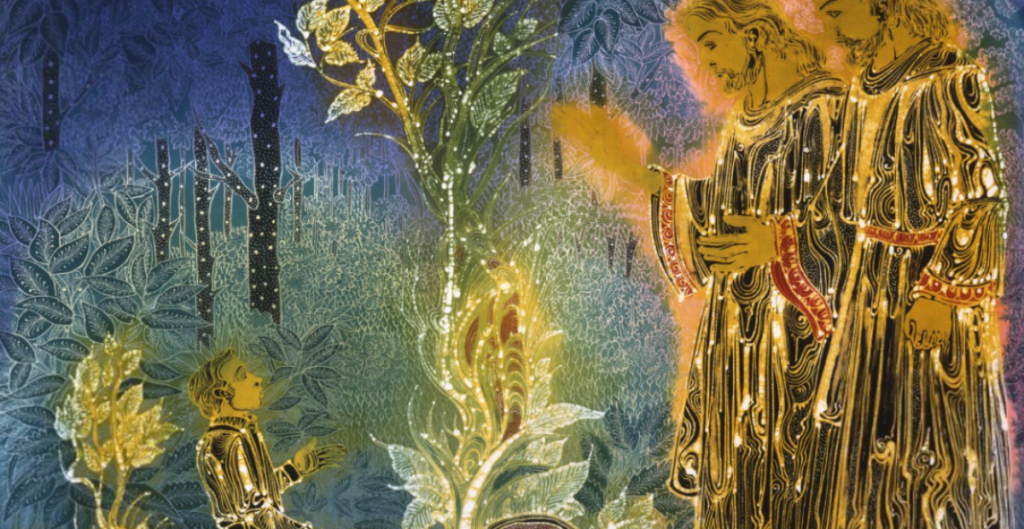
Once there was a child. Many stories start like this, don’t they? I think it is because children have their ears half full of mystery already, so they are always ready for a story to begin. Once there was a child who had questions about God. He was surrounded by many excited voices, saying many different things. And this child was confused. He wondered how to know which voices to listen to. He wondered how to live a good life. And in the heart of his heart, he wondered if he mattered.
Have you ever wondered like this child? Have you ever looked into the sky full of stars and felt very small, and very alone?
One day, this child was reading a book. Books are very special, as you know, because they are like wings you can try on anytime you like. Step into a book’s pages and suddenly you are flying into a new world of ideas. That was exactly what happened when this child read his family’s favorite book. He read the same way you might drink water when you’re thirsty—he read like it was giving him life. He read a sentence that made him stop and stare and read again, and again, and again: “if anyone lacks wisdom, let them ask of God.” That’s me, the child thought, I am lacking wisdom. I am confused and troubled. Would God listen to someone as little as me?
This child did not yet know something that you and I know about God. We know that God loves to listen to little voices. God loves the sound of sparrows, and orangutans, and crocodiles. God loves the music of waterfalls and oceans, the swaying symphony of forests and the jazz ensemble of rainstorms. God loves human voices, too, in their many languages and dialects. God loves the language of those who speak with their hands, and the language of those who don’t speak at all. And you and I also know that God does not hide from creation. God pops out in the funniest, strangest ways, usually when we least expect it. God dances on mountaintops with sheep and goats and sings with the voices of crickets and angels and speaks to frightened, lonely girls and boys in every corner of the world at any time you could imagine. We know that, but the child in this story didn’t.
So he had to be brave. He went to the holiest place he could think of. Where would you go, if you wanted to be alone with God? I think I would go somewhere very quiet, and still, and peaceful. Can you picture it? For the child in this story, the holiest place he could think of was a forest. It was as quiet as any forest on a spring morning. The boy heard the voices of birds and bugs and trees and earth, and he smiled because he knew their voices well. He found a peaceful place, knelt down, and began to pray.
He wasn’t exactly sure how to begin, because talking to someone you can’t see feels a little awkward. But he remembered the words of the book and he tried. At first it was hard. It felt as though the whole forest turned away from him, making his words rough and ugly against the familiar noises of the creatures around him. He wanted to give up, but the song of the birds calmed his fear. He closed his eyes, and spoke his prayer.
God, are you there? It’s me, Joseph. I am little and unimportant. But I believe you are grand and wonderful. And I need help. I need to know who I am. I need to know how to find what is true. I need to know if I matter.
Later, when he remembered what happened, he would stop in the middle of his sentences. He would tell the same story a hundred different ways. He could never quite get it down in words, but to the end of his life he remembered what it felt like. It was as though he were bathed in a pool of glistening light. The whole forest seemed to glow and sparkle. And through the light, he heard a voice. He saw faces. He heard his name.
God talked to Joseph. God told Joseph he mattered, and that truth was as vast as an ocean and as small as a child. God talks to little ones.
Joseph grew up and tried to follow the words of God. He did many good things. He also made many mistakes. He was a person, just like us. But remember this, my little one, from his story: God does not hide. There are a thousand forests and mountains and rivers that burn with the holiness of God. Some we know, some are lost to history. But God does not turn from her creation. God runs to us, swooping and sighing and rushing like the wind to our side. When you feel loved, held, and connected, you will know God is there, because that is God’s language. When you feel afraid, condemned, and alone, let go. That is not God’s language.
Joseph’s story met the path of many stories, and began the paths of other stories. That is the way of God. God is like a waterfall running to the sea. Some of the stories are full of sadness and suffering. Some are full of hope and delight. Most are a mixture of both. That is the way of life. Listen, my love, to these stories. They are your stories, too, because every inch of life in this unending universe is connected. God is as vast as an ocean and as small as a child. God is aflame, holding a torch in the night as we cry out in fear. We will feel the warmth of the flame as we study God’s work in the lives of those who have come before. But we must always remember that God is big, bigger than a single story. Big enough to hold the world close to her heart, softly, tenderly, singing us home.
Artwork
Compiled by Caroline
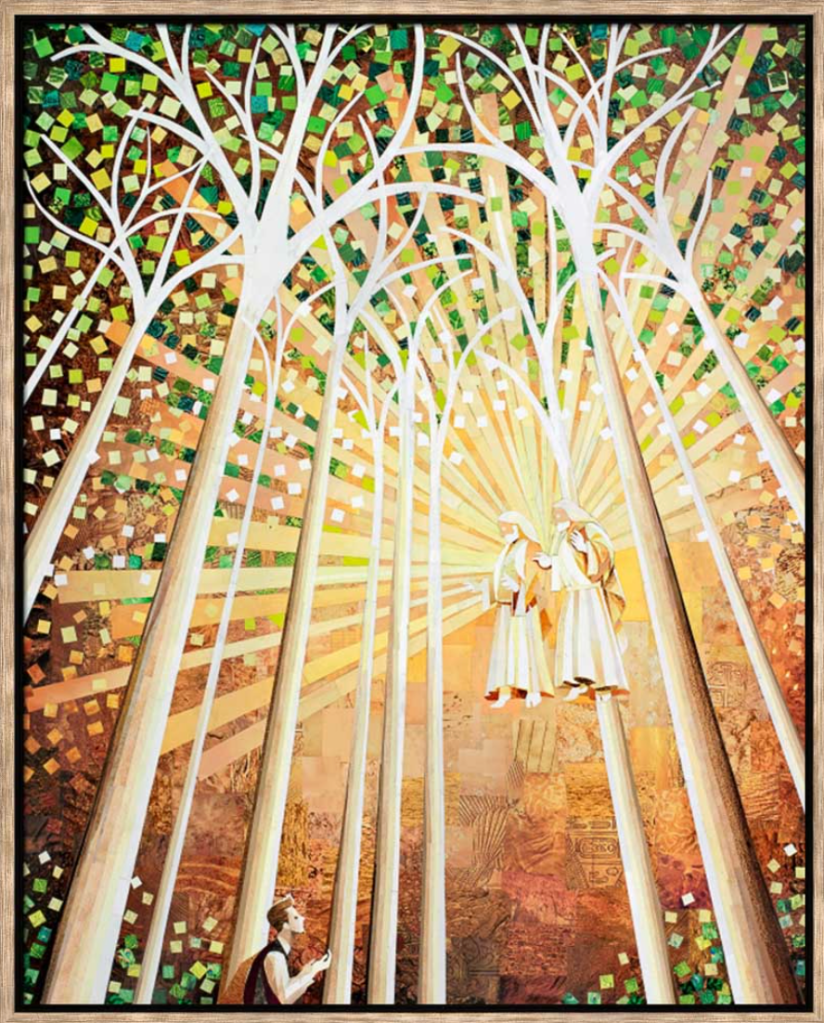
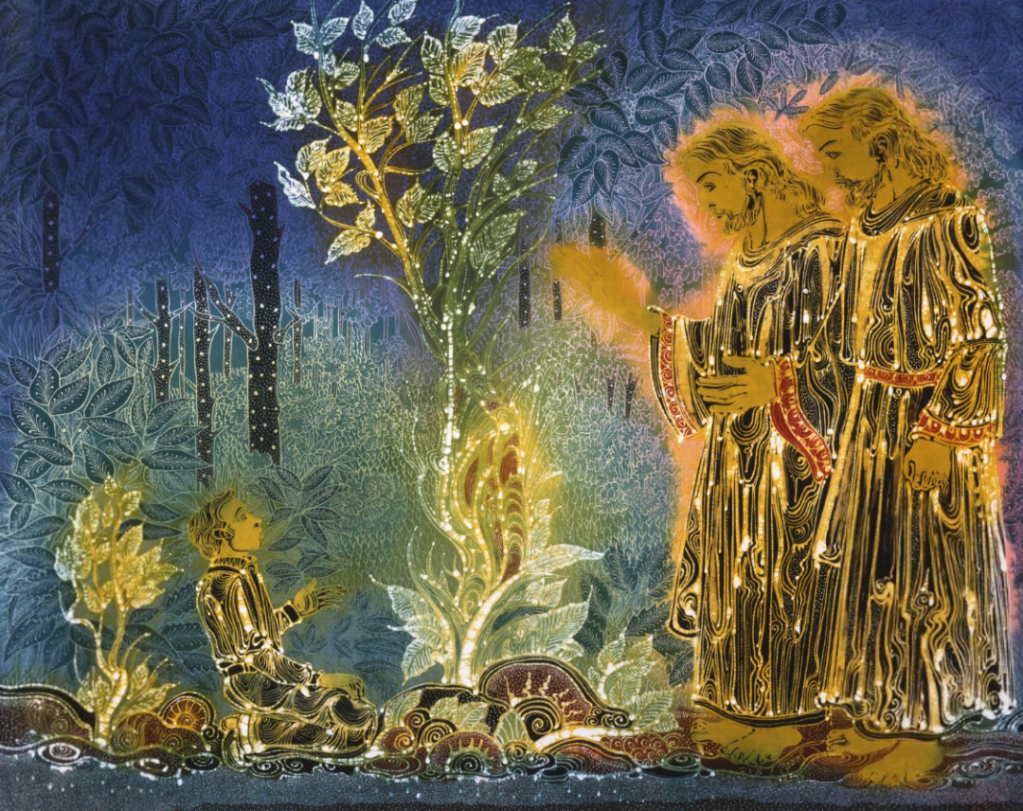
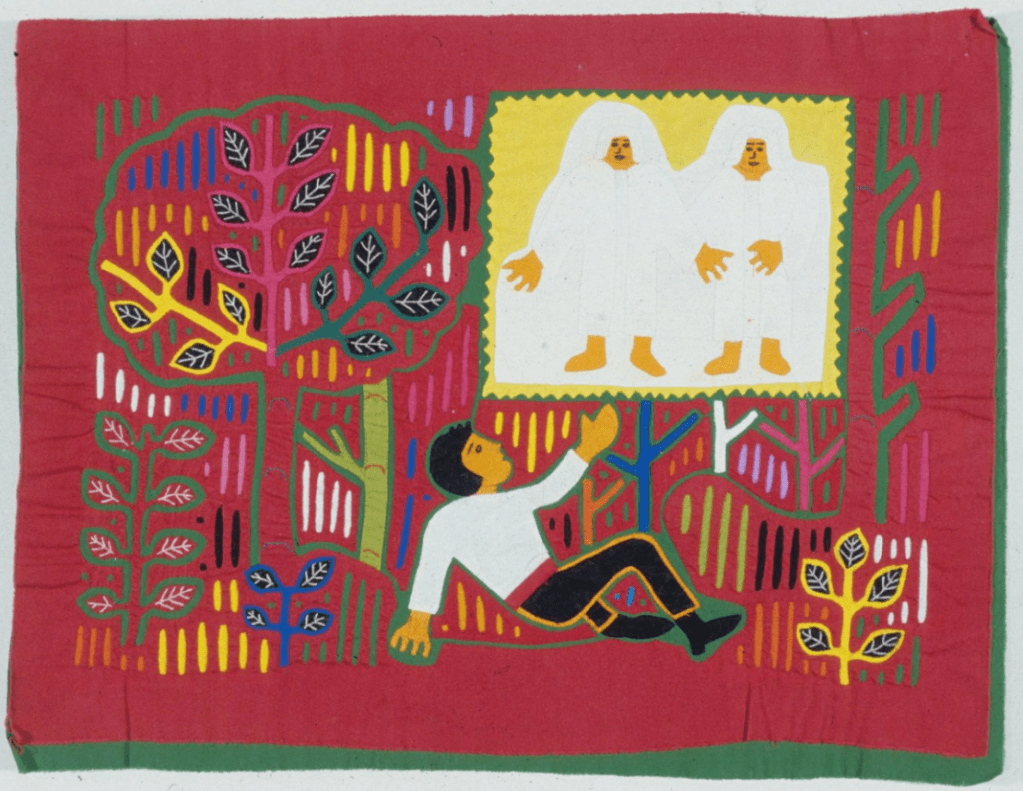
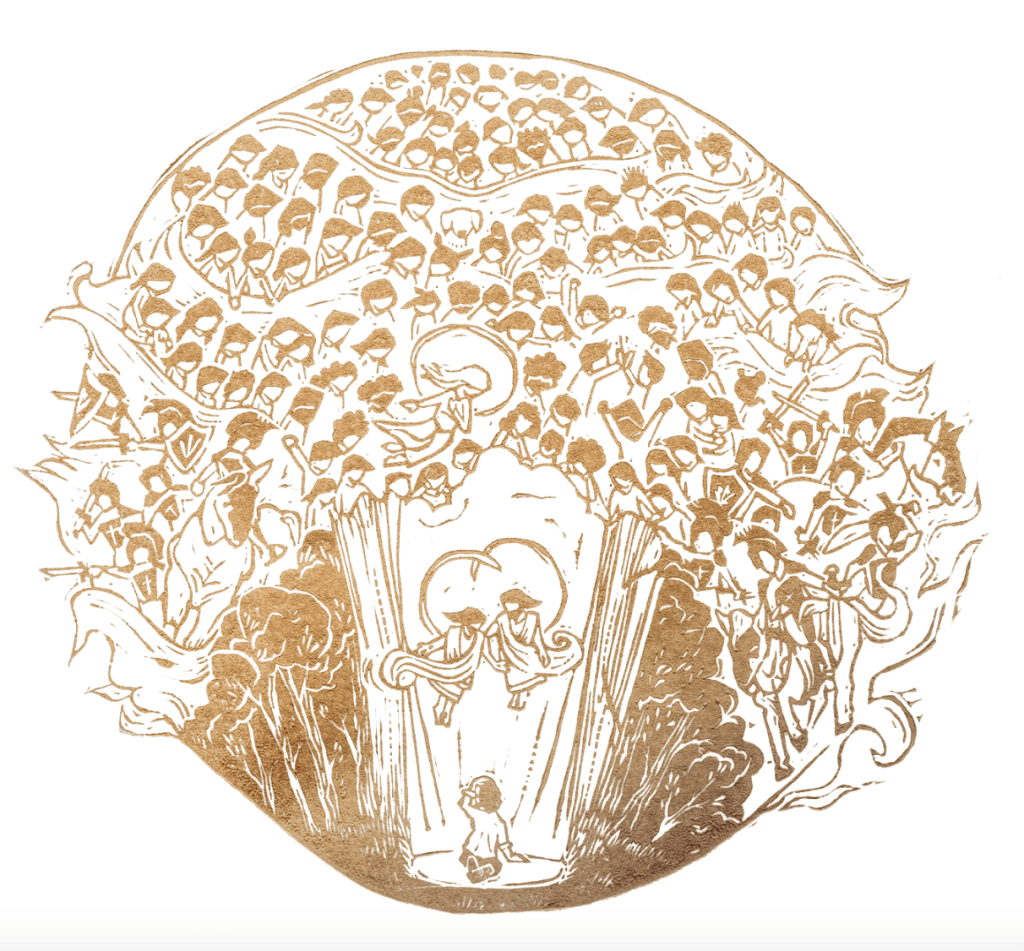
Artistic Resource for The First Vision: https://www.ldsliving.com/capturing-the-vision-joseph-smiths-first-prayer-through-the-eyes-of-those-who-have-portrayed-it/s/92458
Music
Compiled by Caroline
 milk & honey mamas
Leave a comment