

Contributed by Kristen
I want to focus this week’s post on the first five verses of D&C 45:
1 Hearken, O ye people of my church, to whom the kingdom has been given; hearken ye and give ear to him who laid the foundation of the earth, who made the heavens and all the hosts thereof, and by whom all things were made which live, and move, and have a being.
2 And again I say, hearken unto my voice, lest death shall overtake you; in an hour when ye think not the summer shall be past, and the harvest ended, and your souls not saved.
3 Listen to him who is the advocate with the Father, who is pleading your cause before him—
4 Saying: Father, behold the sufferings and death of him who did no sin, in whom thou wast well pleased; behold the blood of thy Son which was shed, the blood of him whom thou gavest that thyself might be glorified;
5 Wherefore, Father, spare these my brethren that believe on my name, that they may come unto me and have everlasting life.
This vision of Christ’s salvific mission, with the specific language of Christ as advocate, is not strongly developed in the New Testament; Christ as advocate is only referred to as advocate once in the New Testament (from the Greek parakletos which roughly means ‘helper’). However, the general theological idea fits well within what we call propitiation or expiation. This view of atonement emphasizes Christ’s role appeasing the wrath or justice of God; such a view was commonly taught in revivalist theologies like Jonathan Edward’s famous “Sinners in the hands of an angry God” and has a long history of exposition in many Christian theologies.
Latter-day Saint scholars like John Tanner expound on D&C 45 and its associated theological insights, suggesting that the designation of a wrathful God and compassionate Christ is too extreme a binary: “I believe that as our advocate with the Father, Christ is not so much placating a wrathful God as He is claiming His rights under the covenant—the new covenant—to redeem those who repent. This covenant and these rights are predicated on the blood of one who “did no sin.” Through the Atonement, Jesus earned a place at “the right hand of God,” as Mormon says, “to claim of the Father his rights of mercy . . . ; wherefore he advocateth the cause of the children of men” (Moroni 7:27–28). Likewise, as Jesus tells the Prophet Joseph Smith, “I am Christ, and . . . by the virtue of the blood which I have spilt, have I pleaded before the Father for them” (D&C 38:4). As advocate, Jesus claims His rights of mercy with the Father, which He earned by virtue of the blood He spilt for us.”
Interestingly, though, the advocate image is not the only image presented of Christ’s atoning work and role. While the D&C contain interesting passages relating specifically to Jesus’ suffering and death as salvific (in line with a propitiation account), the Book of Mormon texts suggest redemption less through suffering and more through solidarity or power-with (see 3 Nephi 11-17, for example). And, given the many different atonement models existent in the broader Christian theological tradition which Latter-day Saints inherit and interpret, it is unclear based on the text exactly which model fits the texts, or whether there is one overarching one (Deidre Nicole Green has recently explored this exact issue here!)
Part of the issue is that atonement theologies intersect numerous other theological assumptions, including the nature of humanity, sin, and redemption. In other words, we are not always clear exactly what the problem is! Are we fallen (original sin) and thus incapable of good without the grace of Christ? Are we simply prone to sin because of our human nature and therefore indebted to Christ’s atoning work? Or is sin a misunderstood paradigm entirely, something more about our own broken and woundedness?
The image of Christ as an advocate with the father presents as many questions as it suggests answers. What is the problem requiring advocacy? Why is a sacrifice necessary (this is a question about theism and the meaning of omnipotence)? What is the nature of creation and its relation to divinity? Is there an unbridgeable chasm between creator and creation? Each question has a hundred more associated questions, all of which I pose to suggest that the statement ‘advocate’ is not the end of the puzzle. It is a formulation which we hasten to explain, drawing on various normative resources, but our very explanations reveal our assumptions and prior convictions (what Gadamer calls our foreknowledge).
Perhaps the image is lifegiving for you, perhaps it is not. Either way, I wonder if the work is not to force our hearts to accept an image deemed authoritative, but question how images can function to help or hinder our understanding of God’s redeeming love.
For kids:
Contributed by Kristen
Did you know that there are lots of different names for Jesus? Different names for Jesus describe different things that Jesus does. See if you can guess some of them.
Healer
Teacher
Shepherd
Savior
Mother
Friend
Which one is your favorite? Do any of them bring a picture to your mind?
I want to tell you about another name that describes something Jesus does: bridge-builder. Jesus is a bridge-builder. When we need to get over rushing waters, Jesus helps us. When we need to cross from where we are to where we want to be, Jesus helps us. When we feel stuck and alone and lost, Jesus will brainstorm plans with us. Sometimes it feels like the path between where we are and where God is has so many miles left to go. But this is Jesus’ favorite bridge. He says, “there’s no space between you and God. God is already here.”
And sometimes it feels like there is infinite space between how broken and sad we feel and what we imagine it might feel to be whole. This is when Jesus just sits down with us and says “tell me all about it.”
Bridges can be spun of silk like a spider web. They can be soft as moss and firm as steel. They can traverse even the deepest pain and even the biggest mistake. Bridges can lead to forgiveness, and hope, and new life, and “I’m sorry.” Bridges can lead to tomorrow, and yesterday, and all the way back to our first mother Eve. But above all, bridges bring us home.
Ideas for Play
Contributed by Kristen

- Read The Book of Mistakes

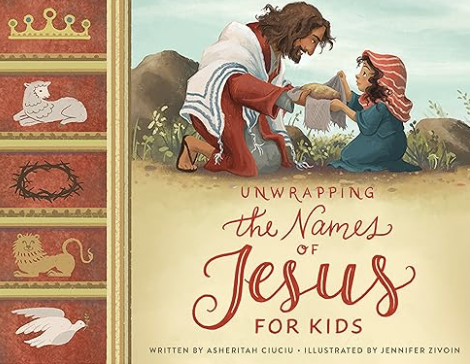
- Read Names of Jesus
- Read books about bridges:
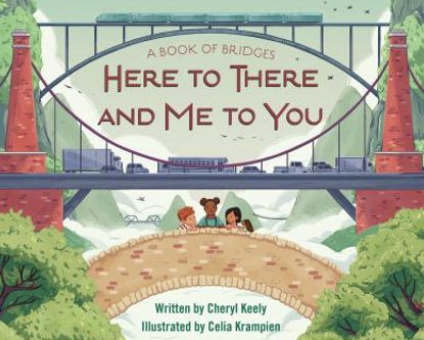
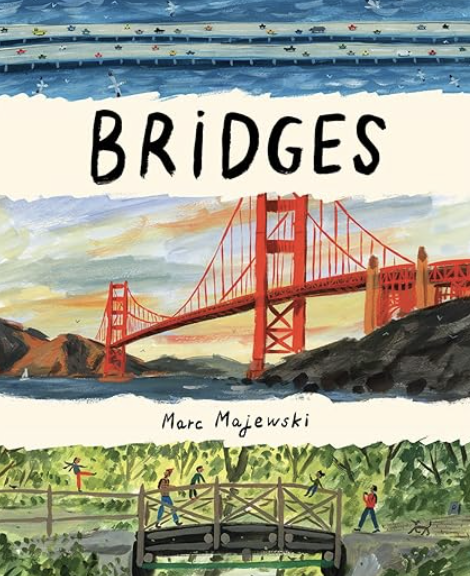
- Write down names of Jesus and draw pictures
- Watch this video of different names of Jesus What does atonement mean to you?
- Talk about one of the names Joseph Smith gave to Jesus: advocate. What does this mean to you? Where does it take your imagination?
Poetry
Sanctuary
by Ada Limón
Suppose it’s easy to slip
into another’s green skin,
bury yourself in leaves
and wait for a breaking,
a breaking open, a breaking
out. I have, before, been
tricked into believing
I could be both an I
and the world. The great eye
of the world is both gaze
and gloss. To be swallowed
by being seen. A dream.
To be made whole
by being not a witness,
but witnessed.
Art

 milk & honey mamas
Leave a comment