

Contributed by Kristen

Mystical theology is the specific branch of theology focused on encountering the divine. Mystics in many religious traditions describe the paths to the gods, usually through extra-bodily experience. In the Christian tradition, mysticism has a long and fascinating history with various paths of exploration. The famous third century thinker Origen of Alexandria is one of the earliest recognized mystics and uses what will become a common metaphor for divine encounter: the soul as the bride of Christ (1). This metaphor will be famously important to a growing group of female devotees in the 13th century whose writings and practices will come to be known as erotic mysticism in which divine union is realized by the soul’s longing love for Jesus. As movements such as erotic mysticism grow, so do efforts to define, categorize, and police it. Male authorities will produce scholarly treatises on approved mystical paths, grounded in scholastic theology and scorning the “bodily” and “emotional” efforts of key female devotees (2).
One of the key disputes in the mystical debates concerns the actual knowability of the divine and the path to that possible knowledge. These disputes come to be described in two camps: apophatic and cataphatic theology. Apophatic theology, also called the via negativa or the negative path, presumes that the divine cannot be described in human language. Any word we might use to describe God will always fail to describe God’s fullness; God cannot be described in concrete terms. The process of apophatic theology is asserting what God is not (God is not human). The via positiva or the positive path of cataphatic theology proposes that God can be known and described concretely. This path focuses on positive descriptions of God (God is omnipotent). These two paths also contain diverging paradigms about the practitioner’s ability to know God. The positive path is often symbolized with a ladder; knowledge can be attained in increasing increments until fullness has been reached. The negative path, on the other hand, is symbolized with mystery or descent; knowledge is not something one can own but is rather a state of being (3). Of course these simple descriptions fail to adequately capture the complex history and philosophy of these different paradigms, but they are helpful in situating the basic differences.
D&C 93 can certainly be categorized as mystical theology, concerned with divine encounter. What kind of encounter does this revelation suggest to be possible? Are Latter-day Saints proponents of cataphatic or apophatic theology? I can understand why this section would be read with the ladder metaphor, as Joseph Smith himself did. I sympathize with the LDS cataphatic position; certainty feels so reassuringly like faith. But I am not convinced.
The revelation includes the following mystical ideas:
“I [God] am the true light that lighteth every [person] that cometh into the world” (93:2)
“And he received not of the fulness at first, but continued from grace to grace, until he received a fulness” (93:13)
“And truth is knowledge of things as they are, and as they were, and as they are to come” (93:24)
Does the ladder metaphor work? First we have the idea that God, who defines Godself as light, is the animating spark of all life. Though this spark can be dimmed, it is not earned by any specific action; it is already present. Alongside this, we have the idea that fullness of light (i.e. fullness of God) is attained “grace by grace.” Finally, we have a philosophical assertion about truth, suggesting that truth is not an attainment but a disclosure—a revelation or an apocalypse (4). Truth in this view, moreover, has a spatial aspect that challenges my notions of continuity. Think, for example, of what it might mean to understand something in contemporary time, in the past, and in the unfolding future. Melissa Inouye writes beautifully about the difficulty of perspective, noting how often good people have been on the wrong side of history. Brother Brigham, for example, made devastatingly bigoted decisions which continue to affect our young church. Inouye writes, “I believe Brigham Young is still striving to follow Christ on the other side of the veil … If this is the, brother Brigham now heartily rejects hurtful things he said in the past, and bellows with rage every time a fellow Latter-day Saint tries to justify those ugly words as the eternal voice of God, not 1850s Brigham,” (5). Seeing the whole picture may require perspective we simply do not possess. And yet, drawing near to God, and God’s light, is meaningful and real work.
I am drawn to the perspective Charles Inouye (Melissa’s uncle) develops in his book zen earth zion sky. For Inouye, the connection between all things, and the living vitality of all things, brings the gods face to face. He describes meeting Astrophysicist professor Kenneth Lang who teaches him that the earth revolves not around the sun but within the sun: “The sun’s solar wind is a part of the sun. It creates a huge bubble in space called the heliosphere. The earth does revolve around the sun, but it always stays within the sun’s radiation bubble … So in this sense we’re revolving in the sun, not just around it,” (6). Inouye connects this to the spiritual life. “The gods are not way over there while we are way over here. Of course the Creator of the world exists as the things of the world! If it is true that we sometimes live at a distance from “things,” it is also true that at other times we lyrically merge with them … There is no intelligent distance between things,” (7). In other words, “The face of God is the face of everyone I meet. The gods are all around us. They are everywhere. There is nowhere that God is not,” (8). The quest for truth, for salve to wrongs and sins, for pure and pristine dogmas, is less propelling than the earthy knowing that the gods are not “out there.” That the earth revolves within the sun. That we are, perhaps, the earth, and the sun, and the gods.
A ladder is a compelling, linear metaphor for attaining knowledge and exaltation. Do the right things, progress in incremental steps, and you will eventually reach the top rung. Unfortunately, the laundry list of the “right things” never, ever ends. The ladder stretches infinitely beyond our capacity to comprehend and the climb is arduous, exhausting, demoralizing. There is always something we can do better, some knowledge we can more perfectly attain. Perhaps we eat too much meat, not landing on the appropriate level of “sparingly” to truly live the word of wisdom. Perhaps we occasionally harbor judgments of our fellow saints, or fail to regularly perform temple work, or forget family home evening. We may not read our scriptures with proper diligence, we might post political rants on Facebook, we are perhaps prone to uncharitable complaints about Sunday School. The ladder is for polished idols, not for saints.
But grace for grace, this is a mystery I can sink into. In this nebulous possibility I can release the myth of perfection and fall, body bent like a child, toward the soft slant of the earth. The trees receive me, spreading their branches like arms in the sky. The roots of the living trees span all the broken ground, softly singing the way home. It is quiet here, warm and dark. I can feel the buzz of the mycelium beneath me, busily spinning the symphony of all the world’s connections. The soil receives me, the soul receives me (9), and I am new again in the womb of creation. This is the light that brings the day (10). Baptize me, bless me, make me whole. Face to face, soul to soul, grace to grace.
1- Origen’s First Principles
2- St. John of the Cross has one of the most comprehensive treatises on scholastic mystical theology. Grace Jantzen does a feminist history critiquing the philosophical categorizations of people like William James.
3- See Wendy Farley, The Thirst of God
4- The Greek word meaning unveiling or revelation.
5- From Melissa Inouye’s Sacred Struggle, page 68.
6- Charles Inouye, zen earth zion sky, page 62
7- Ibid, page 80.
8- Ibid, page 81.
9- Inspired by “Soil” by Irène Mathieu
10- From You are Light by Aaron Becker
Poetry
Mysteries, Yes
Mary Oliver
Truly, we live with mysteries too marvelous
to be understood.
How grass can be nourishing in the
mouths of the lambs.
How rivers and stones are forever
in allegiance with gravity
while we ourselves dream of rising.
How two hands touch and the bonds will
never be broken.
How people come, from delight or the
scars of damage,
to the comfort of a poem.
Let me keep my distance, always, from those
who think they have the answers.
Let me keep company always with those who say
“Look!” and laugh in astonishment,
and bow their heads.
For littles:
“I [God] am the true light that lighteth every [person] that cometh into the world” (93:2)
“And he received not of the fulness at first, but continued from grace to grace, until he received a fulness” (93:13)
“And truth is knowledge of things as they are, and as they were, and as they are to come” (93:24)
My dear one, can I tell you a story? Once there was a rich young man. To be rich means to have everything that you need and everything that you want, and more than that besides. This rich young man had everything and wanted to show that he deserved it. He came to Jesus and he said “I am a very good lad. I follow all the rules. I never forget to brush my teeth. I always remember to say please and thank you. What can I do to be prefect?” And Jesus looked at him, and Jesus loved him. And he said, “my child, forget your riches, and follow me.” The young man was very sad, because he loved his riches. Who would he be without them? Would anyone ever love him if he was not very rich and very good?
One day, God said something to Joseph Smith. God said: “I am the light that is inside of every person that is born into the world.” Joseph Smith was surprised. “But wait, he said, if you are light, and you are already inside us before we do anything to earn your light, what can we do to be perfect?” and God remembered his friend the rich young man. And he said, “my child, it is not your job to be perfect. It is your job to let go and let love wash you from the inside out. Stop trying to earn love and open your eyes to see that love is all around you. I am all around you.”
So when we see another, we see God. The light that is God is inside all living things. We do not need to earn this light, but we can gather more and more of it. God even tells us how: “become as a little child.” That is a mystery. What do you think it means?
Ideas for Play

- Read You are Light by Aaron Becker
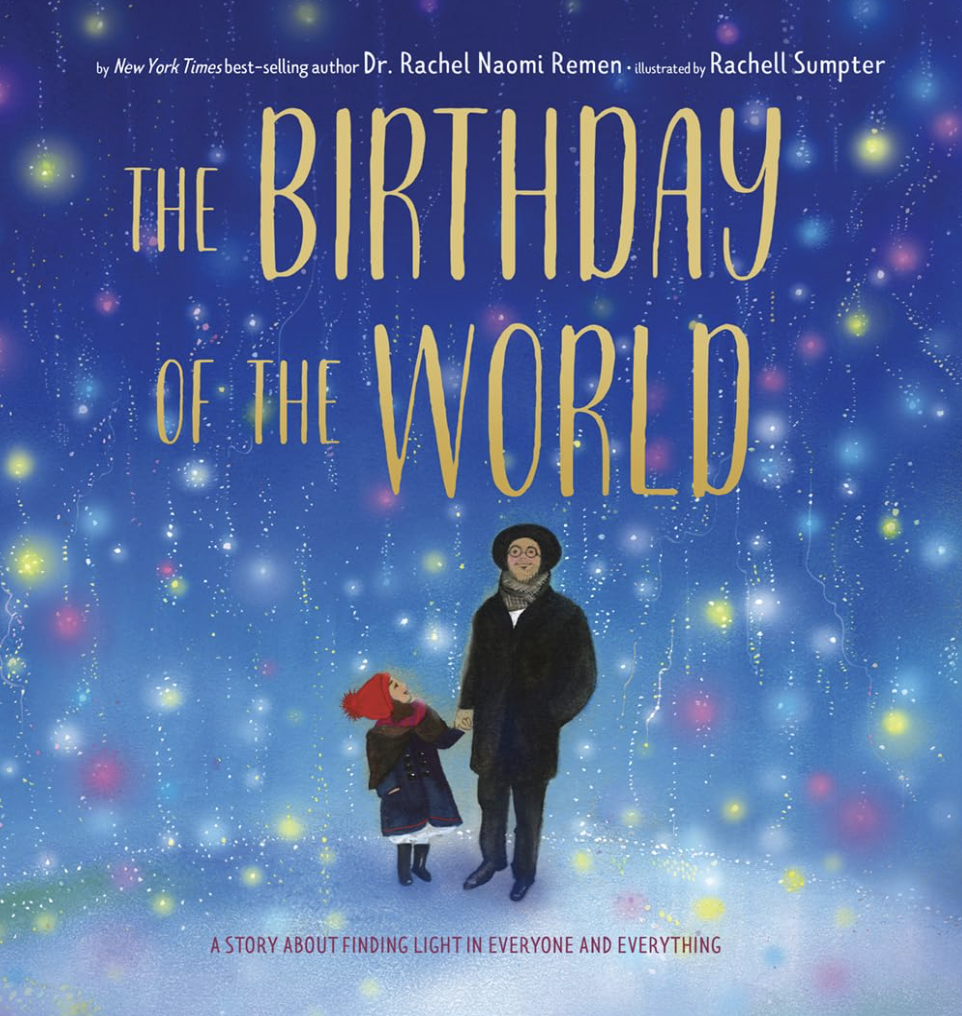
- Read The Birthday of the World by Rachel Naomi Remen

- Read Namaste is a Greeting by Suma Submaranian
- Read the selected verses together as a family and discuss.
- Draw a picture of where God is. Is God way out there, far from us? Where are our ancestors?
- How can we recognize the light in ourselves and in others? Discuss as a family. When do you feel the love of God? Where do you feel it in your body?
 milk & honey mamas
Leave a comment