
Revelation
The book of Revelation is a challenging text for many of us! Some read it as a message about the end of times ushering in the second coming of the Savior. For them, it is a sacred prophecy with signs of the last days we can look for. I do not mean to discount or belittle this reading and the faithfulness of those who ascribe to it. By contextualizing the book, I hope I leave space for a variety of interpretations.
The book of Revelation is a genre text, written in the genre of apocalypse. Apocalypse means “unveiling,” and was a commonly literary genre at the time. The book of David in the Hebrew Bible is another example of an apocalyptic text. Readers would have been familiar with the genre and with the associated symbols and literary tropes. These literary techniques would not have been lost on the readers in the way they are to us; they would have known how to read it with the “codes” of the genre.
The book is deeply anti-Roman (the evil the characters fight against is imperial Rome). Rome is coded as Babylon, and the whole vision is about the downfall of Babylon (which is Rome). The vision is extremely violent, with God exacting the violent revenge of the colonized. For more about the apocalyptic genre, see this helpful overview.
For some, the violent imagery and misogynistic portrayal of women is too much to find much redemption in this text. For others, it is a sacred prophecy of the future (or, for some, the present). How do we engage John’s imagination? What God do we find here in his envisioning?
For us, these questions are once again about storytelling. How do we tell stories of justice? How do we tell stories about violence, war, colonization, and righteous fury? Have you ever needed a God who could exact bloody revenge? And yet, for our children we feel we must tell of a God whose gentleness is bigger than revenge. A God whose vision of justice is greater, softer, and kinder than any we could concoct. We tell of a mother God who loves her children, who weeps for their pain and suffering. And we tell of a God who births new possibilities for Her little ones, delivering new life through the living world.
************************************
John, Jude
“Dear children, let us not love with words or speech but with actions and in truth.”
John 3:18
The epistle of John is, as Gail R. O’Day states, “written to introduce its readers to the story of Jesus so that through the story they can come to believe … Conflict and controversy in the epistles focus on believers who differ on the correct expressions of faith, in word and deed.” Like Peter, this epistle is mostly instructional and can be read in a variety of ways.
Jude likely has a relatively early composition date, drawing from sources that were extremely influential for the early church but not included in the canon (such as Enoch and the Assumption of Moses).
Both of these epistles were written to communities and with contexts now forgotten to history. We can only guess at the occasions for these letters, at their authors’ roles in the Jesus following communities, and at the communities’ reception. How do we receive them, centuries and realities later? I wonder if we can still hear them, listening and reading with closed eyes. I wonder if they are there, behind the words, these ghosts of the early Jesus movement. I wonder if they wish their stories, motivations, hopes, and faith could be resurrected. I wonder if they recognize our Christian communities today as communities akin to theirs. What do they make of us, our questions, our hopes, and our imaginings? I like to think we are still imagining with them, seeking the Jesus that opened our hearts to love and called us to the mountaintop.
***********************************
James, Peter
Be like-minded, be sympathetic, love one another, be compassionate and humble.Do not repay evil with evil or insult with insult. On the contrary, repay evil with blessing, because to this you were called so that you may inherit a blessing.
1 Peter 3:8
James was most likely written much later, probably toward the end of the first century. This letter lacks a coherent theme and has a number of unrelated teachings meant to instruct. Indeed, James has been used in a variety of ways because its words are applicable in “a variety of settings” as scholar Gay Byron writes. Its construction of the importance of works (over grace) as the means of faith and salvation meant that it was derided as an “epistle of straw” during the reformation.
Rejected by the reformers, it nonetheless remains in the canon. It is as Byron says a “repository of practical advice and ethical instruction for pursuing a life of active faith.”
Peter is a challenging text, reiterating the role of women and slaves within the household codes of Roman society. Scholar Cynthia Briggs Kittredge notes that “behavior of women and slaves that violated Greco-Roman conventions of family order could arouse slander and make the community appear to be a dangerous foreign cult.” The instructions interpreted through this lens are meant to be protective, necessary strategies for the survival of the community. However, Kittredge continues, “To appropriate this text in the present requires one to make appropriate historical analogies between the context of text and the situation of the present. It makes a difference whether one reads from a position of dominance or from one of marginalization and with whom one identifies in the text.” Context, in other words, always matters. The words and admonitions are also evidence of what the author was responding to, suggesting that women and slaves were a significant part of the Jesus movement, potentially in ways that challenged the status quo. Debates over the role of women and of the Jesus movement’s position on socially prescribed roles continue today, and Peter is an example of authoritative ways to respond to that debate.
**************************************
Hebrews
“Nothing in all creation is hidden from God’s sight.”
Hebrews 4:13
The letter to the “Hebrews” is unlikely a genuine Pauline letter. It was probably written sometime after the death of Paul, and it is unclear whether it was really written to Hebrews (Jews). The authorship of the letter is also unknown, though some scholars make a compelling case for Priscilla as the author. In that tradition, the letter was probably written to a house church. The anonymous authorship notwithstanding, the letter is quite male-dominated. It tries to make sense of Jesus as a fulfillment of the Jewish law. Because Jesus was not a Levite and thus a priest by Jewish tradition, the letter gives him priesthood through the line of Melchizedek. The author also takes the metaphor of the high priest entering the holy of holies on Yom Kippur (a sacred Jewish practice which continued up until the destruction of the second temple) and asserts that Jesus’ salvific role functions as the equivalent. This is an example of what scholars now call supersessionism, which is a complicated and ongoing discussion in Jewish-Christian dialogue. As biblical scholar Mary Rose D’Angelo writes,
By choosing the high priest’s entry into the sanctuary on Yom Kippur as the high point of the liturgy, the author found a single image that could provide an explanation for the two great traumas that form so many New Testament texts: the death of Jesus and the destruction of the temple, “the place where the sins of Israel were atoned” This image absorbed catastrophe into divine providence. For Hebrews the Pentateuchal prescriptions for the sanctuary and the prophetic promises were proven true by Jesus’ once-for-all sacrifice, rather than invalidated by the Roman destruction of the temple.
Jesus becomes THE high priest, the author argues, redeeming all of humanity through his intercession and atonement on our behalf.
Jesus as a high priest may be a powerful, ennobling image for some. It may be very patriarchal and authoritative for others. The metaphors are deeply embedded in the historical context of Jesus-following Jews attempting to make sense of their tradition and their future.
For this letter, we play around a bit with the language of “high priest,” exploring how the idea can function without the metaphor. We also invest in the idea of a “cloud of witnesses,” engaging the idea of memory and ancestry as a powerful source of spiritual hope and invigoration.
************************************
“Every creature of God is good”
1 Timothy 4:4
The Timothy and Titus letters are known as the Pastoral Epistles. They claim to be letters from Paul to Timothy and Titus, but neither are actual Pauline letters. They were actually written sometime in the middle of the first century of the Jesus movement and are specifically for pastors of congregations. They represent the patristic positions that were solidifying at the time and provide documentation of the debate over Paul’s memory that was ongoing. Moreover, they are “prescriptive” texts, meaning they are meant to be instructive and authoritative.
According to scholars, the Pastoral epistles likely had very little impact on congregations in the time they were written, but they were included in the canon of the New Testament (which was compiled by male authorities) and so have become very influential, especially in the nineteenth century.
Specifically, the household codes were used to justify slavery and the subordination of women. As scholar Elizabeth Johnson writes, “The household codes were used extensively in the nineteenth century to argue for slavery as divinely ordained; the picture of the ideal congregation as a patriarchal household in which women are silent was used in the twentieth century and is still used in some denominations to exclude women from church leadership. The Pastoral Epistles, an early-second-century attempt to control the behavior of Christians, have continued to impact and limit the religious lives of women to this day.”
Philemon, which is a genuine Pauline letter, is also quite thorny. It was used extensively in the nineteenth century to argue that slaves should be returned to their masters (although its ambiguous rhetoric also provided fodder for its use by abolitionists!) Some think that Paul was attempting to “orchestrate the reconciliation between a master and his fugitive slave,” or the “reunite … two estranged brothers,” or discuss the “apprenticeship of Onesimus.” There is no consensus about the true purpose of the letter. The role and position of slaves in Roman society, additionally, was quite different from the race-based slave system America employed. Regardless, its historical use by American slave owners is undeniable. Christian mystic Howard Thurman remembers his deeply spiritual grandmother, who had lived as a slave, refusing to listen to the Pauline epistles. Later, she told him:
“During the days of slavery,’ she said, ‘the master’s minister would occasionally hold services for the slaves… Always the white minister used as his text something from Paul. At least three or four times a year he used as a text: ‘Slaves be obedient to them that are your masters…, as unto Christ.’ Then he would go on to show how it was God’s will that we were slaves and how, if we were good and happy slaves, God would bless us.” (see more on Thurman and his grandmother’s influence here).
Others have written about the complex role of these New Testament texts, including here and here.
These are painful problems. What do we do with these texts? What do we do with their legacy, their historic use, and their decontextualized impacts? I don’t think we can ignore the problems and the pain they have caused and continue to cause so many of our fellows. I do think we can keep looking at the mess, not shying away from its ugliness. And I think I do not know what to do but keep listening and keep trying.
The World Has Need of You
Ellen Bass
everything here seems to need us…
—RilkeI can hardly imagine it
as I walk to the lighthouse, feeling the ancient
prayer of my arms swinging
in counterpoint to my feet.
Here I am, suspended
between the sidewalk and twilight,
the sky dimming so fast it seems alive.
What if you felt the invisible
tug between you and everything?
A boy on a bicycle rides by,
his white shirt open, flaring
behind him like wings.
It’s a hard time to be human. We know too much
and too little. Does the breeze need us?
The cliffs? The gulls?
If you’ve managed to do one good thing,
the ocean doesn’t care.
But when Newton’s apple fell toward the earth,
the earth, ever so slightly, fell
toward the apple as well.
*********************************************
Thessalonians
“The Lord direct your hearts into the love of God, and into the patient waiting for Christ.”
2 Thessalonians 3:5
Thessalonians is most likely a genuine Pauline letter. This letter calls to remembrance how the community has worked with Paul, and how it exists through the grace of Christ. The relationship of the two letters (first and second Thessalonians) is disputed, but many scholars believe that the second letter was probably written first. The readers of the first letter are apparently anxious about the second coming and about the deaths of some of the members prior to Jesus’ coming, while the second letter claims that the day of the Lord has already arrived. Reversing the two letters makes much more sense in this context. The second letter is a response to disputes about whether or not a second coming has occurred. The letters confirm that these early Jesus following communities struggled to make sense of death and its relationship to the possible second coming of Christ which they believed to be imminent.
Paul also employs the term “ecclesia”, remarking on the community being called into the image of God over and against the Pax Romana social order. This is quite a radical idea, and one that very obviously plays out imperfectly. As we continue to see, these letters contain multitudes of contradictions and imperfect attempts at a counter cultural community. Paul imagines a zion state without boundaries or divisions, yet he enforces the standard social order. He and/or other writers put the Roman household codes into the Christian theological imagination even as they teach about a love that surpasses all understanding and sees all as equals.
These contradictions are complicated and can certainly be painful. And they are also reminders of how very human this endeavor was and continues to be. The Jesus movement then struggled to realize distinctness from the culture in which it was born, just as Jesus followers continue to struggle today. We are messy, we trying humans. I read these letters and feel frustration, but I also feel compassion for the imperfect mix of good and bad that comprises the human story. Ultimately, I find enormous comfort in recalling that we are telling stories. They are good stories, beautiful stories, true stories. We speak them with awe and wonder. And with each telling, we try to do better, to capture the magic a little more. To hear the words of the great teacher with a little more clarity, a little more kindness, a little less fear. I want my children to know that they are part of this story, and they are storytellers too. I want them to step in and look around. I want to know what they see.
**************************************
Philippians, Colossians
“Whatsoever things are true, whatsoever things are honest, whatsoever things are just, whatsoever things are pure, whatsoever things are lovely, whatsoever things are of good report; if there be any virtue, and if there be any praise, think on these things. Those things, which ye have both learned, and received, and heard, and seen in me, do: and the God of peace shall be with you.”
Philippians 4:8
Philippians is quite a cheerful letter, despite the fact that Paul is writing from prison. The reason for his joyful tone is, of course, the gospel of Jesus Christ which counterintuitively offers joy and solace in the midst of pain and suffering. The center of the letter is the hymn that Paul quotes:
Who, being in very nature God,
did not consider equality with God something to be used to his own advantage;
rather, he made himself nothing
by taking the very nature of a servant,
being made in human likeness.
And being found in appearance as a man,
he humbled himself
by becoming obedient to death—
even death on a cross!
Therefore God exalted him to the highest place
and gave him the name that is above every name,
that at the name of Jesus every knee should bow,
in heaven and on earth and under the earth,
and every tongue acknowledge that Jesus Christ is Lord,
to the glory of God the Father.
Central to the letter are themes of fellowship and kinship; Paul has positive, loving feelings toward this community and feels bolstered and supported by them. Through his troubles, he continues to preach a gospel of love and hope. Themes of joy in suffering are often taken from Paul’s words in problematic ways. What does it mean to find hope in difficulty? Do Paul’s words resonate with you?
Next, the letter to the Colossians which is grouped this week with the Philippian letter. The Colossian letter was almost certainly not written by Paul but rather in the “spirit” of Paul as was common in the day. In fact, the author of the letter indicates that Paul never visited the Colossian church himself. The letter was likely written by a second or third generation leader of a Pauline community. This week, we don’t include the Colossian letter in our retellings for littles.
This context also helps us understand the household codes that once again rear their lovely heads in this letter, referring to the place of women and slaves specifically. The paradox, of course, is the preceding assurance that “there is no longer . . . slave and free” (3:11) and the following reminder that with God “there is no partiality” (3:25; cf. Rom. 2:11)” (see here). Apparently this does not apply to the social order in which women and slaves are relegated to subordinate positions, as per the prevailing values of the Roman culture in which this letter was written.
Once again, these letters demand a lot of us. They are both beautifully illustrative of the hopeful and liberative promise the Jesus message offers, and deeply troubling in their deference to hierarchical social norms, the interpretation of which served–and serves!–to marginalize Jesus-following people. What do we do? Do you find consolation in Paul’s injunction to rejoice in suffering, or do you read it in another way? What do you do with the household codes–do you dismiss given their context, or does their continuing legacy give you pause?
I find myself lingering in the imagination of agency. The individuals who chose to be part of this fascinating Jesus movement (when the choice was their own) exercised agency in important and complex ways. Those who were at the low end of the social structure, particularly women and slaves, may have been forced to join the movement, but how did they negotiate their position? Or, when they joined despite resistance, what did it mean to them? How did they understand and negotiate these prevalent household codes? We cannot know the answers to these questions. But we can wonder. And I find that as I wonder about those who came before, something inside of me loosens up. I feel less anger and more curiosity. I wonder about them, I dream of them, I honor them. I walk on.
****************************************
Ephesians
That Christ may dwell in your hearts by faith; that ye, being rooted and grounded in love, may be able to comprehend with all saints what is the breadth, and length, and depth, and height; and to know the love of Christ, which passeth knowledge, that ye might be filled with all the fulness of God. Ephesians 3:16-18
Ephesians 3:16-17
Ephesians is one of the letters that scholars consider “disputed Pauline authorship.” In other words, many believe this letter to have been penned by a follower of Paul who used his name (a common practice) but not Paul himself. One reason the letter is likely not a genuine Pauline epistle is that it differs considerably from Paul’s earlier theological claims, particularly by locating the Church within social culture as I will discuss later. Regardless, the letter continues to be very important to many Christian communities and has had a strong influence on the formation of the Christian church.
One of the trickiest aspects of the letter is what is known as the Christian “household codes.” Household codes in Greco-Roman society dictated social order in which the home was understood to be the microcosm of society. The father, paterfamilia, was the authority and head of the household. The domestic duties of all members of the household, including slaves, were prescribed and detailed in household codes. This was the order and law of society. The writer of the letter to Ephesians extends these household codes to the followers of the Jesus movement. We might well wonder why. As I have previously written, Paul’s own views on the subject of gender and household roles are very mixed, sometimes appearing to be proto-feminist and other times adhering to the standards of the day. E. Elizabeth Johnson writes“Paul’s proclamation of freedom to women and slaves, combined with his concern to maintain house churches, created significant friction for succeeding generations. Paul himself apparently found the gospel’s release of women from social conventions problematic at Corinth, because 1 Corinthians 11:2– 16 contains the only assertion of gender hierarchy found in his letters. Furthermore, in 1 Corinthians 12:13, when he alludes to the traditional baptismal formula, he omits reference to the reunification of women and men in Christ.” The writer of the letter to Ephesians confirms this friction, emphasizing the need for Jesus followers to adhere to the household codes that dominated their world.
While Paul’s writings contain contradictions on the subject of social conventions and gender, he is clear that Christ transforms social structures and gives rise to a new society where all are equal. The writer of the Ephesian letter departs from this claim and instead sees the church as an institution within human society (see Johnson).
True to Paul, the Ephesian writer does emphasize the potential for transformation in Jesus. This internal transformation, Christ “dwelling in your hearts by faith,” fills followers with love and allows them a new frontier of comprehension. This is a fascinating and powerful link. The love of Christ has the potential to fill seekers with “all the fullness of God.”
What is the fullness of God? We choose not to use the imagery of armor, finding ourselves frustrated by the plethora of violent metaphors in Christian history, but to instead imagine the fullness of God as flowing garments, swaddling and loving little bodies. Does this subtle shift change anything for you? What does it mean to put on Jesus, to “wear” flowing garments of protection and belonging?
Galatians
“Ye are all the children of God by faith in Christ Jesus.”
Galatians 3:26
The Galatian community was a community of Jesus followers in the Roman province of Galatia. The exact geographical location is debated. This letter corresponds with the Corinthian letter as it deals with some of the same issues, namely Paul’s struggles with the “super apostles” and his own authority. The central issue in the Galatian community regards circumcision. The missionaries contending with Paul were apparently teaching that obedience to Mosaic law, including circumcision, was a necessary requirement for participation in the Jesus movement. The tone of the letter to the Galatians is markedly harsh, omitting the usual lengthy thanksgiving section. Paul is peeved! The thrust of his missionary efforts have been to de-emphasize the role of the Mosaic law, to include the Gentiles in the mission of Christ, and to proclaim the centrality of grace. The apostles preaching in Galatia who emphasize the law are offering a different vision of the Jesus movement.
This letter continues some of the themes of the gospel according to Paul, especially his explanation of the gospel’s extension to gentiles and the grace of Christ. He employs new metaphors to make these claims, all of which are more clear with some context.
Paul argues that “ye are all the children of God by faith in Christ Jesus,” (Galatians 3:26) a statement which has become a dogma. Adoption by faith (as opposed to through adherence to the law) is central to Paul’s vision of Christ’s gospel. This metaphor relies on a patriarchal society which granted status only to male progeny, but Paul’s version is not gender exclusive. Carolyn Osiek notes that “the best interpretation of 3:26 is most likely that all, both male and female, have the equivalent of the legal status of son before God— that is, all stand with Christ as heirs of eternal life. In a society in which no one would have thought of women and men of the same social status as equal, this is a surprisingly egalitarian statement.”
Paul also employs the well-known story of Sarah and Hagar from the patriarchal accounts. Paul dismisses Hagar and her son Ishmael as only a slave, not an heir to the Abrahamic promise, an interpretation that follows the account told in the book of Genesis. This is exceedingly troubling to modern readers.Let us recall that for Muslims, Hagar and her son are the emissaries of the gospel. For Christians, “there is no denying that for both Genesis and Paul, Hagar is rejected. But precisely because of this interpretation, she becomes the symbol and heroine for all those women who feel rejected or less desired because of personal, economic, ethnic, or racist practices. While Paul’s allegory, for his own purposes, ends with Hagar still rejected, the reader of the Bible cannot forget Jesus’ out-reach to just such oppressed and forgotten ones.”
Finally, a note about Paul’s words on “flesh.” As I have discussed before, Paul more than any other writer became the foundation of patristic teachings and dogmas that devalued the body and proclaimed a two-world view. It is easy to read Paul’s statements on flesh as judgements of the body, but as Osiek writes “what he means by “flesh” is not the human body or materiality … What Paul means by “flesh” is the human ability to put self in place of God, to resist God’s Spirit. These root tendencies are equally strong in women and men, even if their manifestation may take different forms. What Paul asks is discernment.” Resisting the flesh, then, is not a matter of dismissing or hating the physical body. Rather, it is a matter of discernment. Read carefully, this is an invitation to mystical thinking and spirituality.
We work with Paul. At once he offers remarkably counter-cultural invitations and solidly patriarchal ones. We sift through his words, we offer grace and patience, we discern. In the process, we find ourselves at the table, writing furiously. We hold our pens lovingly, hopefully, dreaming of the theology we will find and write for our children. We discover the gospel, we make the gospel. We sit beside Paul, discerning.
************************************
2 Corinthians 1-13
“You yourselves are our letter, written on our hearts, known and read by everyone. 3 You show that you are a letter from Christ, the result of our ministry, written not with ink but with the Spirit of the living God, not on tablets of stone but on tablets of human hearts.”
2 Corinthians 3:2 NIV
Reading 2 Corinthians is a literary challenge. The letter is disjointed, at times confusing and somewhat paradoxical, and varying in tone and mood. Paul jumps between a “theology of the cross,” which has become a central theological paradigm to explain suffering, and a defensive rhetoric hedging his authority and status. Scholars agree that the letter (which is, once again, an occasional letter), follows a rift between Paul and the Corinthian community. Something—it is unclear exactly what—happened between Paul and at least one member of the Corinthian community and put Paul on the outs. Apparently his sending of Titus did something to smooth things over, but then some “super apostles,” (as Paul refers to them) turn the community against Paul once again. The letter is reproachful and sometimes accusatory, and it also indicates Paul’s ongoing struggles outside of the Corinthian community, including a stint in a prison in Asia. Jouette M. Bassler notes that the letter, on the whole, is about status. Paul is attempting to defend his own status, over and against the other Christian missionaries he critiques, and the status of the church body. He does not possess the status markers which granted power and authority in his culture (he mentions money specifically), a fact he is well aware of, and so his defenses are theological. The status of the body of Christ, he argues, is outside of the status and hierarchy of a society. To God, status and hierarchy don’t matter. We are all equal before God.
In responding to the issues plaguing the Corinthian group, Paul employs a theology of the cross to explain his perspective on status and authority. Interestingly, without the context of the Corinthians’ struggles and Paul’s loss of status and battle for authority, Paul’s theological comments came to inform a theology of suffering with negative consequences. Paul argues that the cross of Christ is not divided. Paul did not die for the Corinthians, Apollos did not die for the Corinthians, Christ did. And the cross was not divided. As scholar Graham Church writes, “Christ’s death for them places them in a relationship of belonging and interdependence to him and to each other.” The theology of the cross emphasizes the need for unity before this centralizing aspect of their common faith.
Some of Paul’s most famous passages employing this argument, however, have come to represent a “two-world view,” wherein earthly suffering is justified and even glorified in light of the redemption that will follow death. This perspective has been widely criticized by philosophers and theologians alike who emphasize the importance of responding to suffering with compassion and presence.
On the whole, Paul’s letter to the Corinthians leaves us with many questions to consider. How do we respond to suffering? How does suffering fit into our view of this life and the life to come? What do we think of status? What does it mean to be unified? How do we think about and treat authority figures? How do we deal with conflict and disagreement in our communities and with our authority figures?
My heart goes out to Paul when I read his letter to the Corinthians. He is trying hard—both to vindicate himself and to bolster the Corinthian community. The letter is hardly an example of perfection by any standard. Rather, it is one of the most realistic portraits of a struggling saint we possess. I love that. I love remembering that despite it all, despite the mixed legacy and complicated issues, Paul was trying. So am I.
**************************************
1 Corinthians 15-16
“Therefore, my dear brothers and sisters, stand firm. Be on your guard; stand firm in the faith; be courageous; be strong. Do everything in love.”
1 Corinthians 15:58; 16:13
We’ve covered a lot in 1 Corinthians already, and Paul keeps the punches coming with his brief discussion of resurrection. Again, this is an occasional letter indicating that Paul is responding to the concerns of the community. Likely because many Jesus followers (apparently Paul included) were expecting an imminent parousia or return of Jesus, the deaths of community members was a serious challenge. How were they to make sense of this if their hopes were centered on a second-coming and apocalypse? What role (if any) did their dead have in the community? How were they to observe/mourn death? (More on this here).
Paul responds with a fascinating theological exposition on resurrection, which is the first teaching we have about a doctrine that is now central to Christian theology. As you know, Jewish teaching on resurrection was mixed, but resurrection was not an unprecedented idea for the Hebrew people. Paul’s take is unique, however, because he emphasizes Jesus’ resurrection as the power behind all subsequent resurrection. This becomes enshrined in interesting ways as Christianity progresses.
While we don’t know much about how the early church thought about death and resurrection (and while there was certainly no one view), Paul’s teachings have been enormously influential. The idea that the dead continue to participate in the Jesus movement is powerful and introduces a fascinating interplay between spiritual and physical realms. We should take care, however, not to read too many of our modern conclusions into Paul’s writings. Our well-developed theologies and doctrines of resurrections will be unfamiliar here at the beginning of these ideas’ development. Let us read with curiosity, wondering.
*************************************
Is not the cup of thanksgiving for which we give thanks a participation in the blood of Christ? And is not the bread that we break a participation in the body of Christ? Because there is one loaf, we, who are many, are one body, for we all share the one loaf. Now you are the body of Christ, and each one of you is a part of it.
1 Corinthians 10:16-17; 1 Corinthians 12:27
This week’s chunk of 1 Corinthians is a famously dreaded passage among New Testament writings. We come this week to Paul’s confusing statements about women veiling and keeping silent in church. This is in contrast to the several mentions Paul makes to women who are clearly leading Jesus movements and holding leadership and teaching positions as well as his consistent teachings about equality before God and unmitigated access to deity. There is a great deal of scholarly debate attempting to make sense of these passages and their pervasive influence in Christian history. Some believe that the veil is actually a symbol of honor and elevation as is arguably true in the Hebrew tradition (see this article, for example), or that the veil was a status marker available to upper-class women and that Paul was advocating for its employment for all women in an egalitarian move. Others argue that veiling in Roman culture was undeniably a mark of subordination and indicated subservient status, making it unlikely that Paul was some sort of proto-feminist. They interpret Paul’s statements through the lens of the political scene of ancient Rome wherein the patriarchal family structure was central to society and any deviation from that was seen as a political threat. Very likely, the unveiling of women, especially in conspicuous authority positions, revealed women whose heads were shaved; women behaving like men which certainly would have raised concerns (underlining this suggestion we have the fact of other gnostic texts circulating taught that in Jesus women could become man). Many agree that the appeal of the Jesus movement was likely especially strong for women and that this may have been perceived as a socially problematic movement, even internally. In that lens, some believe Paul was largely attempting to reign in male Jesus followers who were concerned about women’s authority.
What of women keeping silent in church? This seems fairly uncharacteristic and surprising for Paul even given the very patriarchal culture he is enmeshed in. He has, as we’ve discussed, made reference repeatedly to female leaders, including teachers who have traveled and taught with him, sent epistles through women, and acknowledged the leadership of women heading church groups. To say that women should keep silent in church seems somewhat absurd and unprecedented. Once again, scholarship is diverse in interpretations of this particularly thorny passage. Some believe that this statement is actually an interjection from a second-century translator and not attributable to Paul. Others hypothesize that Paul was quoting something else rather than endorsing his own view, or that his meaning of “keep silent” is broad and refers to disruptive noise not any contribution. Many scholars agree that Paul was concerned about the political implications of female authority, refusal to marry/celibacy, and so forth which may have influenced his statements as he is trying to protect the small movement.
Regardless, the text stands. The words are painful for many and have a painful history of a particular interpretation and enforcement. Despite Paul’s original intent, despite whatever contextual clues may or may not redeem or explain the statements, the words we read suggest that women are not equal to men or before God, a troubling contradiction to many other statements treasured in the Jesus movement which suggest the opposite.
What do we do? Perhaps you find an explanation that explains the contradiction sufficiently for you and this is enough. Perhaps you simply reject Paul’s words here. Perhaps you feel deeply hurt. Perhaps they don’t bother you at all. Wherever you are, I praise the mess. At no point in the Jesus movement have we had complete clarity or consensus on any given topic. We muddle our way through, interpreting and imagining and dreaming the best we can. When we deny certain voices, we limit our ability to enjoy full revelation. When we prioritize only a few voices, we will inevitably see an incomplete picture.
Amazingly, this same chunk of scriptures holds one of Paul’s most beautiful metaphors: the body of Christ. I take this metaphor literally. Our bodies are embodied. We are joined together not merely in a utopian sense but in the messiness of community. In failed communication, and hurt feelings, and imperfect listening, and saying the wrong thing, and hot meals from already busy people, and hospital visits, and disagreements, and forgiveness, and play dates, and babysitting swaps, and porch visits. The body of Christ is flesh. It is earthy, soft, pliable flesh. It is birthing flesh, and breastfeeding flesh, and infertile flesh, and male flesh, and female flesh, and baby flesh. It is all of us, knitting ourselves to each other and working things out through the murkiness of sexism, patriarchy, racism, and other painful realities of a living world.
I prefer embodiment. I would rather be here in the messiness, feeling the hurt and figuring out my way forward. I want to find ways to grapple with these texts and treat them honestly. To give Paul grace while acknowledging the limitations of his perspective. I imagine, as I read, what Phebe or Chloe or the uneducated, low-status women participating in the movement volitionally or not might add. We never have the full picture, but we are trying anyway. I prefer to stay here, heart beating and legs swinging, awake on the journey. I agree with Paul that love is the thing, the essence, the casseroles and sugar cookies and burning buildings and hand-me-down clothes and shared tears and late-night chats and supportive arms. Love, I think, is the goal. But the only way to it is through the mess, and with the mess, and in the mess. What else can we do?
*******************************************
Do you not know that your bodies are temples of the Holy Spirit, who is in you, whom you have received from God?
1 Corinthians 6:18 NIV
The letter to the community at Corinth is a prime example of an occasional letter. Paul is responding to concerns raised by adjacent communities and attempting to unify the community in their apparently disparate opinions. As with all matters concerning the ancient church communities, there is a lot to take in here! We are dealing with the cultural context of an ancient world, the political threats of the Roman empire, religious/cultural differences (largely unknown as we do not know the composition of the group at Corinth), and more. Moreover, the letter we have is one-sided; we don’t have any of the original documents (if they existed) from the group at Corinth, nor do we know their perspective or how they would present themselves. We can only guess at the issues they were dealing with from Paul’s letter. That said, it is clear from Paul’s (or the pastoral author’s) letter that this community was struggling with at least a few of the following things: leadership, cultural diversity, status and authority, the meaning/comportment of the body, and the orientation toward the Parusia or end of times.
First of all, I want to acknowledge the difficulties for modern readers in this letter. Many of us dread 1 Corinthians, knowing it is the home of strong statements regarding women and their role in church which have been detrimental to female leadership for centuries. There are really no good ways to explain away the realities of these statements, though I will contextualize and foreground them. The fact remains that Paul’s statements about women have had lasting consequences and are simply difficult to digest and hard to understand. His statements about marriage and celibacy, likewise, present challenges to modern readers which I will attempt to address.
Somewhat paradoxically, given a letter exhorting women to keep silent, Paul begins his epistle by noting that the news of divisions at Corinth was brought to him by an adjacent community led by Chloe. Clearly, women are functioning as leaders in the early church. Though Paul does usually address only men, the references he makes to women (and the issues he addresses) make it abundantly clear that women were taking the Jesus movement and running. More on that later.
The Corinthians are, most likely, a diverse group primarily composed of Gentiles. They are dealing with cultural adjustments including the association with pagan practices at home in the empire. They are also struggling with status markers—a crucial mechanism of identity in the ancient world—and leadership in the church. It is not clear that Paul is widely accepted as a leader. They are also clearly influenced by other texts circulating, including non-canonical gnostic documents dealing with the body and the end of times. Very likely, their questions regarding celibacy, marriage, and sexuality have much to do with their questions about the imminent second coming of Jesus (as they believed) and their questions about gender. It appears that women were finding and would continue to find a particular liberation in the ethic of celibacy as is apparent from early Christian martyrs like Perpetua.
Paul’s responses to these questions and their resulting issues are somewhat inconsistent. He appears to endorse celibacy to some extent with a somewhat ascetic tone, yet he resists condemning it altogether. Many scholars interpret Paul’s theological stance in the letter against the cultural standards of the Roman empire which centered around a patriarchal family structure. As we know, his words have been interpreted to endorse an ascetic, anti-body morality with interesting consequences.
But at the center of his response, interestingly, is also a strongly counter-cultural ethic that rejects the traditional power structure and hierarchical status markers of the day. Paul believes that the church is not led by charismatic authority but by the Spirit, by Jesus himself. He believes that all are equal in the body of Christ in the movement toward wholeness. This central thrust of his theology is difficult to settle in comparison to some of his contradictory statements, and that continues to be a reality in church life today.
As I ponder this letter, the questions I linger with are these: what does it mean to be saints? What does it mean to be a community of believers? What works, what doesn’t? How does faith transform a community? How do diverse peoples work together in a shared faith? I also linger with questions about the body, as I contemplate the history of Christianity and Jesus’ original message and the message interpreted by Paul. What is the role of the body? Of relationships? Of flesh and earth? For further insight on the latter, I recommend one of my favorite books: The Revelatory Body by Luke Timothy Johnson.
References: The Women’s Study Bible by Carol A. Newsom, Sharon H. Ringe, and Jacqueline E. Lapsley; Marriage, Celibacy, and Heresy in Ancient Christianity: The Jovinianist Controversy by David G. Hunter; The malady of the Christian body: a theological exposition of Paul’s First Letter to the Corinthians. volume 1 by Brian Brock; After Jesus Before Christianity: A Historical Exploration of the First Two Centuries of Jesus Movements by Erin Vearncombe
**********************************************
Romans 7-16
For I am persuaded that neither death, nor life, nor angels, nor principalities, nor powers, nor things present, nor things to come, nor height, nor depth, nor any other creature shall be able to separate us from the love of God, which is in Christ Jesus our Lord.
Romans 8:38-39
I wrote last week about Paul on sin and grace, and I will do a bit more unpacking here. Because the letter to Romans has been so influential in the development of Christianity, there is a lot to explore in Paul’s words. I’ll briefly touch on a few of the most significant themes in the latter portion of the letter:
Flesh (sin) and law
First, what’s going on with Paul’s discourse on being “carnally minded,” his emphasis on sin, and his exposition of the condemnation before justice? Read through modern eyes influenced by the long history of Christianity, it is easy to find support for the body-denying view Christians are famous for. In this view the “flesh” is bad and should be suppressed and we are inherently wicked and skewed toward sin. As I’ve mentioned, however, sin for Paul is quite a different concept than what we may have grown accustomed to. Because of the fall of Adam and Eve, humans are influenced by a mortal world—we are part of and subject to a mortal world. This world is ruled by the finite, by the forces of entropy and decay. The “spiritual mind” Paul writes about is less a mind free from the desires and pulls of a fleshy body and more a mystical orientation much more similar to eastern religious traditions. A spiritual mind may be a mind awakened, fully present and invigorated with the throbbing fecundity of life. Spiritual awakening gives life to the flesh, appreciation for the glory of being human and living on a finite earth. I think of Thich Nhat Hanh’s “peace is every step” as a beautiful illustration of this paradox. The spiritual is not external to the body; peace is not somewhere out there. The spiritual is an illumination of the body.
Law fulfilled in Christ
Law is also very important to Paul, which makes sense considering his Jewish upbringing and loyalty. How are we to reconcile the precious Mosaic law with a) the inclusion of gentiles and b) different practices? Paul makes his way around this thorny topic by appealing to Jesus (which will become a crucial tenant of Christianity in the centuries to follow!) The idea is that the law remains necessary but is fulfilled because of Christ’s sacrifice. As far as we know, this was not something Jesus ever taught or circulated during his ministry. But as the movement spreads, and as Judaism and Christianity split, it becomes fundamental.
Adoption into covenant
Another critical theological development Paul makes in the latter half of his letter regards the Abrahamic covenant. As an observant Jew, this covenant is of primordial importance. Yet the gospel—which at this point is still a Jewish gospel—is going to a non-covenant bound populace. This may be especially problematic considering that the Jewish people are in a diaspora. The other problem is that Jews generally have not accepted Jesus as the/a Messiah. Why not, if he is the real one promised and foretold? So Paul develops a theory: the Jews were blinded by God so as to deny the messianic mission of Jesus. This stumbling block is an emblem of God’s love because its purpose is to extend the good news of the gospel to the Gentiles, who are—wait for it—adopted into the abrahamic covenant. This may seem run-of-the-mill to us, but this is the most radical, earth shattering paradigm imaginable for Paul. Its implications and consequences, both positive and negative, for the Jesus movement are similarly monumental.
Phebe
Finally, a word about the carrier of the letter: Phebe. We don’t have a further mention of her in canonized scripture, but this letter indicates very clearly that she is a leader in the Jesus movement—a deacon (not deaconess as erroneously translated in some versions). She is a wealthy patron of the movement and the letter suggests that she herself delivered the letter to the community in Rome, making her its first interpreter. For these reasons, and because women were undeniably essential to the formation of the early Jesus movement despite their mostly silenced voices, we choose to imagine her voice here in this letter. More about her here.
****************************************
Romans 1-6
For all have sinned and fall short of the glory of God, and all are justified freely by his grace through the redemption that came by Christ Jesus.
Romans 3:23-24
A few notes about the letters attributed to Paul.
First, scholars generally agree that though almost all of the New Testament letters indicate Paul as the author, the actual authorship varies. Typically, the letters are divided into three groups, and only a few are undisputed Pauline epistles (Romans, 1-2 Corinthians, Galatians, Philippians, 1 Thessalonians, and Philemon).
Second, these letters are what are known as occasional (see here). In other words, they are written for specific occasions, or addressing matters that were important enough to be addressed by letter. This is significant because it should modify, at least moderately, the ways we read them. Paul is not just writing his opinion on doctrine and sending it off to various Jesus communities willy-nilly, Paul is responding to concerns and issues. In that sense, these letters are political (for example his statements about women, marriage, and practice), social (his statements about women, church social functioning, marriage, death, and community), and of course theological, spiritual, and religious. An occasional letter means a letter responding to some sort of issue. Read with that lens, we are attuned to the sorts of questions and problems within the early church. We are attuned to the fact that women apparently were leaders, and this was acceptable in some cases (we know certain women were deacons, patrons, and teachers) and not acceptable on others, (likely for political as well as cultural reasons, but more on that later). We are attuned to the fact that women were practicing in ways that Paul disagreed with, including worship of Sophia/Mother God/Mary (see here). We see that Jesus followers, as well as Paul, anticipated an imminent second coming, were unsure about death and burial practices, and disagreed about how to fit into Roman society.
Third, these letters have been instrumental in the development of Christian theology. Concepts like original sin, the need for grace, atonement, and other central Christian doctrines have a good deal of their roots in Paul and Romans in particular.
Scholars are divided on the occasional purpose of Paul’s letter to the “Romans.” According to the dating of the letter, it is sent before Paul has actually been to Rome; he is writing to strangers. He does, however, connect himself to them, noting that he prays for them “without ceasing.” The King James translation renders the Greek word adelphoi “brethren,” but the word is not gender specific; it refers to believers. Paul was writing to men and women. The New International translation renders the word “brothers and sisters.” What exactly Paul’s relationship is to the community in Rome is unclear. The letter does not explicitly address any particular issue and is theological in tone.
Paul’s theology has been interpreted in support of original sin, something entirely foreign to Judaism. Scholars employing a careful reading of this epistle, however, note that Paul’s thinking regarding sinfulness is much different than our contemporary understanding. Paul is not necessarily talking about sin in the context of individual wrongdoings, but rather Sin with a capital ‘S,’ or the capacity of human beings to hurt ourselves and each other. There is something about the human condition, ushered in with Adam and Eve, that conditions humans to be capable of immense good and immense evil. Jesus, Paul believes, mediates the human way through the murkiness of the ever-present tendency toward self-destruction. We should note, however, that original sin as a doctrine was developed much later (seventh century) most notably by Saint Augustine (see here).
Why was this so important to Paul to emphasize to this particular audience? Was this a theology they also believed? Was he pushing back on something? Was he advocating for something? What else might this letter tell us about the early Jesus followers, especially the community in Rome?
**************************************
Acts 22-28
How we tell stories matters. Who was Paul? What was his mission? What did he think the “gospel” was? How did he fit into the ongoing Jesus movements?
Whoever wrote the narratives we read in the closing sections of Luke-Acts portrays Paul quite heroically. There is much made of his healing power, his supernatural and prophetic abilities, and his evangelical zeal. The famous line attributed to King Agrippa, “almost you convince me to be a Christian” (Acts 26:28) is famously de-contextualized through churched eyes. The term “Christian” as a religious designation shows up during the brief persecution by Emperor Nero and is otherwise inconsistent in official Roman documentation for the first century of the Jesus movement until it is famously defended by Justin Martyr, indicating that it is a subject of debate. My point is that what we think of as “Christian” was a long way away from the reality of the 1st century of Jesus followers. Paul’s depiction of Christ was probably different from the official apostles’ depiction (and we know that Paul was much more radical in some ways than the more politically apprehensive writer of Luke. See here).
Paul’s ministry is fascinating. His journeys are impressive and his tales are campfire worthy. But how we tell the stories matters. When we emphasize the “good” guys over the “bad” guys, when we depict those who rejected Paul’s message (especially the Jews) as wicked, when we over-inflate Paul’s heroism and god-like abilities, we miss some of the power of the story. We forget that we are reading a story! This particular story has been the recipient of a good deal of editing over the centuries; scholars believe that much of the explicitly anti-Jewish polemic we find in Luke-Acts was a later addition. Moreover, this story was written to encourage a fledgling little movement. It was written to evangelize. We should expect to find some rather flat characters and some perhaps overly pompous heroism. And while I love and appreciate the hermeneutics of personal application, we are wise to remember context as well. These texts are political as much as they are spiritual, and the politics of ancient Rome played an enormous role in the Jesus movement.
How we tell stories matters. We are telling a story about Rome. We are telling a story about a time long ago. We are telling a political story. We are telling a story about division, about war, about religious autonomy and freedom. And, still, we are telling a story about Jesus. We walk these lines imperfectly, striving to find the way between what we don’t know, what we think we know, and what we want to believe. We tell stories without fear of what we don’t know, but with the hope that our children will feel the power of a good story. A good story need not be true. But it must be real. When it is, it comes alive.
************************************************
Acts 16-21
God [created] so that [we] would seek him and perhaps reach out for him and find him, though he is not far from any one of us. ‘For in him we live and move and have our being.’
Acts 17:27-28
I find the mention of women in this chunk of scriptures particularly fascinating. Especially by comparison to other canonized texts, Paul mentions quite a few women: an unnamed mother (Jewess) who converts prior to her named son, a business woman named Lydia, a woman with special magical powers (which were apparently being exploited for others’ gain, “chief women”, Damaris, Priscilla, and four “prophesying virgins.” The historical background and potential context for all of these women is fascinating and under-explored (see here and here for some interesting resources to learn a bit more about them). As a practical theologian, my ears perk up when I see so many mentions in such a short space. What’s going on here? Why do Jesus movements appear to be especially appealing to women? What sorts of roles did they play in the early church? How did they function within society?
As scholars remind us about many elements of the early Jesus movement, we can only guess at the answers (although we can make pretty good guesses based on the quality of some of the documents we have!)
The point of this post isn’t to elaborate on possible answers, but rather to point out some of the elements of these texts that sometimes fly under the radar. Beneath the text—whose tone is missional and skewed toward the victorious—we have an understanding of how a tiny spark was fanning into a flame. The writer of Luke-Acts obviously knew how the church was operating, but we do not. We look for clues in the text to piece together what early Jesus followers understood about this movement, how they practiced, what drew them to it, and why they stayed (or didn’t). We are sleuths, seeking tiny details to construct a vision of the past in order to understand our present. As we approach the text from different angles, we suspend our biases and judgements and potentially have more room to read with compassion and grace.
What did the early Jesus movement think about “missionary work,” to use a modern term? What were their goals? What did they think about soteriological questions, such as salvation and “ordinances”? Almost certainly, the answers to these questions are quite different from the answers we might give after centuries of Christian domination. So we try to read a little more softly, wondering what we might find.
***********************************************
Acts 8-15
“[Paul] said, Who art thou, Lord? And the Lord said, I am Jesus whom thou persecutest: it is hard for thee to kick against the pricks.”
Acts 8:5
This week’s texts introduce some interesting concepts and characters that will be with us as we move forward: first, Paul! Most of us are familiar with Paul as one of the big names and leaders in early Christianity. He is a complex character, and we’ll be discussing more of his context and how to understand him (and how to read him with a few grains of salt!) Additionally, and related, this week’s stories deal with the issue of who Christ’s message is for. Specifically, we have the beginnings of anti-semitism (also found in the gospels, which you will recall were likely written after the stories we’re reading this week) and the precursor to Paul’s famous explanation of the Jewish rejection of the gospel as an intentional “stumbling block” so that the gentiles could receive the gospel; this week’s chunk covers Peter’s vision of the gospel going to all people. We’ll dive into that, too. And then we have Paul’s conversion expression, a great story in itself, and all of the ramifications of Paul as a leader of the fledgling Jesus movement. In short, there is a lot to unpack in the theological underpinnings and contextual background of these chapters in order to understand how the movement is unfolding and what is going on in this early Jesus-following landscape.
Paul
Paul. Who was this guy? What’s his story? (Or, if you’re confronting some of his juicer letters, what’s his deal?!) Importantly, Paul was not a member of the Jesus-clan, or those who knew and worked with Jesus during his mortal ministry. This is apparently an issue to the early church, because several of Paul’s letters attempt to establish his credibility despite his lack of familiarity with the mortal Jesus. Paul also did not know any of the original disciples/followers of Jesus, and was not privy to the teachings of Jesus as they were originally received. This becomes very important as the various Jesus movements try to figure out questions of authority and cohesiveness. Paul was likely not considered “the” leader of the Jesus movement—as I mentioned, it is clear from his letters that he had a hard time being accepted in the various Jesus-following communities—but he does strongly establish himself as an evangelist of Christ’s message (as he interprets it).
Paul was a pious Jew, belonging to the sect of the Pharisees. As we know, the Pharisees were concerned (like Jesus) with the right way to interpret the Hebrew bible and understand the Jewish mission in the world. Giving the Pharisees a bit of grace is important; they were not so different in their goals than Jesus, and equally zealous. Still, post-conversion Paul is one of the main reasons Christianity expanded throughout the empire and, eventually, the world. That said, as L. Michael White notes, Paul is not responsible for the “hellenization” of the Christian message—it was already diverse before Paul arrived on the scene. Paul is also not the “first Christian.” He very clearly saw himself as a Jew and the Jews as the original recipients of Jesus’ message.
Paul is a person of his own context, subject to the constraints, fears, norms, and opinions that were part of his world. In my opinion, this is a critical point to understand. Paul, just like almost everyone else in the stories we tell about Jesus, was doing his best. And when we read Paul, we should not read Jesus or God. We should read Paul. We should always give him the most generous possible interpretation, but we should take care to understand his context and to appreciate his difficult situation as a convert to a movement without an apparent leader or a clear audience.
Jews and Gentiles
The question of the gospel’s audience is a major source of tension, at least according to Paul. Some of Paul’s most famous texts chronicle his grapplings with his Jewish identity and the path he sees before him. An important tenet of Judaism is chosen-ness, going all the way back to the Abrahamic covenant. As Jewish theologian Michael Wisengrod notes, this concept of chosenness is at the heart of the Jewish faith, and was likely dealt with in different ways among the various Jesus communities in the early days of the movement. Many saw themselves as Jewish practicing Judaism according to their Rabbi’s instructions. But even before Paul, gentiles (or non-Jews) were involved in the Jesus movement. It is critical to understand how important chosenness is to Paul in order to appreciate the magnitude of his shift in orientation regarding the gospel’s audience. In order to justify his missionary decision (which he describes as being directed and inspired by Jesus), he invokes a complex metaphor, still in use today, in which Jews as a people were intentionally blinded (by God) in order to stumble, reject Jesus, and thus allow the message of Jesus to go forth to the gentiles. I hardly need to state how this metaphor has been stretched and applied to the work of anti-semitism throughout the history of Christianity. In its original context, however, it is quite a philosophical feat and should be understood within Paul’s undoubtedly sincere and passionate efforts to understand and apply the message of Christ to his own context.
***********************************************
Acts 1-5
“Silver and gold have I none; but such as I have give I thee.”
Acts 3: 6
We now embark on a journey with the disciples and the early Jesus-followers, recalling that everything we read in the gospels is a memory written roughly 40 years after Jesus’ death. The author of Acts is widely considered to be the same author as the book of Luke; most biblical scholars refer to the books as Luke-Acts and read/understand them as one text rather than two separate ones.
One of the primary concerns of the writer of Luke-Acts is what constitutes membership in the Christian faith. The writer frequently references tensions between Roman citizenship and the Jesus movement, but is quick to emphasize Jesus’ ethics and the possibility of cohabitation, as it were. The author apparently wants to make it clear that Jesus-followers are not a danger to the empire, a concern which was likely founded given other existing documents. Rome was generally permissive of its conquered peoples’ religious traditions (with some notable exceptions) so long as those traditions posed no threat to the function of Rome’s empire. In other words, Roman (and Jewish) authorities likely did not have thorny theological concerns, but were rather more put-off by some of the more radical teachings and practices of early Jesus-followers anticipating apocalypse, playing with gender and gender roles (important aspects of Roman empire), and undercutting authority (see here and here).
The story of the early Jesus movement is much less defined than many of us believe. It is more accurate, first of all, to refer to Jesus movements (in the plural) noting that there were many diverse groups following the teachings of the Rabbi and demonstrating a wide range of (sometimes conflicting) practices. The later letters to various communities give us an inkling of the dispersion of groups, but because of the way the New Testament is treated many of us think of Paul or other leaders like the Bishops or church leaders we have today. Much more likely, these leaders were not recognized as authority figures (see here), explaining why much of the letters we read are appeals to authority! There was not a centralized location of power/authority, nor was there an organized movement of ecclesiastical function and practice. Different groups thought about things now standard such as baptism, communion, marriage, gender roles, families, death, community, and worship in vastly different ways leading to all sorts of confusions and conflicts. The movement spread, as we know, and gained organizational, political, and authoritative traction, but it certainly did not begin that way.
Reading these early texts with eyes of curiosity and compassion may help us to see the struggles that these early writers faced. The way they choose to present their conflicts and challenges, the themes that emerge, and even the chronology of events all give clues as to what this religious landscape was like. What did Jesus want his followers to do? How should Jesus-followers relate to non-Jesus-following Jews? How about the Roman empire? What did it mean to be a Jesus-follower? Were there special conditions for membership in this new movement? Were there exclusions? What role is Jesus himself going to play – teacher, or God? These questions expand and morph and take on new life throughout the centuries, but as we open Acts we are meeting them with fresh eyes. Jesus has just ascended, with no promise of immediate return. The disciples are committed to following him and continuing his work, but it is unclear exactly what that means. We journey with them, with compassion for their mistakes and shortcomings, and honor the bumpy, rocky road that is the creation of a religious movement.
***********************************************
Matthew 28; Mark 16; Luke 24; John 20–21
What of Jesus’ return? We rightfully emphasize and celebrate the resurrection, that crowning event with such significance for believers, but what was it like for the disciples?
I wonder if they imagined that Jesus’ return meant business as usual. If they perhaps thought that he was back to stay, and that they could carry on the work of miracles and healing and building up the kin(g)dom. Perhaps they hoped that his return meant a military effort after all, and that he had come to rule and reign as the Messiah over Rome. That the gospels were written around the time Jerusalem was destroyed and the Temple annihilated gives additional feeling to these possible hopes. What did people imagine the role of Jesus was to be?
Whatever the disciples thought or hoped, Jesus’ instructions are clear. He will not be lingering. He has come back only briefly. But the work must go on, and the disciples must be the ones to do it. This is serious business, a genuine mandate from a person who was most certainly dead not days before. What did they make of this?
And then, of course, we wonder about the work itself. What exactly was Jesus asking them to do? We have hints, of course, which are almost impossible to read without the paradigms of our religious traditions, but we can wonder. Evangelization was likely not the understood charge prima facie, or at least not in the way we have come to think of the term. Feeding, healing, comforting, and hoping likely were. What is God’s dream? What is Jesus’ work?
We wonder this week, as we do every week, and we imagine. What of Jesus’ return?
***********************************************
Resurrection- Matthew 28; Mark 16; Luke 24; John 20–21
“I have seen the Lord!”
John 20:18
Recently, we visited my parents in Ohio. While we were there, we came across a dead opossum on a walk, killed by a car. My daughter was fascinated by the animal’s body and the drama of its demise. For days, the “opossum story” was told and retold. My daughter asked what had happened. About the opossum’s family. She asked about death, and if all animals die. She asked if I will die. If she will die. We checked out books from the library. We watched Charlotte’s Web. Months later, we’re still talking a lot about death in my house.
In the context of New Testament stories, I’ve noticed that my daughter’s narrations about death often involve the dead “coming back,” usually echoing the language from the stories of Jesus’ miracles raising the dead or his own resurrection. I have wanted to jump in and correct her, to remind her that not all who die come back. I’ve stumbled over language about spirits and bodies and resurrection and heaven and living again. Getting curious about my struggles with the topic, I’ve noticed my feelings of resentment for these miracle stories so out of tune with the human ordinary.
Jesus comes back. He breathes again, and breathes life on his friends. The triumph of this assertion is perhaps reliant on its uniqueness; Jesus stands alone and apart, yet his very separateness bridges the chasms we feel between life and death. Yet I find myself wanting to stay at the cross, the tomb, and the grief of broken hopes in the story’s sequence. Maybe I find them more relatable, these very human aspects of the narrative filled with flesh and blood and hunger and pain. Maybe I struggle to find the same level of resonance with the return, the coming back, the reversing of finality.
Could we read the resurrection both as a story of Deity and the story of humanity? I am used to a telling of this story that emphasizes overcoming, triumph, victory over the morbid forces of life. But I wonder if this telling relies on paradigms that are not indigenous to the story. Easter Sunday does not erase Gethsemane, the cross, or the tomb. Easter Sunday, rather, emphasizes the constant return of life; that this world is worth coming back to. Could renewal and return be, perhaps, the arc of the human Spirit, flowing indelibly with all of creation? Because death feels so very final, resurrection in turn feels distant. Especially for those who are bereaved, the cognitive belief in resurrection is almost never very comforting in the physical absence of a fleshy body. I look then, not just to an abstract belief in a someday state, but to a story of renewal on a bright morning. To a reclaiming of what is human, even after the agony of a human existence. A story of hope after hopelessness, and greeting after farewell. With such a lens, this may be the most human story of all: that life always perseveres, filling the vacuum of death. That the human Spirit is, above all, fiercely hungry for living and that true death occurs only when that thirsty Spirit is finally quenched. Jesus’ life, his teachings, did not center on aestheticism or denial of life. Rather, they emphasized awakening. Internal turning and nourishment, transformed hearts, invigorated spirits, loving bodies; these are the radical teachings of Jesus, and the resurrection does not diminish them. Instead, this may be the ultimate moment of embodiment and with-ness. Life is worth returning to.
Jesus comes back to a body. To breath. To relationships. To pain and suffering. To fatigue, hunger, desire. The resurrection might be read not just as an overcoming of life, but as a choice to be in solidarity with it. To claim it, love it, and uphold it.
To be alive is chaotic. No one is guaranteed protection from the fates of randomness and entropy and chance. Trying to control the future, or refuse to hope for it, are tokens of the same coin of resistance to willing submission. To submit to life is to accept her instability, to give up the idea that things happen for a divinely appointed reason. Instead, we create reason. We dig in the gardens of our lives and cultivate meaning. We bring ourselves to life as we progress toward death. We resurrect as we refuse cynicism and despair. We feed the Spirit that flows through all things and, by so doing, we live. Perhaps no word is better for the idea I am seeking than the Jewish ‘L’chaim:’ to life!
There are abundant paradoxes and abundant invitations to wonder in this climax of the Jesus story. We return again and again, curious and wondering.
Full of life, my little one asks about death. I want to tell her the truth, and I want to shield her from the uncertainties I feel. Balancing, I overly dichotomize the miraculous and the ordinary. And with less anxious eyes, I see that they may not be such disparate things. Resurrection is all around us, and constantly within us. The story of Jesus coming back is also the story of life bursting from ashes, and hope springing from long-closed hearts.
We are telling living stories, stories about ourselves and our world. We keep them alive in our bodies, tending to the cares of the day. It is enough.
L’chaim!
**Further reading for interested adults: Adam Miller and Ada Limon
***********************************************
Matthew 27; Mark 15; Luke 23;
John 19
Some women were watching from a distance … In Galilee these women had followed him and cared for his needs.
Mark 15:40-41
What does the cross mean to you?
Previously, I wrote about the cross as a symbol of Roman imperialism and oppression. In that sense, Jesus willingly succumbed to the dominant power and rose above it. But the cross is also a powerful symbol and metaphor in many other ways. Theologian James Cone writes about the cross as a continuing symbol found wherever there is oppression. The cross, he writes, is also the lynching tree in the Jim Crow South:
The gospel of Jesus is not a rational concept to be explained in a theory of salvation, but a story about God’s presence in Jesus’ solidarity with the oppressed, which led to his death on the cross. What is redemptive is the faith that God snatches victory out of defeat, life out of death, and hope out of despair.
An emergency room chaplain I worked with taught me that the word crisis comes from the same word as cross. To be present in a moment of crisis is intervention at a cross, or intersection. In a moment of crisis, there is often nothing you can say. But you can be there.
I’m drawn to the witnesses of the cross. We know very little about who was there or how exactly the day transpired, but we do know that Jesus’ mother was there, likely at the base of the cross, waiting for her son to die. Perhaps this is why a favorite Easter image for me is the Pieta, the mother holding the body of her boy. The poignant reminder that suffering goes on beyond our own lives, shared between all of humanity.
What was it for Mary to witness the cross, to hold her son in death so soon after holding him in life? What does the dimension of shared suffering add to this scene?
We want very much to look away from the cross, from crisis and cruelty and injustice. It is hard to bear. We want to fix things, resolve them, diminish them. Yet the cross is part of the story. Mary’s helplessness is part of the story. Grief is part of the story. We cannot have Easter Sunday without Good Friday. We cannot look away from this moment, this truly awful depiction of suffering. It is not done away with by Christ’s rising. It occurs again and again, as often as we tell the story, as often as we look for a God who weeps.
Sally Cunneen writes about women who have lost children turning to Mary for comfort. “Only the mother understands,” they say. What does it mean to stand under suffering, to be a witness, to be there? At the intersections of life, perhaps the cross—which can be so many things—is also all of us, bodies bent, praying to be seen.

***********************************************
Luke 22, John 18
I have prayed for you … that your faith may not fail. And when you have turned back, strengthen your [friends].
Luke 22:31
The topic of atonement is, to the least, a big one. When Christians think of atonement, some think of the garden of Gethsemane, some the cross, some the passion entire. Our understandings of the concept of atonement are shaped by our religious upbringings and rooted in the religious context in which we received our first theological training. There are multiple theories of atonement, rooted in the contexts and applicable metaphors pertaining to the times in which they were constructed and applied. Many contemporary Christians employ hybrid models of the most common atonement theories. For a (very broad) overview, I find this article helpful. This book is also a useful guide.
At a personal level, I have yet to find a “theory” of atonement that resonates deeply with me. Marcus Borg proposes a participatory model of atonement in which Jesus invites us just not to be saved from sin by him, but to join him in the work of love and healing. This, more than any other theory, lands for me. What lands for you? How do you conceptualize sin—or is this an important part of atonement for you? (Jesus, by the way, never heard of original sin). How do you think of human need and divine response? Is atonement an answer, or a witness, or something else entirely? Is atonement necessary? Is it relational, integrated, or hierarchical?
As I contemplate human pain and suffering, I am less and less drawn to analyses of atonement that emphasize human depravity, weakness, and need for gratitude. There is something off, I think, about focusing on Christ’s pain as though it can excuse all other pain (a hierarchical olympics of suffering on a cosmic scale!). Rather than singing “I stand all amazed,” I find myself singing, “Savior, stay the night with me.” Perhaps the shift from worshipful to relational is subtle or insignificant, and perhaps I am falsely dichotomizing the two approaches. But then again, perhaps as we imagine in our version of this story for our children, there is something very human about an atonement. About seeking to understand, to love, and to stand under each other. Perhaps there is something deeply participatory, something invitational, something tender and graceful that acknowledges the depth of our individual complexity and struggle and difficulty.
The reality is that despite the promises of grand atonement theories, most if not all of us do feel alone and comfortless from time to time, especially at our most difficult moments. I have been witness to many who feel deeply betrayed by God at these tender times, when they expected companionship and comfort. How do we sit compassionately, without rushing to resolve this sort of paradox? I think of Job’s petition to his maker, his well-deserved polemic against the powers that be. God’s response is rather peripheral. More or less, the Master of the Universe says, “yes, but look. Whales.” Is the created world its own animate response? Could the tree in Gethsemane really be a witness, as we have imagined it to be in our story this week? Could the tree outside my own window be likewise?
Let us continue to come to our own conclusions, my curious and wandering friends. I am sitting this week with the power of this one line from Jesus: “I have prayed for you.” Is this atonement? Is it anything else?
***********************************************
John 14-17
Peace I leave with you, my peace I give unto you: not as the world giveth, give I unto you. Let not your heart be troubled, neither let it be afraid.
John 14:27
From John we derive the theological study of the Holy Spirit, termed pneumatology. What is this ‘comforter’ Jesus speaks of? Who, or of which substance, is this comforter? What does Jesus mean that he will send “another” in his place, to provide peace and balm to his disciples’ wounded spirits?
As usual, there are myriad interpretations and imaginings concerning this comforter, also called “Holy Spirit,” “Holy Ghost,” “The Spirit,” and “Spirit of God.” Some, in Trinitarian understanding, envision the comforter flowing through the one God realized in three distinct personages. Some associate the Holy Spirit with femininity, rooted in ancient tradition gendering wisdom as a woman. Non-Trinitarian understandings sometimes imagine the comforter literally embodied as a woman, or disembodied (yet male), or disembodied and genderless. Some imagine a personage, others an essence. We imagine, we wonder, we preach.
As to exactly what the Holy Spirit is, few claim complete consensus. I am captured, however, by the idea of Jesus promising comfort to his friends. In the famous passage concerning the comforter, John 14:27, Jesus promises to leave his friends with the gift of peace. He bids them be not afraid. He also introduces a concept which will ripen in later passages, that of a seeming division between world and spiritual ascension.
19 Now Jesus knew that they were desirous to ask him, and said unto them, Do ye inquire among yourselves of that I said, A little while, and ye shall not see me: and again, a little while, and ye shall see me?
20 Verily, verily, I say unto you, That ye shall weep and lament, but the world shall rejoice: and ye shall be sorrowful, but your sorrow shall be turned into joy.
21 A woman when she is in travail hath sorrow, because her hour is come: but as soon as she is delivered of the child, she remembereth no more the anguish, for joy that a [child] is born into the world.
22 And ye now therefore have sorrow: but I will see you again, and your heart shall rejoice, and your joy no man taketh from you.
33 These things I have spoken unto you, that in me ye might have peace. In the world ye shall have tribulation: but be of good cheer; I have overcome the world.
These are beloved scriptures. Peace not as the world gives. Sorrow that turns to joy. Overcoming the world. Much has been made of these ideas, and much criticized as they have turned into the two-world view so despised by philosophers like Frederich Nietzsche. Is Jesus renouncing the world, though? Is he setting up a dichotomy in which the earth is all suffering and death is the only means of overcoming?
I love the analogy of childbirth. A woman in labor is in immense pain. And then the joy of that infant, that life nurtured in the woman’s own womb, illuminates the tiny universe of the woman once in agony, now breathless at the tiny toes and fingers of the new life clinging to her for nurture. So it is, so is life. Agony, bliss, despair, hope, death, life.
The spirit, perhaps, is the intermediary between all of these things, the flowing breath of life and death, the nerve center of vivacity and the messenger of decay. Spirit, perhaps, is that which propels us forward, toward life, and that which continues after mortal demise. More deeply, spirit is perhaps realized in the circle of life that creates from decay new life, and from new life demands death. It is that urgency of living, the thrust toward renewal that encompasses entropy. Spirit is not separate, in other words, from earth. It is the hum of life beneath our feet, the quiet push of saplings from the earth, the sound of a tree falling when no one is there to hear it.
Lisel Mueller could have been writing of spirit in her poem “What the Dog Perhaps Hears”:
If an inaudible whistle
blown between our lips
can send him home to us,
then silence is perhaps
the sound of spiders breathing
and roots mining the earth;
it may be asparagus heaving,
headfirst, into the light
and the long brown sound
of cracked cups, when it happens.
We would like to ask the dog
if there is a continuous whir
because the child in the house
keeps growing, if the snake
really stretches full length
without a click and the sun
breaks through clouds without
a decibel of effort,
whether in autumn, when the trees
dry up their wells, there isn’t a shudder
too high for us to hear.
What is like up there
above the shut-off level
of our simple ears?
For us there was no birth cry,
the newborn bird is suddenly here,
the egg broken, the nest alive
and we heard nothing when the world changed.
And maybe it is the sustaining, the assurance of life despite its sometimes cruelty, the mockery of fresh buds in a forest of felled trees, the absurdity of wild flowers in war trenches, that Jesus was talking about. Or Dostoyevsky’s, “You will burn and you will burn out; you will be healed and come back again.” We do not always find peace. We do not always (and in fact rarely) miraculously heal. We burn, and we burn, and the world burns around us. And then, each spring, new buds burst from the earth. Lilacs unfurl. We stammer, we shrink, and we awe. We say with Ada Limon, “I’ll take it. I’ll take it all.” Spirit persists. Spirit propels relentlessly, sometimes recklessly toward life. Spirit continues, over and against decay. Take comfort, Jesus sings with Job and Jeremiah and Isaiah, this is a beautiful, awful, tormented, incandescent place. I would not be anywhere else.
*For adults interested in further reading, check out these book recommendations.
***********************************************
Matthew 26; Mark 14; John 13
We focus again on the last supper this week because we feel that these images of feeding, washing, and loving are some of the most important to remember and attend to as we tell the stories of Jesus. If you’d like more from our vault of stories for holy week, check out our Easter resources, here.
Bodies in all of their reality—their hungers and thirsts and frailties and mortalities—are central in these stories. Before the first Eucharist sacrament, the gospels tell the story of Jesus’ anointing. Again, his physical body is the central image and site of worshipful care. Mary anoints Jesus, preparing his body for its imminent death. It is hard to read this as other than a blessing, a sacrament in itself with all of the tenderness, love, and quiet devotion sometimes missing in the rote performance of sacraments today. Mary blesses Jesus’ body, his whole being. The next day, Jesus blesses his friends, their bodies, their whole beings. These are fleshy, earthy blessings. Jesus washing feet, the dust and grime and dirtiness of daily life impossible to romanticize away. Jesus inviting his followers into participation with his very body and blood. Jesus calling forth the hunger, the thirst, the appetites of human life. Jesus rendering the flesh sacred and worshipful.
If you participate in regular eucharist services today, how does your body feature? Is your body the locus of worship and communion, of chastisement and shame, of indifference? How do we attend to the connected images of washing, eating, blessing, and commission? Are they each separate components, or do they blend and flow into each other?
To eat Jesus, to feast, to love one another. Long ago, Ezekiel and Jeremiah used the metaphorical language of eating holy words in order to relate them to their people (Ezekiel 3, Jeremiah 15). The concept of ingestion, of digestion and metabolization in the case of spiritual matters is indeed metaphorical. But perhaps we give too much power to the unreality. What is metaphor if not invitation to imagine otherwise?
I read the eucharist scene as one of, if not the, culminating dramas of the entire story of Jesus. So many threads come together here, in the upper room, at the table laden with food, accompanying people relating holy stories. Jesus invites followers into fleshy, earthy, recurrent participation. He invites followers into his own self, and bids us remember our own earthiness. Hunger, fatigue, embodiment are attended to literally and with tender care. All of it flows into the great commission, the charge to love. Could it be otherwise? Could love exist in some detached, perfected, disembodied form like a philosopher’s perfect argument? Is love anything other than earthy, fleshy, messy, and tinged with hunger? Perhaps. But again, perhaps not. So we return, wondering, to the scene of the supper, the bread and wine, the dirty water and wet cloth, and to Jesus, walking toward death, asking after hunger.
***********************************************
Matthew 24–25; Mark 12–13; and Luke 21
“Inasmuch as ye did it to one of the least of these …. ye did it unto me.”
Matthew 25:40
The posthumous return of Jesus is a common theme in New Testament texts, and was apparently an important topic for followers of the early Jesus movements. Theologians and practicing Christians today have a whole host of words to describe terms and fields of study associated with the concept of a “second coming,” as it is popularly known, including the scholarly ‘eschatology’ and the evangelical ‘rapture.’ Many, particularly those who subscribe to an evangelical faith, believe in a literal reappearance of Jesus and a transformation of the earth as we know it at some future, unknown date. This is sacred doctrine for many, and so I try to discuss the context of the synoptic teachings found in this week’s passage with care and respect.
The word most often used in the New Testament to refer to the reappearance of Jesus is the Greek parousia, literally meaning presence. Most scholars agree that the term parousia was used in the early Jesus movement to discuss what followers believed was an imminent return of Jesus. Many of the rich, apocalyptic images about destruction and sin describe the events surrounding the destruction of the Temple in Jerusalem, after which followers clearly anticipated a return of Jesus. Indeed, Paul speaks of a “delayed parousia,” and discusses at length his belief that the end is near and that believers must hold faithful. Indeed, some of the issues Paul addresses within various communities of Jesus-followers deal directly with the problems of delayed parousia; what are followers to do when a member of their community dies before meeting Christ? Are they to marry or bear children if the apocalypse is at hand? (See N.T. Wright, as well as others for more on parousia and delayed parousia).
Was Jesus anticipating an imminent return? Was he describing a “second coming” in the “last days” as contemporary believers now attest? Were the synoptic writers portraying something that Jesus himself never discussed, in light of their own contexts and struggles? We can only guess at the answers to these questions, but the subject of second coming remains a significant aspect of the gospel narratives. The imagery the writers use (and, as we will discuss later) as Paul uses, is often taken out of context and misunderstood. N.T. Wright reminds us that images of total renewal have their roots in Biblical prophecy: “The New Testament, building on ancient biblical prophecy, envisages that the creator God will remake heaven and earth entirely, affirming the goodness of the old Creation but overcoming its mortality and corruptibility.” The New Testament writers add, “When that happens, Jesus will appear within the resulting new world.” Exactly when, in what context, and with what accompanying affects is, like many other things, a matter of debate.
How do we read these passages, and make sense of these apocalyptic images, within the narrative arc of the text? Matthew is predictably guarded, writing with a voice of warning about being prepared and alert (the parable of the wise and foolish virgins, for example). Mixed with his more conservative stance we have memories of Jesus teaching about compassion and love. We hold an impulse toward fear-based pedagogy (we must prepare before it is too late) and an earthy, present-oriented pedagogy (don’t wait to see the face of Jesus before acting in compassion). We hold these perspectives not necessarily in contradiction, but with curiosity. Why do we as Christians act in compassion? Is it to prove ourselves worthy and earn the love and approval of God? Or is it, of course, because our changed hearts cannot bear to witness suffering? Do we long for a new world so as to escape this one and witness the punishment of those we disagree with, or do we work to build a new world because we ache for a place where all are welcome? Is life a test, or is life a project?
In one of the most powerful images in all of the gospel texts, Christ merges with all humanity. By lifting one downtrodden soul, a follower of Jesus lifts the Messiah himself. This incarnation theology is fleshy. It is a reminder, as Barbara Brown Taylor writes, that Jesus is comfortable in skin. Seeing all human beings as the imago-dei is also an invitation to witness holiness in every fleshy thing surrounding us. Compassion is not a weariness, but an attunement to the cadences of our fellows, a sense that we are not separate beings but intertwined spirits. My suffering is yours, and yours is mine, and attending to it with compassion is like watering a garden. As Taylor writes, “Whoever you are, you are human. Wherever you are, you live in the world, which is just waiting for you to notice the holiness in it.”
And still, the impulse of connectedness is enough. As the widow’s mite teaches, the smallest measure of outreach, connection, kindness, compassion, is enough to merit the soul’s expansion. The giving that is sincere, whole-bodied, full-throated, is the giving that transforms me to we, or It to Thou as Martin Buber famously wrote. And the goal is not the satisfaction of God or the merit of righteousness. The goal is not salvation in the sense of being set-apart from all others by virtue of holiness. The goal is connectedness, being-with, holy attunement. The goal is an eschatology now, as though my act of kindness will stop and start the world. As though each uplifted fact, in fact, does.
***********************************************
Matthew 21–23; Mark 11; Luke 19–20; John 12
“And when Jesus came to the place, he looked up, and saw [you].”
Luke 19:5
We circle back in this section to the last week of Jesus’ life, retelling the so-called “triumphal entry,” the cursing of the fig tree and temple, and Mary’s anointing of Jesus. But within these early days of the week, we also read of Jesus’ tussles with the Scribes and Pharisees, their challenges, and his responses. We work to disentangle the coming events from the memory of the evangelists. In particular, we see the writers making sense of the next few months within the words of their narrative, and the parables they shape from their memory of their beloved Jesus. Matthew in particular favors the topic of salvation, visiting and revisiting it frequently and alluding in almost every parable to eschatological (end of times) themes. His parable of the marriage of the king’s son is particularly complex and requires some contextualization to fully appreciate.
This parable only appears in Matthew, although there is a similar story told in Luke. Many scholars conclude “either that the two parables are similar stories told on different occasions or that the evangelists had access to different versions of the story” (Olmstead, 142). Matthew’s version, however, is part of a trilogy of parables with strong polemic and eschatological themes. The parable of the two sons, the wicked tenant, and the marriage of the king’s son weave together and climax in the extremely harsh events of the final parable (the wedding feast). Together, they repeat the themes of a powerful ruler (God), and his son (Christ) who is rejected. Importantly for Matthew, the rejection comes at the hands of those who should be the recipients of the son’s goodness. Matthew’s (harsh) polemic is very clearly toward Jewish leaders, who he believes are to be blamed for rejecting Jesus. He also interprets the events of the Temple’s destruction (in the wake of which he is writing his narrative) in this context, as punishment for Jesus’ rejection. Scholar Wesley Olmstead believes that the parable also extends from a censure of the Jewish leaders to a censure of the new Christ-following community; even the ones who eventually show up to the feast can’t manage to please the king and are severely punished for failing to wear the proper wedding garments. The meaning or symbolism of the wedding garments is subject to significant debates and interpretations, but from a social and political perspective, Olmstead notes that “wearing festal garments indicated one’s participation in the joy of the feast. To appear in ordinary,soiled working clothes would show contempt for the occasion, a refusal to join in the king’s rejoicing…Once again, this is no ordinary act of dishonor to a host but a matter of political significance” (125). This context is interesting, but Olmstead adds, “all of this may be true and may supply important local colour, but it is nevertheless also true that earthly kings do not sentence their rebellious subjects to hell” (125).
Understood in the context of how Matthew is making sense of the events following Christ’s death, the harsh punishment and strict casting is much clearer. Matthew is extending the parable to a metaphor on eschatology—God’s judgment of the Jewish leaders and subsequent Christian community who are not receiving the intended message. For Matthew, the result of the rejection is kingly wrath, displeasure, and ultimate punishment. The parable serves as a warning.
How do we read and interpret it? It is common practice to place ourselves in the parable, or to place unbelievers in the role of those rejecting the generous invitation. This is understandable, but I hope that the context of the story gives us pause. Matthew—and all of the evangelists—are struggling to make sense of unthinkable and unforeseen tragedies and to propel a new movement forward. Matthew’s words in particular have been and continue to be used as anti-semitic polemic by those who take Christ’s message as one of combat and defense. But at the root of the story, intertwined with the layers of complexity, there is a message that sounds to me like Jesus. It’s a message about food. Nourishment. Plenty. The invitation is out, and everyone is invited.
This is God’s feast: available to all of us in our isolated trees. The story of small little Zaccheus found in Luke fits into this arc as we anticipate the first eucharist which will come just a few days later. Jesus is the bread of life, the substance of the feast set for a weary world. Jesus is the body, the blood and the flesh, that weeps with humanity’s aching flesh and dripping blood. God has set the table with good things to fill and nourish these earth-bound bodies, and Jesus’ heart beats with ours. He offers us bread, and water, and rest, and comfort. He sees us where we feel invisible, in our longing. He calls to us, asking to dine in.
Whose story is this? Is this a story about being prepared and ready to defend a faith, or a story about hungry people and a generous God? Is it both? Is it neither? Read it again, gently, and ask your own questions.
***********************************************
Matthew 19–20; Mark 10; Luke 18
“Suffer the little children to come unto me, and forbid them not”
Matthew 19:14
Russian author Fyodor Dostoevsky wrote The Brothers Karamazov in 1880. The novel remains one of the most significant philosophical inquiries into the problem of evil, suffering, and the possibility of real Christian belief (note: in philosophy, the “problem of evil” refers to the question of how an omnipotent, omniscient God can allow bad things to happen to good people). One of the most famous passages is between two of the brothers, Ivan and Alyosha, concerning the depths of the problem of evil. Atheist Ivan challenges Alyosha, a priest in training, with the horrible reality of suffering innocent children face:
I want to forgive. I want to embrace. I don’t want more suffering. And if the sufferings of children go to swell the sum of sufferings which was necessary to pay for truth, then I protest that the truth is not worth such a price … And so I hasten to give back my entrance ticket, and if I am an honest man I am bound to give it back as soon as possible. And that I am doing. It’s not God that I don’t accept, Alyosha, only I most respectfully return him the ticket.”
“That’s rebellion,” murmured Alyosha, looking down.
“Rebellion? I am sorry you call it that,” said Ivan earnestly. “One can hardly live in rebellion, and I want to live. Tell me yourself, I challenge your answer. Imagine that you are creating a fabric of human destiny with the object of making men happy in the end, giving them peace and rest at last, but that it was essential and inevitable to torture to death only one tiny creature—that baby beating its breast with its fist, for instance—and to found that edifice on its unavenged tears, would you consent to be the architect on those conditions? Tell me, and tell the truth.”
“No, I wouldn’t consent,” said Alyosha softly.
Brothers Karamazov by Fyodor Dostoevsky
The question of the suffering of innocents haunts philosophy and theology throughout every age and into the present, with a variety of responses articulated by believers and scholars. Indeed, there are entire fields of study devoted to this question and to the variety of responses taken from scripture, literature, and philosophical inquiry. It is a thorny question. In my work as a hospital Chaplain, I found that one of the most important gifts I could give to suffering patients was a suspension of resolution; simply sharing the feeling of why and how do I face this was far more meaningful than presenting some neat and tidy method of making sense of tragedy.
But many of us ache for resolution. We want to know why suffering happens, we want to explain it and justify it and make sense of it. We want to understand the “ticket” as Ivan puts it, and comprehend the workings of God. Thus we create beautiful myths, like “everything happens for a reason,” trying to narrate the mysterious workings of life. In her book Everything Happens for a Reason (and other lies I’ve loved), theologian Kate Bowler writes,
I can’t reconcile the way that the world is jolted by events that are wonderful and terrible, the gorgeous and the tragic. Except that I am beginning to believe that these opposites do not cancel each other out … I think the same thoughts again and again. Life is so beautiful. Life is so hard.
Everything Happens for a Reason (and other lies I’ve loved) by Kate Bowler
I begin with this foregrounding to approach one of Jesus’ most famous statements: “suffer the little children to come unto me, and forbid them not” (Matthew 19:14). I love this statement. And when I look at how it is connected to other events in the gospel narratives, I find depths of meaning and intersection that deepen and sweeten its message. If I were to hone in on a question that this passage of scripture indirectly deals with, it would be what is righteousness? And that question, of course, is very intimately connected to more personal questions, like am I worthy, am I loved, am I good enough, and what must I do to justify my existence?
First off, Jesus answers questions about marriage. Lots of folks are very interested in Jesus’ responses here, and understood in context they are very interesting and in line with the best of Judaism (though I urge us to resist taking them out of their context). I am more interested, however, in how the marriage discussion moves into the statement about children, considering that the gospels are not minutes of Jesus’ life and ministry but rather works of literature in their own right. “How do we interpret the law?” the Pharisees and Jesus go back and forth, engaging in theological debate. And of course, these debates are interesting and meaningful because at their root, they are really questions of “how do I earn my way,” and “what will justify my life?” It’s easier, no doubt about it, to debate particulars on an impersonal level. But then there’s this little sidelined verse, “Then were there brought unto him little children, that he should put his hands on them, and pray: and the disciples rebuked them” (Matt 19:13). Who was bringing the children? And why? Who are the hidden characters, what motives did they have, and how did they relate (or not) to the high-level theological debates preceding their stage entrance? Significantly, Jesus will not hold with the impersonal level of engagement. He will not stay in his lane of authority and scholarship. He goes to the deeper level.
What does it mean to be righteous? Beneath that, the deeper question: why must I be righteous? Why must I and innocents around me endure this world, and how do we make sense of it? This is the question Jesus circles and lives into. If I were to capture his response in words, I would turn to Ram Dass, “Be here now.” Children, perhaps more than anything else in our world, invite us to be present, earthy, engaged, and aware of our own inner landscapes. After Jesus invites the children to come to him, he engages the rich young ruler. Then he tells the parable of the laborers in the vineyard. These sequences are connected in rich, multifaceted ways. Righteousness is not skin deep, it is not exactness or perfection. It is an interior orientation, a wholeness of inner connection beyond the barriers of the self. Obedience does not equal blessings in a prosperity gospel kind of mythology, obedience when it is the state and orientation of the soul is the blessing.
Why did mothers (as I imagine) bring their children to Jesus? What suffering did their hungry, sick little bodies know? The gospels do not tell us. Jesus does not ever answer the problem of evil. He doesn’t heal every sick child or bless away all the pain around him. Instead, he tells the story of hungry, anxious, desperate people hoping to feed their families. He tells the story of an authority figure who gave them hope, and a chance at dignity. He embraces children, getting on their level, in the midst of rigorous theological debate. And he insists again that love is freely given, it need not be earned.
I take Jesus’ “suffering” of children literally. They are the real thing, little bodies and eager imaginations and unregulated emotions. Woven together, the passages of scripture from this segment settle here, among the small ones. I imagine Jesus speaking through Toni Morrison, prophet of our day: “You are about to find out what it takes, how the world is, how it works and how it changes when you are a parent. Good luck and God help the child.”
***********************************************
Luke 12-17; John 11
Are not five sparrows sold for two pennies? Yet not one of them is forgotten by God. 7 Indeed, the very hairs of your head are all numbered. Don’t be afraid; you are worth more than many sparrows.
Luke 12:6-7, NIV
What does it mean to be lost?
The parables in this week’s chunk of scriptures are well known. The stories of the lost sheep, lost coin, and lost son are familiar to most churched individuals, and their meanings and morals are likewise well rehearsed. Recovering the stories beneath our conception of the stories is challenging work for all of us, but it’s worth wondering how a Jewish audience would have heard and received them. For starters, they would probably not have interpreted Jesus’ message being about forgiveness, at least in the way most of us think of it. Luke adds that lens of interpretation, but it is not found in Matthew or in the (non-canonical) book of Thomas where the story is also found. For Matthew, the stories are instructions to church leaders for those who have been deceived (he renders the sheep not having gone astray, but having been “deceived”). For Luke, the stories are about the wrongheadedness of a certain class of people (Pharisees and scribes) and the difference between them and those with whom the readers are to identify (sinners and tax collectors) (Levine). Pharisees and scribes, however, are often taken to connote Jews in general, over and against whose sins Jesus is raised to shine the brighter. A rather harsh portrayal of Judaism is often at play in common interpretations of these parables and their meanings, such as the idea that Jesus is presenting a kind and loving God in contrast to the harshly stoic one of the Hebrews, or that the heroes of the stories are unthinkable protagonists in a Jewish context, lauding Jesus as revolutionary feminist. These interpretations often rely on single quotations from obscure sources, taken out of context, to support the view that Jews were on the whole a perniciously fallen bunch. These readings fail to appreciate Jesus’ orientation, and the goals of the gospel writers.
The parables of the lost sheep, coin, and son are usually read as being about repentance and forgiveness. To be lost in this framework means to have gone astray, fallen off the path of righteousness, or come outside of the community of believers. But, as Amy Jill-Levine writes, if any blame is to be assigned in the actual stories themselves, “then the shepherd and the woman are at fault, for the “lost,” respectively, the sheep and the coin.” The third parable might also be renamed: “The Father Who Lost His Son(s)” (Levine, 27). There is actually no discussion, until Luke adds it, of any “sin” or deviance on the part of the lost objects. Rather, the emphasis is on the discovering of having lost something. Having 100 sheep was not common; it was a mark of excellent stewardship that the shepherd noticed one was missing. The woman needed to count her money to notice the coin that was missing. And to ask for an inheritance was not (contrary to many popular interpretations) akin to wishing for the father’s death. It was fairly common, if not prudent, and the father acquiesced. Is this the story of rebellion or of a pampered and overly-indulged child? Moreover, the father is wrong about who is lost. The younger son may or may not ultimately repent in full sincerity of heart; we as readers are not given to know the depth of his integrity, though it seems likely that he well knows how he will be received by his loving father. The story ends, however, without an expected lack of resolution in a new direction. The younger son is secure in the safety of his household, but the older son is filled with resentment and anger. The father, perhaps, did not take account of his household and assumed stability in his relationship with his faithful elder son. The story ends with the father’s assurance, but without any resolution or sense of the son’s acceptance.
What does it mean to be lost? What does it mean to be found? In a reading of the latter parable, Christian mystic Howard Thurman observes that the interior story is about relationship. He reads the father in the parable as a symbol for God, and writes, “you’re lost if you are out of primary fellowship with God, whatever else you may have. And you may be out of primary fellowship with God, without ever going away from home. For the older boy didn’t ever go away from home. He was out of fellowship, nevertheless” (Thurman).
Following these parables, at least in this week’s scriptures, is the story of Jesus raising Lazarus from the dead. Loss, recognition, relationship, community, resurrection. What does it mean to be lost? What does it mean to be found? There is much hope in the image of resurrection, of resuscitation after the final breath has been long expunged. In our culture’s deep fear of death, this image is above all remarkable to us: the overcoming of that which is our constant shadow. Yet most of the time, we do not experience resurrection. Most of the time, Lazarus stays dead, the living weeping at the tomb. We can of course and often do project ourselves into another world for comfort, imagining a day when death will no longer haunt us. But reading the parables of lost and found in concert with stories of resurrection brings new meaning to both. One can be alive and dead, if loss is death. One can be alive and dead, if to be found is resurrection. To witness, to recover, to reconcile is to resurrect the fragments of connection and reforge them in the warmth of relationship. The one who is lost, the thing that is lost, may be in front of you. It may be you yourself. As Levine writes, “Take advantage of resurrection–it is unlikely to happen twice.”
A father had two sons…. The details can be filled in, and filled in, by any among us. The scriptures of Israel give us hope for the sons in Luke’s parable. They should give us hope for our own reconciliations, from the personal to the international. We need to take count not only of our blessings, but also of those in our families, and in our communities. And once we count, we need to act. Finding the lost, whether they are sheep, coins, or people, takes work. It also requires our efforts, and from those efforts there is the potential for wholeness and joy.” (Levine, 69-70)
***********************************************
John 7-10
Characteristically for John, this short chunk of chapters contains a depth of theological insight and authoritative statements attributed to Jesus. Also characteristically, the language is often somewhat veiled, with what some scholars interpret as gnostic undertones (referring to a popular philosophical tradition in Rome adopted by some early Christian thinkers. Other scholars disagree). Additionally, not all of the stories in John as currently canonized are found in the original records. The famous story of the woman taken in adultery (now found in chapter 8) is most likely a later insertion based on stories about Jesus that circulated in the early Jesus movement. Original authorship is unknown, though some think it may come from a passage in a 3rd century text called the Didascalia Apostolorum. The story became too beloved for later church authorities to remove it from the accepted set of “official” records. Saint Augustine, though cognizant of the story’s mismatch, writes about it passionately.
This story, as well as the story of the man born blind, feature in the theological richness of John 7-10. The many theological assertions and the weaving of an authoritative, philosophical portrait of Jesus and his mission, happen in the context of these two very human stories. At their heart, to my reading, are deep philosophical questions: why do bad things happen, and how do we respond when they do? Linked to these questions we modern readers have centuries of teaching about original sin (or “the natural human”), the mortal condition, and the role of a Messiah that we are readily equipped to answer with. But if we try to enter these stories in their own context, without our own preconceptions, we have the opportunity to discover new insight.
Do bad and unjust things happen for a reason? Does God punish people for previous mistakes or transgressions? Is sin an act of agency, or an inescapable condition of mortality?
Just as answers to these questions vary within Christian traditions (and congregations of those traditions), so do they and did they vary within Judaism. Jewish law clearly stipulated that parties caught in adultery (an act which is clearly defined in the law and pertains to male and female participants equally) are to be stoned. Yet the leaders eager to catch Jesus in a bind bring only the woman. It is easy to condemn all of Judaism as sexist without this context, rather than understanding that the censure, for Jesus, is on these elite leaders looking to continue benefiting from Rome’s oppressive and hierarchical systems.
The bind for Jesus is acute: uphold the law and face an account of treason against Rome (who alone could dole out the death penalty). Fail to uphold the law and risk denying God’s word as stipulated in scripture.
The bind for us may be in how we read these stories and interpret them. An eye to the deeper questions at play—which, I might add, remain poignant—bring our attention to the ways Jesus avoided dogmatic statements or pithy sermons. He does not, according to the records, frequently answer questions. But he does act in mercy and compassion. He does meet people at a personal, intimate level. He acts out the questions, responding in the arc of gracious being-with, and invites us into a heart-space where our questions can hum with the rhythms of life, finding if not resolution, companionship.
***********************************************
Matthew 18; Luke 10
“Go, and do thou likewise.”
Luke 10:37
Jesus’ parables are not straightforward. They are not meant to be straightforward. They are meant to challenge, to provoke, and to interrogate. This week’s passages include the parable of the unmerciful servant and the parable of the good Samaritan. I read them as three questions: what does it mean to forgive; who is my neighbor; and what is the good that Jesus brings?
First, what is forgiveness? Peter raises this question in the synoptic accounts. He came to Jesus with what he believed was an extremely generous proposal: we should forgive “till seven times” (Matthew 18:21). Many commentaries on this passage emphasize the stinginess of Judean law concerning forgiveness, noting that forgiving even three times was considered generous. This is, however, largely taken out of context and misconstrues the heart of the Hebrew Bible, which speaks frequently and passionately about forgiveness. It is true that the law states that a person who has sincerely repented and sought forgiveness three times is expunged of her debt and, if denied forgiveness, transfers the debt to the unforgiving one who has been injured. It is also true, however, that many passages in the Hebrew Bible, including within the sections of Torah pertaining to the law (like Leviticus) are adamant that forgiveness be generous and frequent. Jesus is not critiquing Jewish law, or even adding to it, but rather drawing from it in his response to Peter. Moreover, since Hebrew is alphanumeric (meaning that individual words have numeric value), Jesus’ response of “seventy times seven” (490) is also deeply symbolic, meaning “complete,” or whole.”
Within the context of the rich tapestry of the Judaism Jesus is representing, the parable of the unmerciful servant comes into view. This is a story about the upper class: both the king and the servant are dealing in enormous (really almost unthinkably enormous) sums of money. They were—both king and servant—wealthy, powerful, and politically motivated. It is the servant’s servant who represents the 99%, or the average Joe’s of society. Some, including William Herzog, read the parable as a subversive rethinking of a messianic role. A king or messiah might offer generous forgiveness, but within the confines of a system wherein a powerful upper-class servant must demonstrate power to maintain the semblance of honor and dignity, will it ultimately matter? Is forgiveness always a matter of power and authority (debt versus debtor), and how do systems of power interfere? Does the scale of debt matter, or is it the interior state that is significant in a spiritual sense? The parable deals in symbols of money, but what about when a debt is emotional, social, or spiritual? What does it mean to forgive; what might the parable speak to you?
What is forgiveness?
Next, who is my neighbor? The parable of the good Samaritan is one of the most well-known of all Jesus’ parables, and its “meaning” is preached frequently. Many people know that Samaritans were the cast-offs of Jewish society, considered ritually unclean and theologically contaminated. They were offenders to both religious law and the Jewish state, and Judeans did not look upon them favorably. Priests and Levites, on the other hand, were the Judean elite. Specifically chosen from specific families, these individuals controlled the out-facing Jewish religious life, maintaining relationships with Rome and officiating in the Temple. They were, in short, the face of Jewish orthodoxy and status. Many of us know that Jesus is suggesting our neighbor to be our enemy, our most abhorrent guest, our least-desired friend. We know that the Samaritan offers hospitality (a critical tenant of Judaism, emphasized strongly throughout the Hebrew Bible) and that we are to likewise learn from this example. But in practice, this is increasingly complex. What if the injured man is a Trump supporter, or a Biden supporter, or pro-choice, or pro-life, or a refugee, or an anti-vaxxer, or an illegal immigrant, or your sexist neighbor down the block, or the Bishop you don’t see eye-to-eye with, or a drug addict, or a politician you particularly dislike? One message I take away from this parable is to not look away from suffering, wherever I see it. My cousin Sarah (@forlittlesaints) wrote about this some time ago:
“It is difficult, I think, to look at suffering for very long.
We were driving home from the hospital after my child was born. His perfect fingers were curled around mine, and he slept in the car seat. I looked out the window and saw the world that was busy with people. It was Christmas time, and shopkeepers were setting out lights. Students were hurrying to their last few classes. Everything seemed to be humming. And then, there on the corner, I noticed a homeless man. I blanched and looked back at my child. “What I want most in the world is for Clarence to have a good life,” I said. What I meant was I don’t want Clarence to end up on that corner. I saw the man, but I was not moved.
Truthfully, there is probably so little that I could do in that situation. Improving his life in any meaningful way would likely require years of investment and the assistance of dedicated friends, therapists, and healthcare professionals. And offering that to every homeless person, every struggling individual you come across is simply and obviously unsustainable. There are problems that feel so massive, so complex, so rooted in generations of trauma that it seems all we can do is pray Jesus will heal their wounds, for we cannot.”
Sarah, @forlittlesaints
I am often overwhelmed by the enormity of suffering. And it is enormous. Trying to diminish, explain, or justify it simply does not do it justice. It is real, and deep, and profoundly complex. Yet Jesus bids us to look, anyway. To look again. To look with compassion, not merely pity, not merely gratitude that we are not on that corner, but with compassion for the many complex realities that brought a fellow human being to that corner. Jesus bids us be moved, behold, look, cry, and let our hearts bleed for our fellows. To be knit one with another. To be devoted in our own little corners to alleviating suffering wherever and however we can.
Who is my neighbor?
Luke 10 ends with a famous exchange between Jesus, Mary, and Martha. It is often interpreted as being a censure on Martha who is bustling about taking care of the myriad needs around her. Mary, many believe, is praised for choosing simply to be with the Lord, for selecting the “good part.” Perhaps this is a fair reading, but I sympathize with Martha. Who else was going to feed the hungry, wash the dishes, prepare the beds for sleep, and ensure order and peace? The endless and ever repeating nature of what is most commonly women work is often and frequently discredited, undermined, and undervalued. It is invisible labor, necessary but rendered meaningless behind the “holier” things. I am skeptical that the “good part” of seeking Jesus means shirking all duties and leaving essential labors to unlucky others. What if, rather, the “good part” is an internal orientation, an earthy ever-day shine to the realities of daily life? The good informs all other questions. The heart’s treasure allows forgiveness, and community, and care. What then, is the good part? Perhaps the two questions of these scriptural passages are also possible answers: what is the good: forgiveness and compassion. Behind these, all other concerns fade. Within these, all other concerns are illuminated.
***********************************************
Matthew 14; Mark 6; John 5-6
One of the “perks” Rome offered the former citizens of its conquered lands was their famous baths. Romans used aqueducts to pipe water from mountains into cities, and their medicinal and recreational bathing practices were well-known and appreciated.
On the other hand, Jewish practice in Jerusalem, particularly that associated with the temple, employed water ritualistically very rarely. Water was used for certain purification rituals and a few other rites, but it was not strongly associated with temple worship (Wahlde). This is important context for the images and symbols, circulating around water, that dominate the stories in this section.
John the Baptist (better translated as John the Bather, according to Erin Verncomb) is representative of a few alternative Jewish groups that were gaining popularity during Jesus’ day. All of these groups, opposing the Pharisee-controlled Temple worship associated with Israelite Orthodoxy and officially sanctioned by Rome, employed water ritualistically. John the Bather, for example, regularly took followers to natural bodies of water—this is specifically noted—for baptism (or, perhaps, bathing). The Qumran group, from whom we have several important religious documents, also practiced daily water rituals (Wahlde). This is especially significant in light of the context: Roman imperialism. Bathing, while presented as a gift of the empire, was a symbol of Roman domination. Groups like the community at Qumran and John the Bather specifically avoided Roman baths and went out of their way to employ natural sources of water in Jerusalem. Coincidence? Maybe. But much more likely, this is deliberate (and unsanctioned) opposition to a violent, domineering Empire (Verncomb).
In this context, we better understand the death of John the Bather. Most of the time, religious leaders were left alone by Roman authorities. Very likely, he was killed because he was a threat. This underscores the text in ways that the original audience would not have missed, but that we often do.
In the shadows of John’s death, two more scenes involving water unfold. One is told in the synoptic gospels and one only in John. First, Jesus walks on water. This story is both tender and somewhat perplexing. Is this a show of power over the elements? A lesson about faith and trust? A confidence-builder for Peter? The gospel writers are quick to emphasize Jesus’ miraculous abilities, his other-worldly power. I am also interested in Jesus’ relationship to the elements, the natural world, and his seemingly perfect confidence in the water’s ability to hold him aloft.
Next, Jesus heals a man at the pool of Bethesda. As I’ve noted, ritual bathing was not a strong feature of orthodox Judean practice, but most scholars associate this pool with Judean belief and custom. Likely, the pool represents popular belief influenced by other religious traditions, and was probably sought out by invalids who were denied access to the Temple (Wahlde). In this setting, we meet an unnamed man who says he has visited the pool regularly but because of his limited mobility is never able to access its healing waters quickly enough. Interestingly, Jesus does not employ the water at all, but heals him immediately and gently bids him “take up your bed and walk” (John 5:8).
I see water connecting and flowing through these stories. Read with the shadow of the Empire hanging over the people of Israel, I also see a commentary about faith and trust. The scene between Peter and Jesus happens not in the city, but on the wild water. Trust me, Jesus calls to him. Trust yourself to do the unthinkable. In the context of a people in the claws of an empire, this call to faith is especially meaningful. It is not in the city, or even in the Temple that healing and trust occur. It is not even in historically blessed places, like the pool of Bethesda. It is relationally, Jesus to individuals, in scenes set apart from the structures of official life.
What does it mean to walk on water, to rise above the powers that be and overcome forces that threaten to subsume? What does it mean to stand up, to find healing in the presence of Jesus? How does water, that life-giver which flows so prominently through the many stories of Jesus, enliven our understanding of Jerusalem under Roman rule, and Jesus, and all things new?
***********************************************
Matthew 13; Luke 8; 13
Jesus’ parables belong to a literary genre, the origins of which are found in the scriptures of Israel. They are meant to be provocative, to draw on the experience and associations Judean hearers would be trained to recognize, and to spark questioning and engagement. The writers of the gospels recall Jesus teaching that he uses parables “because [his hearers] seeing see not; and hearing they hear not, neither do they understand” (Matthew 13:13). The parables are meant to confuse, to obscure, and—by the same token—to invite. The rabbi teaches that parables invite those who “see with their eyes, and hear with their ears, and … understand with their heart” (Matthew 13:15). He speaks poetically, telling the disciples that they are blessed for their eyes that see, and their ears that hear. He is of course not talking about the physical ability to see and hear, but the spiritual capacity to receive his teachings and enter his stories.
It is easy, however, to wrest Jesus’ parables out of their context and to misunderstand some of his censures toward non-hearers in the gospels. The parables are not meant to have a pithy interpretation that can be unlocked only by a few belonging to an elite club. Amy Jill-Levine writes “reducing parables to a single meaning destroys their aesthetic as well as ethical potential. This surplus of meaning is how poetry and storytelling work, and it is all to the good” (1).
Matthew, who is extremely concerned about Jesus fulfilling prophecy, spends a significant amount of time linking his teachings and sayings to biblical passages “foretelling” them. Read without this context, one might assume that Jesus had something particular to say and was saying it in a convoluted way to confuse the hard-hearted listeners. A more generous interpretation might be that Jesus shook things up. He used words, common images and associations, and played with them. When read from the perspective of his primarily Judean audience, his stories were extremely disconcerting.
Jill-Levine writes, “when we seek universal morals from a genre that is designed to surprise, challenge, shake up, or indict and look for a single meaning in a form that opens to multiple interpretations, we are necessarily limiting the parables and, so, ourselves” (4). The parables are a lot like poetry; they are invitational.
In theology, there’s a field called theopoetics, a word we’ve given for methods of theology that don’t use traditional scholarly methods. Poems, music, art, and parables fall under the blankets of this overly-academic word, which attempts to describe how ordinary people make sense of the chaotic cacophony of life. At our lowest moments, most of us do not turn to scholarly treatises. Most of us turn to art; a poem that captures the way loss feels, a song that sings with you, a painting that you can’t look away from. When words fail, these forms speak to us through the heartstrings. This, I think, is at the core of the parable. A way into the heart. Put another way, it is the way you get to the thing that matters. That’s what Jesus is after, the way to get to the thing that matters.
Jesus finds the kingdom of god in a kitchen, presided over by a woman baking bread. He finds the kingdom of god in a tiny seed which grows miraculously into a tree sheltering birds. He sees it in a pearl whose rare beauty so captures a merchant that nothing else will fill her heart. And he sees it in a hidden treasure that a man is willing to abandon his life for simply to possess the land holding it. The kingdom is earthy, fleshy, and apart from the sanitized hierarchies many of us imagine. It is domestic, involves mere laborers as heroes, and is imagined on earth. His hearers would not have missed the political undertones in this teaching. Imperial Rome was a violent, domineering, patriarchal system. The kingdoms Jesus’ hearers would have been familiar with were a far cry from the kingdom—shaking up even the word itself—Jesus imagines and invites his hearers to.
Science fiction writer Octavia Butler reimagines the parable of the sower in a time of apocalypse. God, her young heroine imagines, is change. “Create no images of God. Accept the images that God has provided. They are everywhere, in everything. God is Change— Seed to tree, tree to forest; Rain to river, river to sea; Grubs to bees, bees to swarm. From one, many; from many, one; Forever uniting, growing, dissolving— forever Changing. The universe is God’s self-portrait.”
God not as emperor (or empire) but as change, as yeast, as home, as earth. What is the kingdom of heaven? Where is the kingdom of heaven? Who is in the kingdom of heaven?
In several of Jesus’ parables, we find the verb “hides.” This would have been disconcerting for Jesus’ readers as it is for us. You don’t “hide” yeast in bread, or treasure in a field. Because it is so odd, I love this word. I love the idea of pure, unfiltered delight upon discovering the hidden thing. Finding that the bread, in your absence, rose. That the flower bloomed. The tomato burst from flower to green to lush, glowing red. Discovering a perfect shell on the beach, or seeing a crab scuttle certainly by your feet. There is delight in the mysteries, and mystery in the delight. I think the kingdom of god has a lot to do with this delightful discovery, this feeling of belonging that occludes all else and eclipses one’s entire life. It is a knitting in, a gathering, a release, a rising, a resurrection. The kingdom of god is like this.
***********************************************
Matthew 11-12; Luke 11
The Pharisees are a tricky group to discuss. Most contemporary Christians have a fairly negative view of both Pharisees and Sadducees, which is exactly what the gospel writers intended. Part of what contributes to our most frequent misconceptions is the myth that Judaism was a fully formed religion in Jesus’ day, or that Jesus was peddling a new religion.
If we think about Jesus as a critic of ancient Judaism (as though it was one set thing), it’s easy to judge the entire religion. The complicated reality is that Judaism and Christianity fleshed each other out. The early centuries of the Jesus movement struggled to figure out whether they were Jewish or something else and how to interact with Jews who had rejected Jesus. Remember that Judeans in Jesus’ day were under Roman rule, far removed from their unified kingdom of Israel. They had different feelings about their diaspora, Hellenism, and biblical interpretation.
Pharisees, Sadducees, and Essenes are the most well-known groups of Jews during Jesus’ day. Each of these groups interpreted scripture differently and had strong feelings about proper adherence to the law and about righteous behavior and living a good life. Many scholars believe that the Pharisees and Sadducees in particular get such a bad rap in the gospels because Jesus was doing the exact thing they were: offering an interpretation of Hebrew scripture.
The people of Israel as a whole were scattered and under a violent and domineering political system. As such, they were struggling to figure out their identity away from their golden, Davidic age. That said, the Pharisees in particular represented a group of Judean officials that played an active role in continuing the domination system of imperial Rome. The elite classes lived opulent lives, and their dismissal of the growing majority of impoverished masses is Jesus’ real concern, certainly not a rejection of Israel or Judaism as a whole.
Pharisees are the predecessors of modern-day Rabbinic Judaism. Various texts in the New Testament are, and have been used to be, extremely (and violently) anti-semetic. Reading with context helps put things in their place and recall why the gospel writers might have chosen to paint Pharisees as they did. This isn’t to say that Jesus’ often harsh critiques are unfounded or that he couldn’t have really said them, but rather to recall the context of his criticism. Jesus is not anti-Israel and he is certainly not other-than-Israel. Rather, he is fiercely opposed to worship masquerading as justice, or empty worship (see Borg and Crossan). He is opposed to a domineering system that privileges a few and condemns the majority. In this context, Jewish scholars remind us that Jesus in context represents the best within Judaism, not over-and-apart from Judaism (Judith Plaskow).
All of this matters when we read one of Jesus’ most famous lines: “Come to me, all you who are weary and burdened, and I will give you rest. Take my yoke upon you and learn from me, for I am gentle and humble in heart, and you will find rest for your souls. For my yoke is easy and my burden is light.” One way to read this is as a censure of the way religious leaders burdened the people and a defense of the oppressed. It is certainly true that Jesus does not hold back in his critiques of public displays of righteousness over genuine compassion and humanistic charity. I do think Jesus has strong words for those who use power to abuse others.
But I also think his invitation, as with all of his invitations, has no real qualifiers. He is still opening the kin-dom of God to all who are hungry and all who are weary. What are we to make of Jesus’ chameleon-like shifts between censure and compassion, argument and healing, invitation and rebuke? At times he weeps with those that mourn, at other times he says he comes not to bring peace but a sword. How we fit these things together, how we form a picture of Jesus, is of course a matter of interpretation, but it is also a matter of application.
Coming to Jesus is an act of practical theology, very different from the act of writing about the theological context of the Jesus movement. How we practice Jesus’ words, how we eat them and digest them, requires some good preparation (context matters!) but it is ultimately a personal and intimate matter. Between you and Jesus, in the feasting, I hope there is rest.
***********************************************
Matthew 9-10; Mark 5; Luke 9
The early centuries of Christian history are rife with controversy. The fledgling Jesus movements (there were definitely more than one!) struggled to define themselves, to figure out who they were, how they would operate, and what their theology would be. Christian history is replete with theological controversies and officials declaring each other anathema (heretical) over disagreements. Some of the most significant controversies included questions about Jesus’ personage (was he fully human, fully divine, or somehow both?), his teachings (did he teach that followers should no longer adhere to the law of Moses?), his relationship with God (were Jesus and God one and the same? Separate? Was Christianity monotheistic (worshiping one God) or polytheistic (worshiping multiple gods))? And his substance (was there ever a time when Jesus did not exist, or was he created?) These questions are complex, and though most Nicene Christians have today resolved them with Trinitarian theology, they are still legitimate brain twisters (here’s a fun overview, or a great book here).
It’s understandable, when you look at the materials the early church leaders had to work with, that there were lots of questions. We do not have any direct material from Jesus, only second-hand accounts. Those accounts have their own theological and political agendas and represent the concerns and interests of the writers as much as anything else. Moreover, they are a complicated literary interweaving of both narrative and theology. We read stories with characters and events, and then we read the recorded teachings and sayings of Jesus. These sayings of course come to constitute dogma in the early church, but it’s not always clear what to prioritize or what to make of a particular scene/saying. In Matthew 9-10, for example, you can read about Jesus healing a blind man, raising the daughter of Jarius from the dead, casting out devils, and telling his followers that he comes “not to bring peace but a sword.” The chapter shifts back and forth from story to teaching without warning, and readers are left to sort through both what is said and what is unsaid.
Christian readers today read through churched eyes. Most of us have already been taught what to look for, how to interpret certain murky sayings, and what everything will ultimately mean. The priorities of our theological education usually remain with us, guiding our reading. If we were taught to prioritize priesthood authority, that is the lens through which we will read Jesus ordaining disciples. If we were taught about a Trinitarian God, we will read the transfiguration on the mount through this lens (and through quite another lens if we were not raised with Trinitarian theology!) If we were taught that the message of the gospel is compassion, we will read accordingly.
How do we (or how should we) determine what to prioritize? How do we make sense of the shifts between Jesus as healer to Jesus as judge to Jesus as God to Jesus as authority? How do we glean theological insight from stories versus the recorded sayings of Jesus? Biblical scholars pay attention to different things (like the fascinating question of why Jesus sometimes tells followers to broadcast his miracles and other times tells them to keep them secret) that color the picture of the world Jesus lived in and the way his words might have been interpreted. For us, one challenge is to find ways to meet Jesus with new eyes, to read his words and stories as though for the first time, and to maintain curiosity rather than rigidity as we interpret and apply his teachings.
In this week’s passage, I find images of Jesus moved with compassion as he beholds the suffering of humanity. I find passages of theological richness that give rise to new questions each time I meet them. I find Jesus on the move, Jesus present, and Jesus commanding. I find challenging theological ideas that bring me discomfort, and comforting theological ideas that bring peace. I think all of these things are important and worthy of our continued wrestling, seeking, questioning, and meeting. We are finding Jesus, again.
***********************************************
Matthew 8; Mark 2-4; Luke 7
This section of scriptures emphasizes Jesus’ role as a miraculous healer, which we have chosen to focus on in the stories for our children. The different writers have slightly different emphases as they tell the stories. Matthew is famously concerned about relating Jesus’ doings to prophecies from the Hebrew Bible. Mark highlights secrets and signs in Jesus’ work with an apocalyptic orientation. All the writers feature Jesus’ healings as miracles and evidence of his divine role and mission.
The role of healing within Christianity has varied over the centuries. In the earliest moments of the Jesus movement, including when the gospels were constructed, healing was vitally important and a tool of evangelism. Indeed, it was likely the most prominent reason for conversion to Christianity. In later centuries, healing became a less prominent feature. With asceticism, church leaders like the desert fathers were reluctant to perform healings. Moreover, the division between physical and spiritual and the Neoplatonic philosophy of the body as the prison of the spirit became entrenched in the Christian story. Evangelical movements, including contemporary ones, have emphasized healing to various degrees, but the relative place and philosophy of healing within the Christian story remains somewhat changeable (see here).
For many, Jesus as a spiritual (and sometimes physical) healer is a beloved and cherished aspect of the master teacher. What does this mean? What does it mean to be healed, to be whole, to be well? Are physical and spiritual healing entirely different, or are they related? What is the relationship between faith and healing?
These and many other questions are complex and multifaceted. We grapple with questions of ableism, of how God sees our bodies and minds, of what is “acceptable” or “normal” to God. But when we look at the stories of Jesus as told in the gospels, we don’t see judgment of wrongness, unfitness, or unworthiness in the people the Savior heals. Rather, we see him gravitating to people systemically cast out of society and inviting them back into fellowship. Many of his healings are both physical and spiritual in nature; he often talks about faith being an instrument for healing. The division between body and spirit is thin for Jesus, if it exists at all. The body is healed as the spirit is well. He consistently comments on spiritual sickness as opposed to physical sickness, critiquing spiritual posturing while healing (or perhaps visibilizing) the chronically hidden and outcast.
I don’t think Jesus defines us by our deficiencies. I don’t think we need Jesus as a healer because we are sick. If his primary role was to heal our deficiencies, it seems to me there would be more healing. But actually I think that healing doesn’t happen the majority of the time. Most of us don’t have a miraculous last minute resurrection of a loved one. The lost child stays lost. The chronic illness remains chronic. The cancer comes back. The heartbeat flatlines. The marriage fails. The car crashes. The diagnosis remains. What does it mean to believe in Jesus as a healer in this reality? How do we relate to stories like those in these passages when our own hoped-for miracles never come?
I think we all find our own ways through these questions. But here’s a final thought: perhaps to be whole means to be in community. To be part of something bigger than you, to be part of humanity. Perhaps, as Howard Thurman taught, we all share the pain and the joy of the human condition. We are not microcosmos separate from each other. We are one. Perhaps faith reaches from the depths of despair and seeks the hand of another. And perhaps healing is not a moment but a transformation of being, a rebirth. And perhaps as we become children again, we see for the first time what has always been there: love, and love, and love.
***********************************************
Matthew 6-7
The second half of Jesus’ sermon on the mount continues the themes of the first. Jesus strongly and clearly locates himself within Jewish tradition and theology, but he also says very explicitly that he has come to complete God’s mission for the chosen people. That mission, Jesus lays out in the sermon on the mount, is to transform the human heart. Behavior, or acts of righteousness, are not the primary concern. Outward manifestations of goodness are trivial to Jesus, even frustrating. Rather, he is interested in a people whose hearts are such that acts of righteousness happen naturally. People who are so filled with compassion that they help and lift others because they desperately want to. People who are so loyal to their intimate relationships that they cannot even think of violating them. People who are so filled with love and light and flavor that they light and season the world.
Jesus is interested in interiority, in our inner world. He calls out the ugliest and most common aspects of human nature: greed, selfishness, lust, pride, and asserts that God created humans to be more than these things. God created humans to be truly and deeply good, not just good at acting good. Then he asserts that he is the means for allowing that transformation. That he can make the human heart new.
Jesus lays out a gift economy. The earth clothes and feeds its own without money and without price. Life from the earth produces milk and honey, abundance, glitter and gold that simply live beside us. God, he suggests, invites us into this gift economy, into a relationship of care and nourishment. But as Robin Wall Kimmerer says, “in the gift economy, gifts are not free. The essence of the gift is that it creates a set of relationships. The currency of a gift economy is, at its root, reciprocity. In Western thinking, private land is understood to be a “bundle of rights,” whereas in a gift economy property has a “bundle of responsibilities” attached” (Braiding Sweetgrass). Jesus invites his followers to relationships of reciprocity, with ourselves, with God, and with others.
The flowers of the field and the birds of the sky call us into relationship, into relationships of gratitude and awe and stewardship. God calls us into relationships of loyalty, commitment, and love. God invites us to become new, to become more than our human impulses and shortcomings. Yet there is not the division between physical and spiritual that will characterize much of Christianity in its later history. As Jesus teaches, the physical and the spiritual are interwoven. We do not deny the flesh by letting Jesus make our hearts new. We embrace the flesh. We return to the earth, to relationships of love and gratitude and awe, and we allow ourselves to be washed by the mother. We become children again, fresh and curious and eager to love and be loved. Our inner landscape reflects our outer landscape, and we come to be at peace.
***********************************************
Matthew 5, Luke 6
The sermon on the mount is one of the most famous passages in Christian theology. These short collected sayings of Jesus reflect a style of teaching common at the time: memorization. Followers would hear a teacher or rabbi’s sayings repeatedly and memorize them so as to commit the teachings to heart. That these teachings are preserved in the form we have them is probably thanks to the Q source and to this memorization technique.
Many Christians think that Jesus was introducing new theology to his followers in the sermon on the mount. On the contrary, Jesus was a Jew intending to reform and repair Judaism. The teachings found in the sermon on the mount have deep resonance with Biblical passages, especially Isaiah and Jeremiah (according to scholar Jonathan Pennington). Though later Christian interpretation would focus on Jesus’ words proving our need for grace and our inherent unworthiness, this reading misses the thrust of Jesus’ message. “The sermon is not … “law” that makes us see our need for “gospel.” Rather, it’s wisdom from God, inviting us through faith to reorient our values, vision, and habits from the ways of external righteousness to whole-heartedness toward God. This isn’t “law” but “gospel.” Jesus is inviting us into life in God’s kingdom both now and in the future age. This is grace.” (Pennington)
“Blessed are you,” Jesus repeats again and again, inviting a reorientation to life, to holiness, to relationship, and to right action. Shifting our attention to blessing, invitation, and reorientation might help us tune out the stress of a perfectionistic reading and tune in to the cadence of Jesus’ words, washing through us like waves.
In her book My Grandfather’s Blessings, medical doctor Rachel Naomi Remen writes about how when she was a child, her grandfather would place his hands on her head every week and talk to God about her. He would tell God about her victories and her struggles and bless her, commending her to the care of the Mothers—Sarah, Rachel, Rebekah, and Leah. “My grandfather died when I was seven years old,” Remen writes, “I had never lived in a world without him in it before, and it was hard for me. He had looked at me as no one else had and called me by a special name, “Neshume-le,” which means “beloved little soul.” There was no one left to call me this anymore. At first I was afraid that without him to see me and tell God who I was, I might disappear. But slowly over time I came to understand that in some mysterious way, I had learned to see myself through his eyes. And that once blessed, we are blessed forever” (23). Perhaps, she wonders later as she recalls her grandfather telling her the story of Jacob wrestling with an angel, “the wisdom lies in engaging the life you have been given as fully and courageously as possible and not letting go until you find the unknown blessing that is in everything” (27). To be blessed, in Remen’s understanding, is to be seen. To be claimed, called, cared for. To live into the blessing is to persist, to uncover, to refuse to leave until you have found what has been promised.
How do you imagine the blessing of God? Do you consider yourself blessed, and if so what does that mean (do you think of material blessings, or a state of being)? As you read and imagine with your children, I hope you wonder. What is Jesus’ blessing? What does He invite us toward? How is Jesus asking me, and all of us, to reorient?
One final note: Jesus’ social, geographical, and theological context matters and can help us understand his words. Check out this video if you’re interested in a great theological introduction to the sermon on the mount.
***************************************
John 2-4
The book of John records Jesus traveling. He starts off in Bethsaida beyond Jordan, where he encounters John the Baptist (John 1). There he is clearly recognized as being from Nazareth.
The next scene finds him in Cana, at a Jewish wedding (John 2). Soon after, he is in Jerusalem for Passover (John 2), and then Judea (John 3) and Samaria (John 4), which was a religious region treated by Jews with contempt. Though it was faster to travel through Samaria from Jerusalem to Galilee, Jews usually went around to avoid passing through it.
For reference, the following map shows the distance between these places:
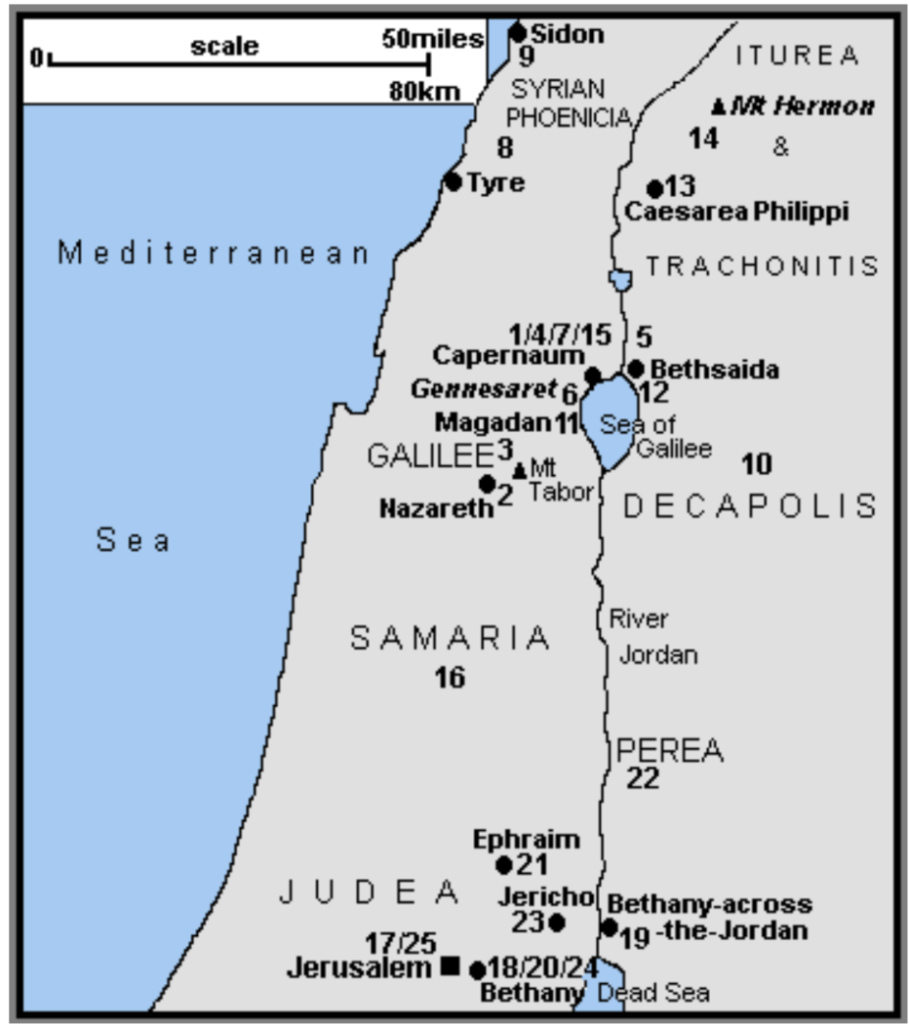
This matters because the land matters to John. Israelite identity, geography, class, and custom all matter deeply and are intimately woven into these stories opening the chapters of John’s gospel. Understanding how connected Jesus was to this ancient world and its customs helps us understand and think differently about the stories John tells.
John 2-4 records three stories ushering in Jesus’ ministry and identity as the Son of God: the changing of water to wine at the Jewish wedding in Cana; the meeting with Nicodemus and Jesus’ teaching of being born again; and the meeting of the Samaritan woman at the well. Each story builds on the previous ones and connects them. Each involves water and corresponding images of life, rebirth, and newness. Two out of the three stories involve women, and all involve traditionally feminine images (marriage, feeding, birth, motherhood, woman’s work). Each also intersects different aspects of the complex class and religious landscape of this world. All of them are disruptive in some way; socially or theologically.
The miracle at Cana begins Jesus’ ministry and sets the stage for what will come next. Following this miracle, he has disciples, believers, and his prophetic message follows from the miracle of filling ceremonial jars with new wine.
How do we understand miracles? Are they about power, domination, and hierarchy—a rejection of the old and an introduction of the new, or are they about life, love, renewal and abundance?
Perhaps we can read these first chapters of John, opened with a miracle that starts waters flowing, as the introduction to a ministry of love and awakening, life and renewal, rather than a ministry of correction and rejection. Perhaps we can think about miracles not as events outside the laws of nature but as manifestations of loveliness and grace amid entropy and chaos.
“For miracle is a word that describes the process by which all things change. How a man repents, how a woman recovers, how anyone survives. The movement of the world is not reactions at all, but actions. Which is to say, the world moves and changes and forms through miracles every day, every moment of everyday, and in no other way.” –
Josh Sabey @forlittlesaints
***************************************
John 1
Where does the New Testament come from? This amazing book about the life of Jesus was written many years after Jesus died–scholars believe the earliest gospels were composed about 30 years later. We know that there were a few main documents circulating among followers of the Jesus movement, a collection of stories (which would become the book of Mark) and at least one other source called the Q source that may have been a collection of sayings remembered by followers of Jesus. The early church was facing many questions, including how to relate with other Israelites (were Jews and Christians too different?), how or whether followers of Jesus could be good citizens of the Roman emperor, when Jesus was going to return, and how followers should live and work together. This Jesus movement was not yet “Christian” in the way we now think of that term, nor were Jews “Jewish.” Lines were blurry, and it would take much longer for these religions to define themselves and each other as two separate traditions.
Matthew
Matthew was a disciple of Jesus, one of his twelve apostles. He was a tax collector, also known as a publican. That means he was a Jew employed by the Roman government to collect taxes This would not have made him at all popular among the Hebrew people! In fact, among some of the sects of the Hebrew people, including the Pharisees, tax collectors were thought of as “sinners.” Matthew was with Jesus for most of his ministry. In some of the other books of the New Testament, he is also called ‘Levi.’ There are many myths about how Matthew died after Jesus’ death and resurrection, but we don’t know for sure. Matthew is writing to a Jewish-Christian audience and is the most “Jewish” of the gospels.
Mark
According to tradition, Mark was not one of Jesus’ disciples but rather a (later) follower of the apostles. Mark’s gospel is the earliest written gospel, and it sets the pattern for Matthew and Luke. Mark seems to have a collection of miracle stories about Jesus (sometimes called the Q source) that he uses to tell the story of Jesus’ life. Mark’s gospel is a careful work of literature that tells the story in very specific ways to make certain theological points. The account helps us understand the kinds of issues the early church was facing.
Luke
The book of Luke is actually two-volumes, Luke and the book of Acts. Sometimes scholars refer to the book as Luke-Acts. The author of Luke is very concerned with showing how the Jesus movement is a fulfillment of the promises in the Hebrew Bible, and he writes to both Jews and Gentiles.
John
The books of Matthew, Mark, and Luke are sometimes called the synoptic gospels. Synoptic means “taking the same view,” or seeing the same way. These books are very similar in their telling of the stories of Jesus, Jesus’ life, miracles, and death. The book of John is different! John tells different stories, emphasizes different things, and writes in new ways. From what we know, John was a disciple of Jesus who knew Him well and loved him very much. John can be very poetic and sometimes confusing—he incorporates lots of theological ideas that were circulating in ancient Israel (occupied by Romans) at the time. His gospel is also the most deliberately separated from—and sometimes hostile toward—Judaism.
 milk & honey mamas