
Participation
Written by Kristen
Theological Background
While they were eating, Jesus took bread, and when he had given thanks, he broke it and gave it to his disciples, saying, “Take it; this is my body.” Then he took a cup, and when he had given thanks, he gave it to them, and they all drank from it.“This is my blood of the covenant, which is poured out for many,” he said to them.
Mark 12: 22-24
Mark 14:12-72; John 13:1-17. Meaning “mandate,” Maundy Thursday specifically commemorates the new commandment (mandate) Jesus gives to his disciples, to love one another. This passage is not found in Mark, who records a very full Thursday. Jesus celebrates Passover with his disciples on this day (in other accounts Passover is on Wednesday), shares a final meal, prays in the garden of Gethsemane, is betrayed by Judas and arrested, and is condemned before Pilate.
In some traditions, Gethsemane is the place of atonement. In others, the garden scene is a place of prayer and the cross the place of atonement. Either way, the concept of atonement is very important—even central—to Christian theology.
Christ died for our sins, most Christians believe, and his death and resurrection overcame death and allowed the possibility of eternal life for all who believe. The concept of atonement has been developed over the centuries with a variety of models (see this book, or this overview article). Most models rely on the concept of original sin, that Adam and Eve fell from grace and that all humanity is condemned without a savior. Some theologians argue, however, that sin is better understood as woundedness (Terryl and Fiona Givens), and that the need for Christ is less in the form of a substitute for our wretchedness and more in the form of an empathetic healer.
However you understand atonement and Christ’s mission, the idea of atonement brings us back to the questions of universal and particular. As human beings, we are all wounded. No one escapes the challenges of being mortal. Challenges and barricades are not, however, equally distributed, and some face insurmountable difficulties that others are shielded from.
It can be challenging to figure out how to hold and treat our particular struggles in this context. Some cling to particularity defensively, refusing to see their sufferings in the context of humanity. Some sink into shame and struggle to articulate their own woundedness, believing that they are unworthy of claiming suffering.
Somewhere in the midst of this, the universal human condition (whether we think of that as a state of sin or a state of woundedness) and the particular suffering of individual lives, Christ enters in. Universal and particular. How do you tell the story?
Story
Contributed by Kristen
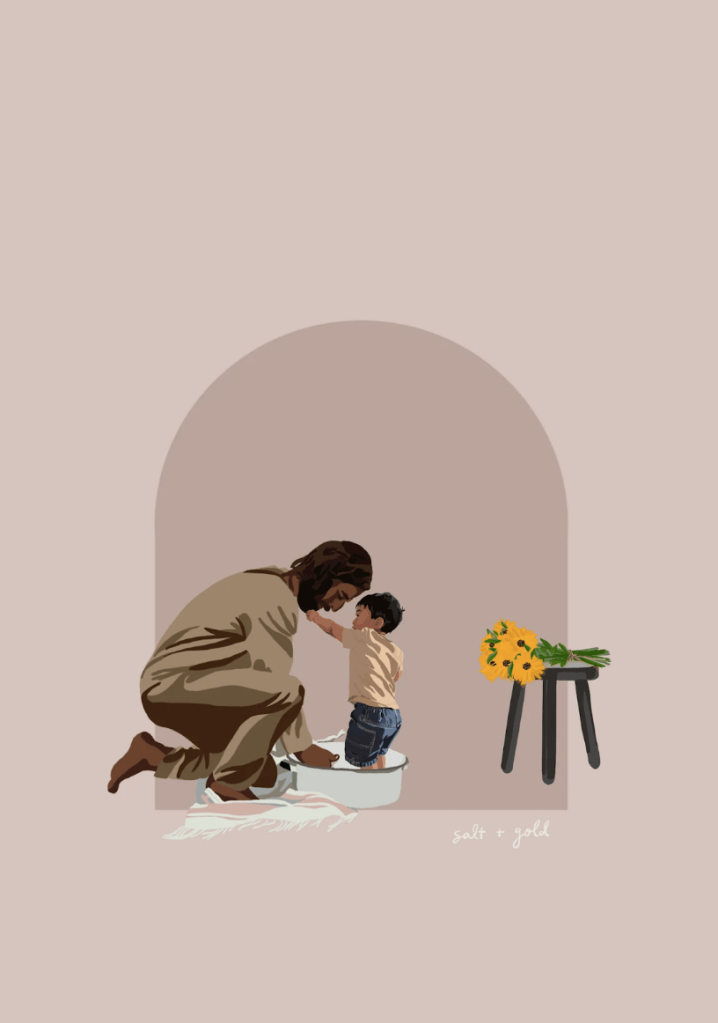
Thursday is the day of Passover. Jesus and his friends find a small room in the home of a stranger, who kindly invites them in. They gather around the table, hot and sweaty and dusty. Jesus notices how tired they look and he says, “come.” He gets a towel, and a bowl of water, and one by one, he washes his disciples feet. Ever so gently, he pours the water over their dusty toes. He wipes away the dirt. He pats them dry. He looks into the eyes of his friends, and he smiles.
Together, they sit at the table. They eat the flat, unleavened bread and remember how the Israelite women did not have time to let their bread rise as they fled from Egypt. They dip herbs in salt water and remember the sweat of their forefathers when they were slaves. They eat the lamb and remember how the blood of the sacrifice spared their children from the angel of death. They remember how God parted the Red Sea, and the mothers and fathers and children before them came across to freedom.
Jesus looks around at his friends, his disciples, his beloved ones. He holds a piece of bread in his hands and he says, “beloved ones. Take this bread.” He passes the bread around so everyone at the table can eat. “This bread, dear ones, is my body. Take it, eat it. As you eat, you are bringing my words and my teachings and the kin-dom of God inside your beautiful bodies.
He holds up some grape juice, “Take this wine,” he says, and passes it around. “This is my blood. You are with me. You are part of me. We are on this journey together, and I will always be with you.”
Then he pauses, and looks at each of them. “Love one another,” he says, his voice soft and gentle. “Love one another, as I love you. This is my commandment to you. Love each other.”
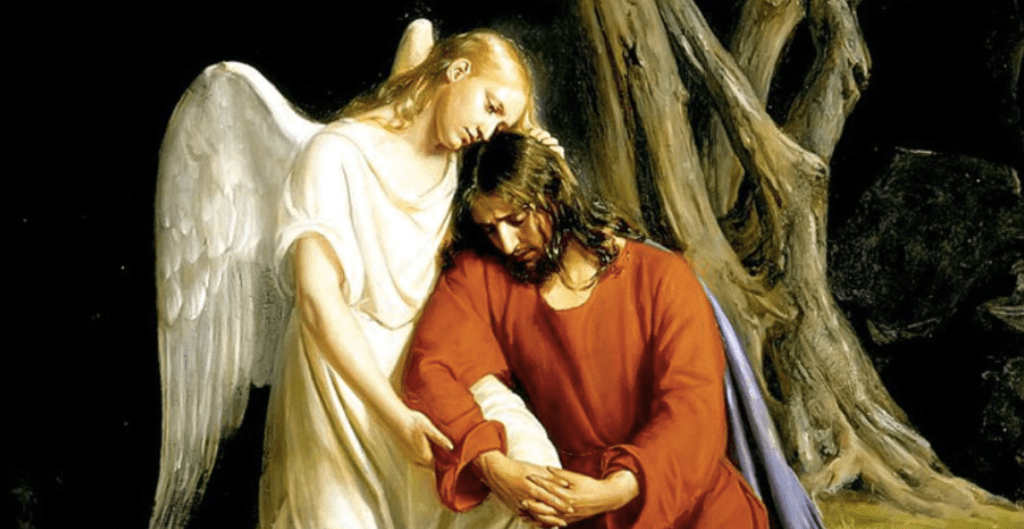
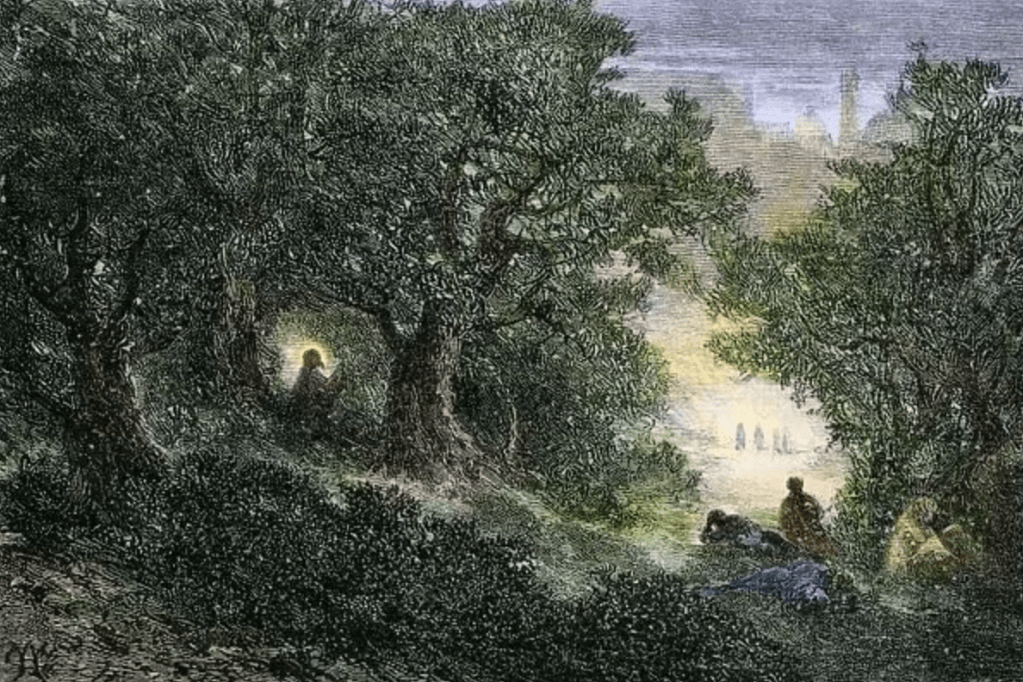
That night, they go together to the garden of Gethsemane. It is a beautiful place, with olive trees dotting the hillside. The disciples are so very tired, they cannot stay awake. But Jesus is awake. He knows what will be coming.
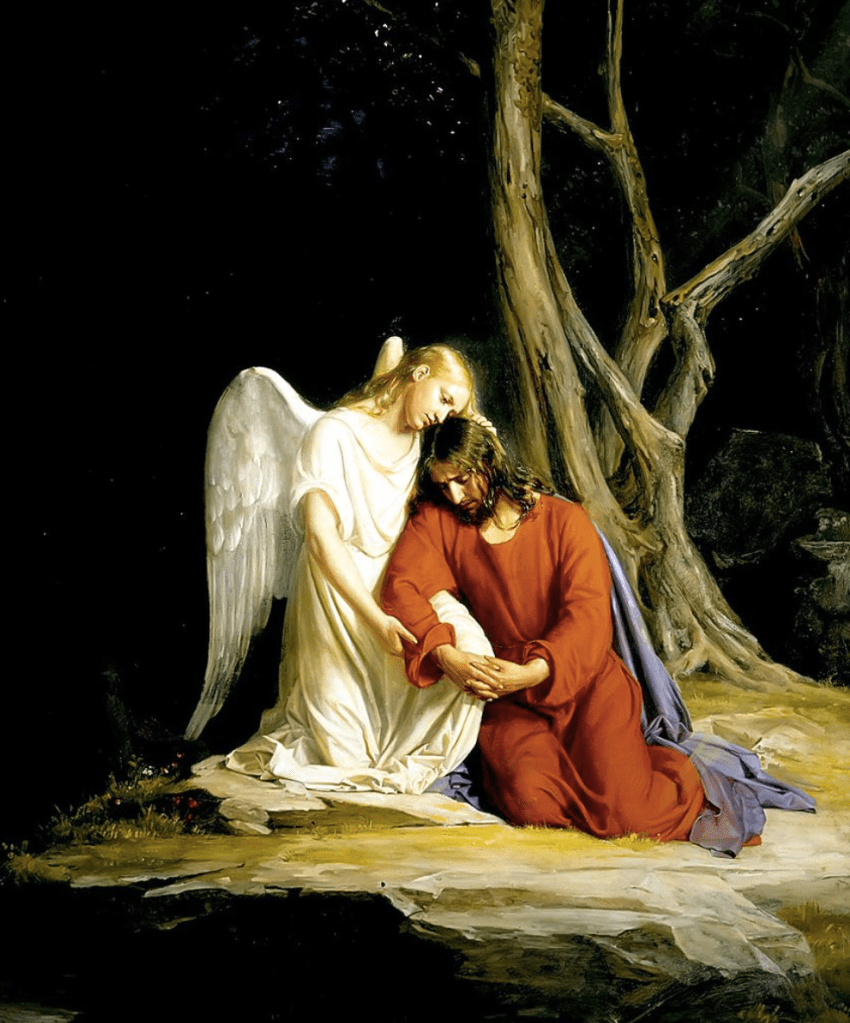
He finds a quiet spot, and he prays. He prays for everyone in the world, including me and you. He prays for all of the hurts in our lives, the times we fall down and the times we get hurt and the times we feel lonely and ignored and left behind. He prays that he can listen to all of our sadness, and sit with us when we cry, and help us.
And Father and Mother God cry with joy and with sorrow. With joy because this is the very prayer they hoped Jesus would pray, and with sorrow because of the sadness and pain in the world. Because of Jesus’ prayer, Father and Mother send waves of love through the whole world and across time.
But sometimes, fear shuts out love. The people who were afraid of Jesus came that night and took him. The man who was his friend betrayed him. They took Jesus away, and they found him guilty. They condemned him to death.
His disciples were helpless. They look at each other, and they don’t know what to do. But they remember that last supper with Jesus, and how he washed their feet, and gave them bread and wine, and told them to love each other. And they take each other’s hands, and they try to be brave.
Activity
Contributed by Kristen
- Watch this video created by Kristen
- Wash each other’s feet
Poem
Compiled by Caroline
Gethsemane by Mary Oliver
The grass never sleeps.
Or the roses.
Nor does the lily have a secret eye that shuts until morning.
Jesus said, wait with me. But the disciples slept.
The cricket has such splendid fringge on its feet,
and it sings, have you noticed, with its whole body,
and heaven knows it never sleeps.
Jesus said, wait with me. And maybe the stars did, maybe *
the wind wound itself into a silver tree, and didn’t move,
maybe
the lake far away, where once he walked as on a
blue pavement,
lay still and waited, wild awake.
Oh the dear bodies, slumped and eye-shut, that could not
keep that vigil, how they must have wept,
so utterly human, knowing this too
must be a part of the story.
Song
Art

 milk & honey mamas
Leave a comment